
loading...

 Ferrari Luce: The Electric Supercar That Changes Everything
Ferrari Luce: The Electric Supercar That Changes Everything
Tue May 26 2026
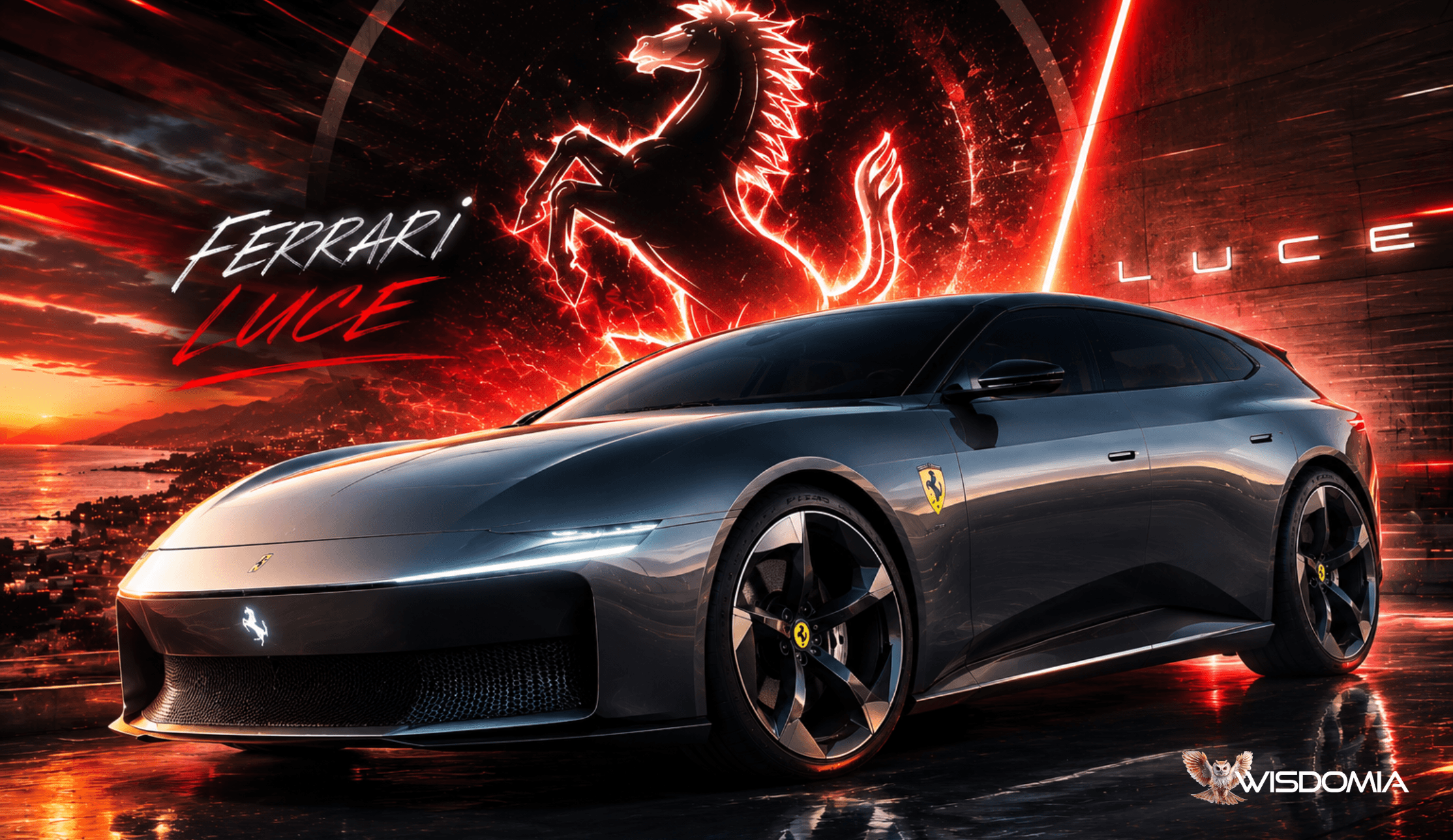
Ferrari’s first electric supercar is here — a futuristic EV designed with Jony Ive that looks more like a spaceship than a car.
Ferrari's first-ever electric vehicle has arrived and it's unlike any Ferrari ever built.
On May 25, 2026, the most storied name in motorsport unveiled the Ferrari Luce at a landmark ceremony in Rome, Italy, the very city where Ferrari won its first race 79 years ago. The venue chosen was the Vela di Calatrava – Città dello Sport, a setting selected to mark the beginning of a new chapter in Ferrari's history of engineering excellence.
The name says it all. “Luce”, Italian for “light”, is more than a name. It is a vision: electrification as a means, not an end; a new era where design, engineering and imagination converge into something that did not exist before.
A Design Revolution, Powered by Apple's Former Genius
The Luce isn't just Ferrari's first EV. It's a collaboration between two of the world's most influential design forces. LoveFrom, the creative collective founded by Sir Jony Ive and Marc Newson, has been collaborating with Ferrari for five years on every dimension of the new car's design, exterior, interior, and interface alike.
The Ferrari Luce features a spacious, five-seat cabin enclosed in a large curvaceous glasshouse, the upper portion of the vehicle that includes the windscreen, side windows, rear window and a panoramic glass roof. This is paired with aluminium body panels at the sides that transition into wide aerodynamic wings at the front and rear of the car, creating the impression of a single teardrop form wrapped in a coloured metal shell.
Far from a screen-dominated cockpit, LoveFrom conceived the interior to defy the convention that "electric cars must be dominated by large touchscreens." Instead, the design team prioritised physical controls, inspired by the design of classic sports cars and Formula One single-seaters.
The steering wheel feels like the project's centrepiece — a three-spoke design made from recycled aluminum with an anodised finish, glass elements, leather grips, the Manettino, torque-control paddles, and the binnacle moving together as one unit. It's like a piece of product design fit inside a 1,000-horsepower machine.
Even the key is an experience. LoveFrom integrated a colour-changing E Ink display into Luce's glass key fob, which fades from yellow to black when placed into its dock in the car's centre console. At the same time, the gear selector and control panel light up to signal the car is ready to drive.
Raw Performance, Redefined
Don't let the design-forward exterior fool you, the Luce is a performance machine at its core.
Four electric motors, one per wheel, produce a combined 1,036 hp, pushing the Luce from 0–60 mph in under 2.5 seconds and on to a 193 mph top speed. A 122 kWh battery offers around 329 miles of range, and an 800V architecture supports 350 kW fast-charging that takes the pack from 10% to 80% in roughly 18 minutes.
Despite weighing close to 2.3 tonnes, Ferrari claims the Luce handles like a car 400 kg lighter, thanks to torque vectoring and a centre of gravity 95 mm lower than the Purosangue SUV.
Ferrari has also solved one of EV's most emotional challenges, the missing soundtrack. The car employs an accelerometer system that captures vibrations from the electric motors and rear chassis, with an algorithm filtering unwanted frequencies while amplifying what Ferrari considers more musical sounds — audible both inside and outside the vehicle.
A Bold Bet in a Skeptical Market
The Luce arrives at a complicated moment for luxury EVs. Rival Lamborghini canceled its upcoming EV due to a lack of demand, while Porsche's Taycan and Lucid's Air sedans have been struggling recently.
But Ferrari isn't backing down.
We want to test something completely different with different approaches," said Ferrari's chief commercial officer Enrico Galliera. The reaction from non-Ferrari clients who previewed the car was "extremely positive.
CEO Benedetto Vigna told reporters in Rome: "It's the result of five years of work." Ferrari argues that younger buyers raised on technology and AI may prove less attached to the 8- and 12-cylinder engines that defined the brand's past.
Sources
- Ferrari Official Luce Page — https://www.ferrari.com/en-EN/auto/ferrari-luce
- Ferrari Press Release (Rome Unveil) — https://www.ferrari.com/en-US/corporate/articles/ferrari-luce-a-new-chapter-for-the-maranello-marque
- Ferrari Interior & Name Reveal — https://www.ferrari.com/en-EN/corporate/articles/ferrari-luce-revealing-interior-interface-design-and-the-name
- Ferrari Magazine Interior Deep Dive — https://www.ferrari.com/en-EN/magazine/articles/ferrari-luce-interior-design
- GagaGadget — https://gagadget.com/en/712220-ferrari-luce-the-ps440k-five-seat-electric-supercar-designed-by-jony-ive/
- Dezeen (Interior) — https://www.dezeen.com/2026/02/13/jony-ive-marc-newson-lovefrom-ferrari-luce-interior/
- Dezeen (Full Reveal) — https://www.dezeen.com/2026/05/25/electric-ferrari-luce-jony-ive-marc-newson-lovefrom/
- Designboom — https://www.designboom.com/technology/ferrari-luce-first-electric-car-jony-ive-marc-newson-lovefrom/
- 9to5Mac — https://9to5mac.com/2026/05/25/ferrari-luce-ev-debuts-with-jony-ive-designed-cockpit-and-familiar-design-cues/
- MacRumors — https://www.macrumors.com/2026/05/25/ferrari-luce-jony-ive-photos/
- Yahoo Finance — https://finance.yahoo.com/sectors/technology/article/ferrari-announces-luce-its-new-640000-ev-designed-by-jony-ive-to-test-something-completely-different-115957447.html
- Benzinga — https://www.benzinga.com/markets/tech/26/05/52768670/jony-ive-ferrari-luce-price-interior-vs-tesla
- GearMusk — https://gearmusk.com/2026/05/26/ferrari-luce-ev/
- Wikipedia — https://en.wikipedia.org/wiki/Ferrari_Luce
Share this

Sara Srifi
Sara is a Software Engineering and Business student with a passion for astronomy, cultural studies, and human-centered storytelling. She explores the quiet intersections between science, identity, and imagination, reflecting on how space, art, and society shape the way we understand ourselves and the world around us. Her writing draws on curiosity and lived experience to bridge disciplines and spark dialogue across cultures.
More Articles

Filmmaker Chuck Russell and Neumorphic AI Set Production Partnership with AI Platform Higgsfield

The Violent AI Backlash: What Humanity Is Really Telling Us About the AI Revolution
"Do Architecture": Wang Shu and Lu Wenyu Reveal Vision for 2027 Venice Architecture Biennale

Netflix's INKubator: How AI Is Rewriting the Rules of the Creator Economy
About
Where Wisdom Meets AI Utopia Edutainment
Wisdomia.ai is a 3D AI edutainment platform that seamlessly blends learning with immersive play. As the first AI-powered 3D Web 3.0 marketplace created by creators for creators. Founded by renowned serial entrepreneur and author Dinis Guarda, Wisdomia empowers individuals to flourish in an ecosystem designed for collective wisdom EQ. Join us in shaping humanity's future as we harness the power of AI to visualise and create a better world—where technology serves human potential, and innovation is guided by utopian wisdom.
Contact us
Produced by


