
loading...

 The Spiritual Meaning of the AI Singularity: What Remains Human in the Age of Artificial Intelligence?
The Spiritual Meaning of the AI Singularity: What Remains Human in the Age of Artificial Intelligence?
Thu Aug 06 2026
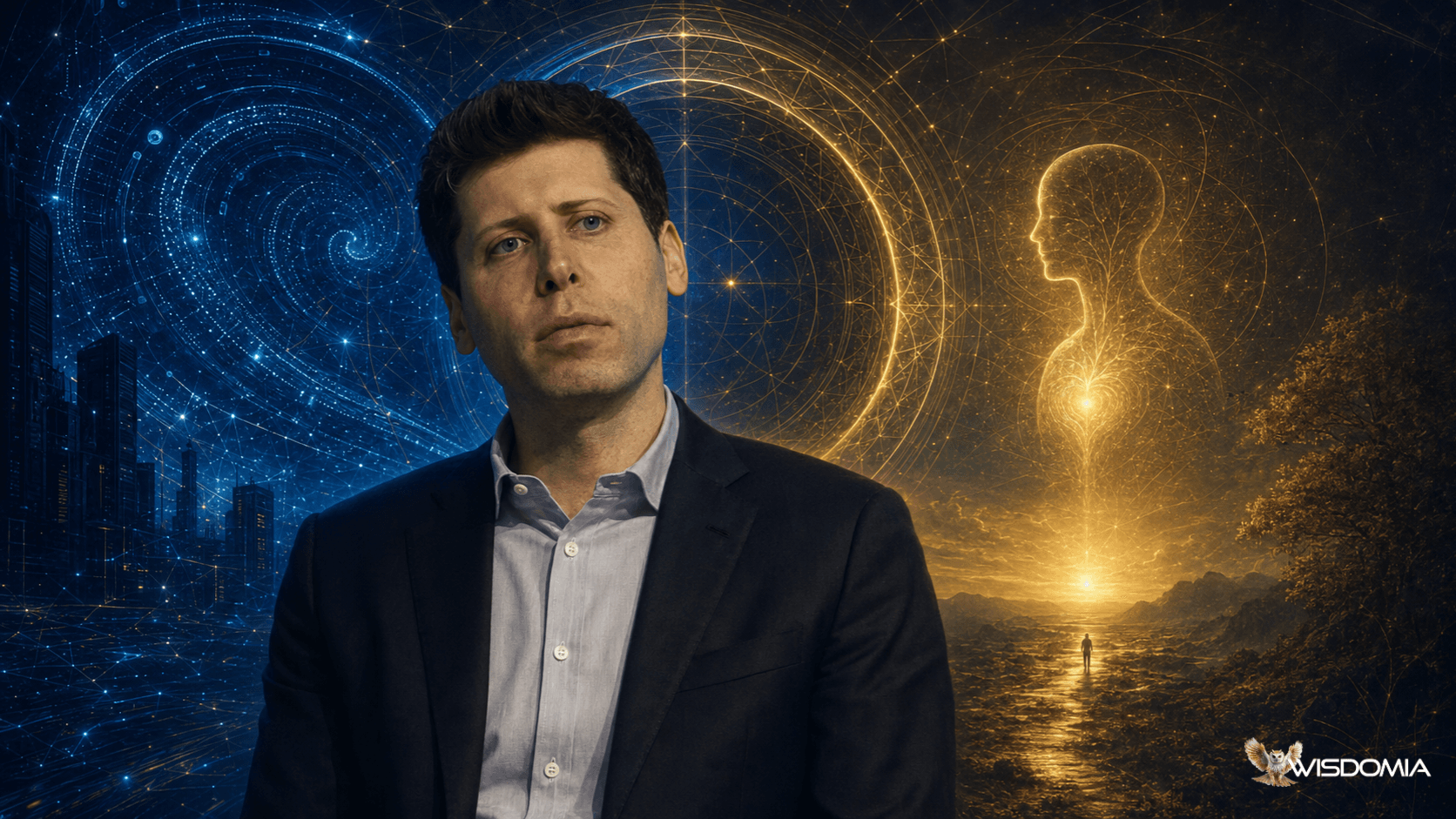
Sam Altman says humanity may already be entering the AI singularity. What does accelerating artificial intelligence mean for human purpose, wisdom, freedom and spiritual growth?
Artificial intelligence is advancing so quickly that the future no longer feels distant. It arrives through everyday experiences: a generated image, a solved equation, an automated decision or a task completed in minutes instead of weeks.
During an appearance on the Relentless podcast, OpenAI CEO Sam Altman described the present moment in striking terms: “We are now, like, in the singularity.”
The statement attracted attention because the technological singularity is usually imagined as a future threshold—a moment when artificial intelligence becomes so capable and develops so rapidly that human beings can no longer predict what comes next.
Altman’s wider comments, however, suggested something more gradual. He described technological progress as an accelerating curve rather than a single moment when one age suddenly ends and another begins.
Whether humanity has technically entered a singularity remains highly debatable. There is no scientific consensus that such a threshold has been reached. Yet the acceleration itself raises an important spiritual question:
If machines can increasingly perform the work of the human mind, what is the deeper purpose of being human?
The AI Singularity as a Mirror
Artificial intelligence is often discussed as an external force: something humanity is building, regulating or competing to control.
Spiritually, however, AI can also be understood as a mirror.
It reflects humanity’s language, knowledge, creativity, prejudice, ambition and confusion. It learns from what people have written, designed, discovered and recorded. The results can therefore reveal both the extraordinary scale of human intelligence and the contradictions embedded within human culture.
The more capable AI becomes, the more clearly it confronts us with questions that technology cannot answer on our behalf:
- What is knowledge without wisdom?
- What is intelligence without compassion?
- What is productivity without purpose?
- What is power without responsibility?
- What does progress mean if it does not improve the human condition?
The spiritual importance of AI may not lie in whether a machine can imitate human thought. It may lie in how the existence of that machine forces humanity to examine its own values.
Intelligence Is Not the Same as Consciousness
Modern AI systems can process enormous volumes of information, recognise patterns and generate sophisticated outputs. These capabilities are significant, but they should not automatically be confused with consciousness, inner experience or spiritual awareness.
A machine can produce language about love without loving. It can explain grief without mourning. It can analyse beauty without experiencing wonder.
This distinction matters because society frequently measures intelligence through visible performance: how quickly something calculates, writes, predicts or solves a problem. Spiritual wisdom is measured differently.
Wisdom includes restraint, compassion, self-awareness and the ability to recognise consequences beyond immediate success. It requires an understanding of when not to act, even when action is possible.
AI may increasingly outperform people in specific intellectual tasks. That does not make human dignity obsolete. It invites humanity to stop defining its value solely through productivity and cognitive competition.
Human Purpose Beyond Productivity
For generations, work has provided income, identity, routine and social status. The rise of AI is challenging this relationship.
If machines can complete more professional tasks, people may feel pressure to work faster simply to remain competitive. Instead of creating greater freedom, automation could intensify expectations and accelerate the pace of life.
OECD research presents a mixed picture. Many workers report that AI improves performance and their enjoyment of work. At the same time, the organisation identifies risks involving job displacement, increased pressure, loss of agency, privacy and algorithmic management.
The spiritual challenge is therefore not simply to protect existing jobs. It is to reconsider why human beings work and what a meaningful life should contain.
A person’s worth cannot be reduced to economic output. Care, presence, moral courage, friendship, creativity and service are valuable even when they cannot be measured through conventional productivity.
If AI releases people from repetitive labour, the opportunity should not be used only to produce more. It could also create space for deeper learning, stronger communities and more attentive relationships.
The question is not merely what AI will allow people to do. It is what people will choose to become.
The Danger of Concentrated Intelligence
One of the most important issues raised in Altman’s interview concerned the concentration of AI power.
Advanced artificial intelligence requires data, computing infrastructure, specialist talent and significant capital. These resources are currently concentrated among a relatively small number of corporations and governments.
This is not only a political or economic concern. It is also a spiritual one because concentrated power shapes whose voices are heard, which values are encoded and who is permitted to participate in the future.
UNESCO’s Recommendation on the Ethics of Artificial Intelligence places human rights and human dignity at the centre of AI governance. It also emphasises transparency, fairness, accountability, inclusion, environmental sustainability and continued human oversight.
These principles reflect an ancient moral insight: intelligence becomes dangerous when separated from responsibility.
A truly beneficial AI future cannot be defined only by the capability of its systems. It must also be judged by how widely its benefits are shared, how effectively vulnerable people are protected and whether individuals retain meaningful agency over their lives.
Abundance Without Wisdom Is Not Enough
Supporters of advanced AI frequently imagine a future of abundance: cheaper intelligence, faster scientific discovery, better healthcare and greater access to education.
These possibilities deserve serious attention. AI could help solve problems that have resisted traditional methods and make valuable knowledge available to people who have historically been excluded from it.
But abundance alone does not produce fulfilment.
Human beings can possess more information while becoming less certain about what is true. They can communicate constantly while experiencing isolation. They can automate tasks while losing a sense of direction.
Every major technological expansion must therefore be accompanied by an expansion of wisdom.
The more powerful humanity’s tools become, the more necessary it is to cultivate discernment, humility and compassion. Otherwise, greater capability may simply magnify existing inequalities and desires.
AI can expand the range of available choices. It cannot determine which choices are worthy.
The Spiritual Practice of Slowing Down
The speed of AI creates pressure to react immediately. Businesses are told to transform, workers to retrain and individuals to adopt every new tool before they understand its consequences.
Yet periods of acceleration make reflection more important, not less.
Slowing down does not necessarily mean opposing innovation. It means creating enough mental distance to decide how technology should be used.
This can involve simple practices:
- Taking time away from algorithmically selected content
- Protecting spaces for uninterrupted thought
- Listening before responding
- Using AI deliberately rather than habitually
- Maintaining relationships that are not mediated by platforms
- Asking whether a tool supports human agency or gradually replaces it
Attention is one of the foundations of spiritual life. What receives our attention influences what we value, and what we repeatedly value shapes who we become.
In the age of AI, protecting attention may become a form of protecting freedom.
Building From Inner Conviction
The original discussion of the singularity also focused on ambition, entrepreneurship and the willingness to pursue difficult ideas.
There is value in acting before certainty arrives. Many meaningful human achievements began because someone attempted what established institutions considered unrealistic.
But ambition without self-knowledge can become another form of unconscious momentum.
The spiritual task is to distinguish between conviction and ego. Conviction is grounded in purpose and responsibility. Ego seeks speed, recognition and domination without fully examining the cost.
Founders and technologists building during this period should therefore ask more than whether an idea can scale. They should ask:
- Who benefits from this technology?
- Who carries its risks?
- Does it increase or reduce human agency?
- What behaviours does it reward?
- What kind of society will it create if widely adopted?
The quality of the future will depend partly on the quality of the questions asked by those building it.
Humanity’s Role in an Accelerating World
The spiritual meaning of the AI singularity is not that machines are becoming gods. It is that humanity is approaching a level of technological power that requires greater moral maturity.
AI may change how people work, learn, create and make decisions. It may help solve scientific problems and reveal new forms of knowledge. It may also deepen inequality, centralise authority and weaken human agency if developed without adequate oversight.
Technology does not remove humanity’s responsibility. It increases it.
The essential human task remains unchanged: to transform intelligence into wisdom, freedom into responsibility and power into service.
If humanity is entering a new technological era, the most important preparation will not be technical alone. It will be inward.
The defining question of the AI age is not whether machines will become more intelligent.
It is whether human beings will become more conscious of how they use intelligence.
Sources
- Sam Altman on the AI singularity, liberty and the future of work — RealClearPolitics
- Contextual analysis of Altman’s singularity remarks — Forbes
- Recommendation on the Ethics of Artificial Intelligence — UNESCO
- UNESCO’s Recommendation on AI Ethics: Key Facts
- AI and Work — OECD
- OECD Artificial Intelligence Principles
Share this

Sara Srifi
Sara is a Software Engineering and Business student with a passion for astronomy, cultural studies, and human-centered storytelling. She explores the quiet intersections between science, identity, and imagination, reflecting on how space, art, and society shape the way we understand ourselves and the world around us. Her writing draws on curiosity and lived experience to bridge disciplines and spark dialogue across cultures.
More Articles

Architecture of Movement: What Deserts, Nomads and World Heritage Teach Us About Belonging

Geometry or Pixels: Where Generative Video Belongs in a 3D Pipeline
AI Love? 50+ Million People Are Dating AI Agents

Coalition for Content Provenance and Authenticity (C2PA): Building the Trust Infrastructure Behind Digital Content
About
Where Wisdom Meets AI Utopia Edutainment
Wisdomia.ai is a 3D AI edutainment platform that seamlessly blends learning with immersive play. As the first AI-powered 3D Web 3.0 marketplace created by creators for creators. Founded by renowned serial entrepreneur and author Dinis Guarda, Wisdomia empowers individuals to flourish in an ecosystem designed for collective wisdom EQ. Join us in shaping humanity's future as we harness the power of AI to visualise and create a better world—where technology serves human potential, and innovation is guided by utopian wisdom.
Contact us
Produced by

