
loading...

 Jony Ive and Ferrari's $640,000 Bet on the Future of Driving
Jony Ive and Ferrari's $640,000 Bet on the Future of Driving
Thu Jun 04 2026
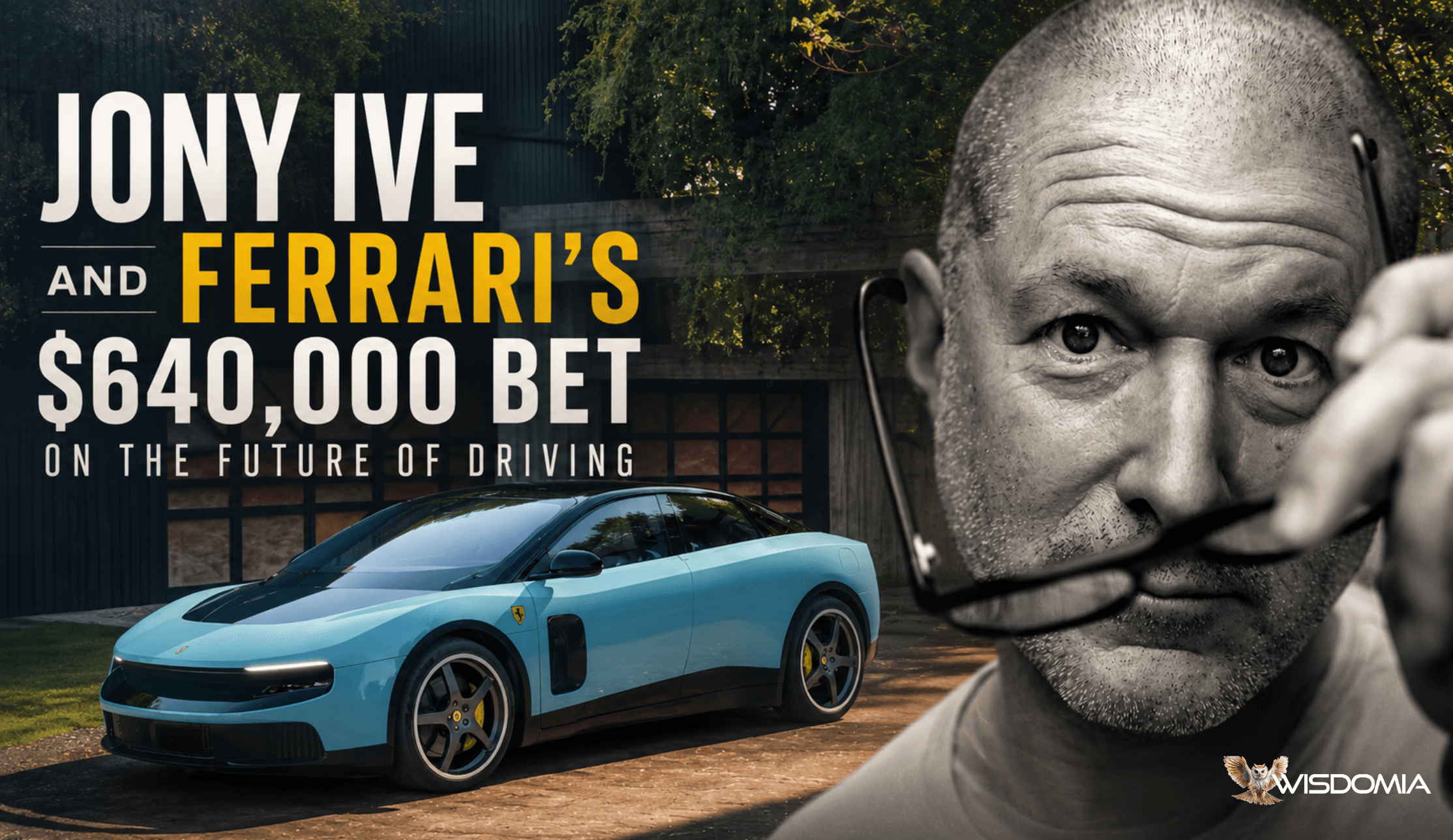
Ferrari’s first electric supercar is here, a futuristic EV designed with Jony Ive that looks more like a spaceship than a car.
Ferrari's first-ever electric vehicle has arrived and it's unlike any Ferrari ever built.
There is a short list of designers who have genuinely changed how human beings interact with the world. Jony Ive, the man who shaped the iMac, iPod, iPhone, and Apple Watch over three decades at Cupertino , sits near the top of that list. Now, having left Apple in 2019 to co-found the creative collective LoveFrom with industrial designer Marc Newson, Ive has turned his obsessive attention to an entirely new canvas: the interior of a Ferrari.
The result is the Ferrari Luce, Italian for “light”, and it is one of the most consequential unveilings in the luxury automotive world in years. Revealed in Rome in late May 2026, the Luce is Ferrari's first fully electric vehicle, five years in the making, and the first production car to carry LoveFrom's design DNA from bumper to dashboard.
A Design Revolution, Powered by Apple's Former Genius
Born in north London in 1967, the son of a silversmith, Ive studied at Newcastle Polytechnic before being hired by Apple in 1992. There he rose to become the creative alter ego of Steve Jobs, co-authoring a string of products that rewired the culture of an entire era. When Jobs died in 2011, Ive remained at the helm of Apple's design until 2019 and then, with characteristic deliberateness, stepped back to found something new.
LoveFrom is selectively collaborative by design. Ive and Newson are both self-described petrolheads who share an eclectic collection of cars, including a Bentley Continental S3, a Bugatti Type 59, and a Ferrari 250 GT Europa. When Ferrari's executive chairman John Elkann proposed a collaboration on the company's electric future, the prospect proved irresistible.
We wanted to explore an interface that was physical and engaging, to take the most powerful parts of an analogue display and combine them with a digital display.— Sir Jony Ive, speaking to Top Gear
A Car Unlike Any Ferrari Before It
The Luce is a four-door, five-seat liftback — Ferrari's first five-seater — built on a dedicated electric vehicle architecture that gave the designers extraordinary packaging freedom. At 197.9 inches long, it sits in the same ballpark as a Tesla Model S, but the design language is something altogether different. Surfaces are smooth, continuous, and convex, with no sharp edges, described by Ferrari as a "shell-like form" with "floating front and rear aerodynamic wings". In doing so, engineers achieved the lowest drag coefficient of any road-going Ferrari.
The design is deliberate, divisive, and unmistakably intentional. The cabin sits unusually far forward, the rear doors use a coach-door configuration, and the windscreen wipers park upright against the A-pillars. It is not a traditional sports car silhouette, more akin to a grand SUV-saloon in proportion and it looks nothing like the renders circulating online in the years before the reveal.
The Dashboard as a Philosophy
If the exterior is conversation-starting, the interior is where LoveFrom's sensibility truly lives. In a world where nearly every premium car now centres its cabin around a vast touchscreen, the Ferrari Luce goes deliberately the other way. Ive and Newson's brief was clear: physical controls, satisfying tactility, and a hierarchy of information that serves the driver rather than dazzling them.
The result is a cockpit rich with precision-engineered mechanical buttons, dials, toggles, and switches, combined with multifunctional digital displays used sparingly, where analogue alone cannot serve. The three-spoke steering wheel is machined from 100% recycled aluminium. Ferrari describes the interior as combining "the most powerful parts of an analogue display with a digital display," and the effect, by all accounts from those who have experienced it, is viscerally different from the rolling touchscreen showrooms that define most of its competitors.
Getting into a car and seeing one big display, it sucks the life out of me. This is so much more engaging and visceral.— Sir Jony Ive, Top Gear
LoveFrom unveiled the interior in February 2026 at the Transamerica Pyramid in San Francisco, a building itself renovated under Lord Foster, who previously collaborated with Ive on Apple Park. The choice of venue was quietly symbolic: the same city where Ive now works, shaped by the same circles of design thinking.
Power, Price and the Bet Ferrari Is Making
Under the shell-form body, four permanent-synchronous electric motors deliver a combined 1,035 horsepower, one motor per wheel, with a top speed above 310 km/h and a WLTP range of 529 km (329 miles). The 800-volt, 122 kWh battery from SK On supports 350 kW DC fast charging. Kerb weight comes in at 2,260 kg, and to compensate for the mass, Ferrari amplifies the natural vibration sounds of the powertrain to preserve some of the visceral character expected of the prancing horse.
Pricing starts at €550,000 in Europe, approximately $640,000. Production begins in late 2026, with US deliveries expected in Q2 2027. Ferrari CEO Benedetto Vigna, speaking at the Rome unveiling, called it "the result of five years of work."
The commercial stakes are real. Rival Lamborghini cancelled its own EV programme citing tepid demand. Bentley has repeatedly delayed its first electric model. Porsche's Taycan and Lucid's Air have both struggled. Ferrari is betting that by positioning the Luce as a genuine design object, conceived by the mind behind the iPhone, executed in the workshops of Maranello, the ultra-wealthy will respond differently to electric than the broader market has done.
Why This Matters Beyond Automotive
The Ferrari Luce is not merely a car launch. It is the first major physical product from LoveFrom — a test of whether Ive and Newson's philosophy of deep material craft, physical engagement, and considered restraint can survive the complexity of automotive manufacturing and the expectations of the world's most demanding marque.
Ferrari's decision to hand its electric future to an outside design consultancy is simultaneously bold and calculated: bold because few brands trust their identity to external collaborators at this scale; calculated because it gives Ferrari the option to walk the experiment back if the market rejects it. That measured risk-taking is itself a form of design thinking.
Early reaction from non-Ferrari clients who previewed the car was, according to chief commercial officer Enrico Galliera, "extremely positive." Whether brand purists will accept a Ferrari that looks nothing like a Ferrari, and costs as much as a small fleet of them, remains genuinely open. But the question the Luce forces upon the industry is important: in an era of software-defined vehicles and screen-dominated interiors, does the most thoughtful design involve adding technology, or knowing when to leave it out?
Jony Ive, who once spent three weeks in northern Japan studying metalworking with craftspeople simply because he felt he did not understand titanium well enough, knows the answer he believes in. Whether the market agrees is the next chapter.
Sources
- Engadget — "Ferrari Luce Unveiled: Here's The First Car From Jony Ive's Design House" (May 2026)
- Dezeen — "Jony Ive and Marc Newson shun touchscreens for interior of Ferrari's first electric car" (Feb 2026)
- The Wall Street Journal — "Ferrari Launches $640,000, Jony Ive-Designed, Glass-Clad Electric Speedster"
- Top Gear — "A large touchscreen doesn't work in a car: Sir Jony Ive on designing the Ferrari Luce's interior" (Mar 2026)
- Wallpaper* — "Your first glimpse at the much-anticipated Ferrari Luce" (Feb 2026)
- CNN Business — "Ferrari unveils its first electric car — and it comes with a $640,000 price tag" (May 2026)
- MacRumors — "Ferrari Reveals $640,000 EV Co-Designed by Jony Ive" (May 2026)
previous
Filmmaker Chuck Russell and Neumorphic AI Set Production Partnership with AI Platform Higgsfield
next
Pope Leo's Papal AI Technology Encyclical Entitled Magnifica Humanitas, or "Magnificent Humans"
Share this

Sara Srifi
Sara is a Software Engineering and Business student with a passion for astronomy, cultural studies, and human-centered storytelling. She explores the quiet intersections between science, identity, and imagination, reflecting on how space, art, and society shape the way we understand ourselves and the world around us. Her writing draws on curiosity and lived experience to bridge disciplines and spark dialogue across cultures.
More Articles
Serpentine Launches Future Art Ecosystems R&D Fellowship to Explore AI, Culture and Public Life

Indie Lab to Help Independent Studios Build AAA-Quality Games

TeamHuman: Can a Creator-Led Movement Help Keep Humans in Control of AI?

Human Peer Review and AI: Do Machine-Verified Proofs Change What Scientific Trust Means?
Yayoi Kusama Dies at 97, Leaving Behind One of Contemporary Art’s Most Recognisable Visual Worlds