
loading...

 Pope Leo's Papal AI Technology Encyclical Entitled Magnifica Humanitas, or "Magnificent Humans"
Pope Leo's Papal AI Technology Encyclical Entitled Magnifica Humanitas, or "Magnificent Humans"
Mon Jun 01 2026
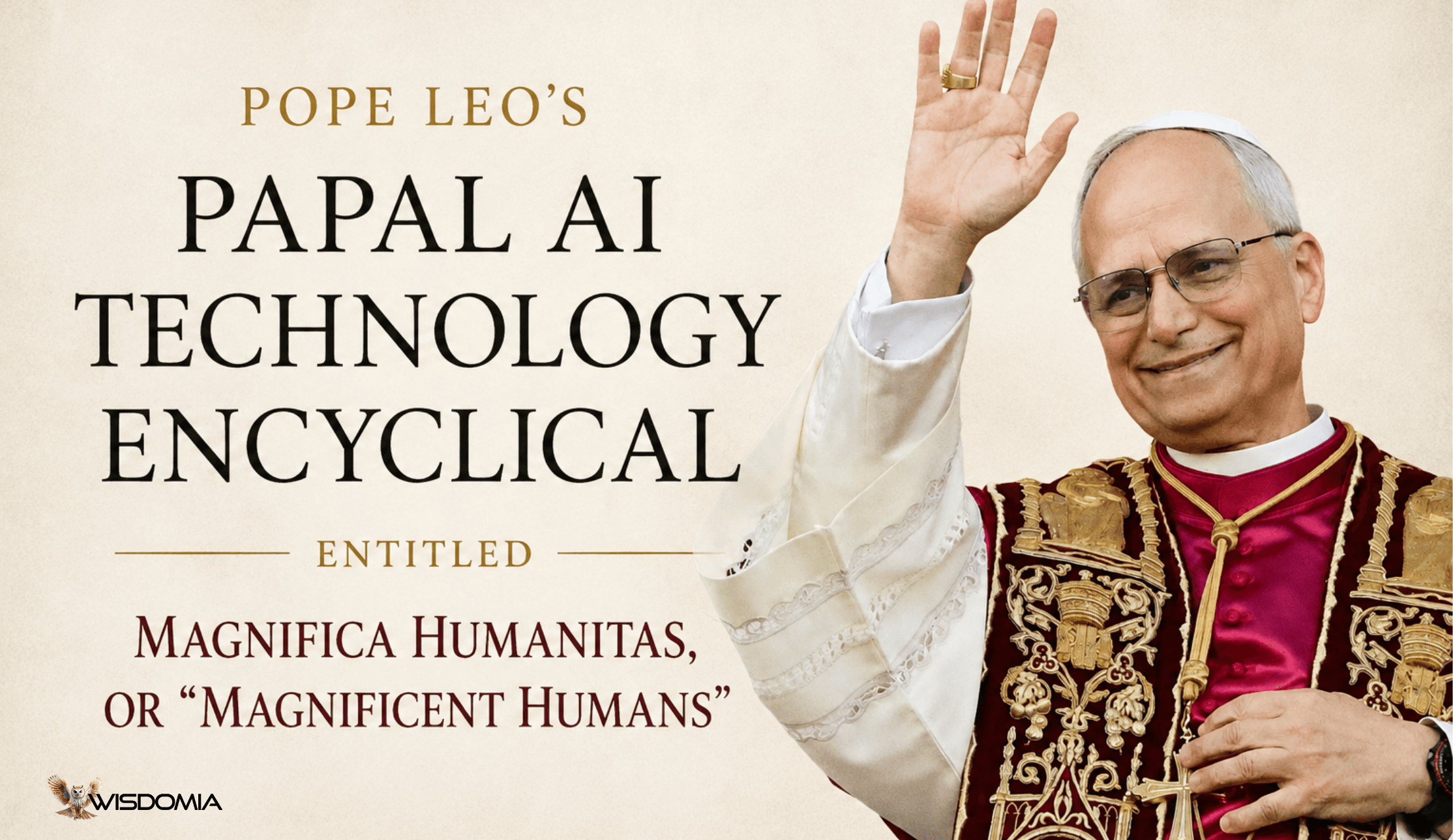
Discover Pope Leo XIV’s Magnifica Humanitas, the Vatican’s landmark 2026 encyclical on AI, human dignity, ethics, work, and the future of technology.
Pope Leo XIV's first encyclical, Magnifica Humanitas ("Magnificent Humanity"), is a landmark papal document released by the Vatican on May 25, 2026, and signed on the 135th anniversary of Pope Leo XIII's groundbreaking social encyclical, Rerum Novarum. The 83-page open letter, spanning 245 paragraphs and roughly 45,000 words, focuses on safeguarding the human person in the era of artificial intelligence.
Background & Historical Context
Pope Leo XIV drew an explicit parallel to his namesake predecessor, reflecting that 135 years ago, Leo XIII observed the situation of factory workers whose families had been uprooted by rapid industrial transformation and understood that the Church could not remain distant. Today, he writes, we face a transformation of similar, perhaps even greater, magnitude.
Pope Leo XIV signed Magnifica Humanitas on May 15 – the 135th anniversary of Rerum Novarum – that most famous social encyclical which is considered a foundational text of modern Catholic Social Thought. It addressed numerous issues facing the working class during the Industrial Revolution. Just two days after his election, Pope Leo XIV referenced his namesake's 1891 encyclical in an address to the College of Cardinals, foreshadowing the attention he intended to pay to the modern version of the same issue.
Leo XIV is also notably the first pontiff to personally present an encyclical letter to the world at the Vatican, rather than delegating that role to cardinals or senior figures – a signal of how seriously he takes this moment.
What Is the Encyclical?
Entitled Magnifica Humanitas, or "Magnificent Humans" in English, the document outlines principles for "safeguarding the human person in the time of Artificial Intelligence." It is quite a beautiful and moving document, which you can read in full at this link.
The document features five distinct chapters, exploring technology, human identity, work, truth, and the Christian vision of authentic humanity. It covers everything from the development of Church social doctrine to technological responsibility, the culture of power, building civilization through love, and preserving humanity through truth, work, and freedom.
The encyclical serves as the Catholic Church's moral and ethical guide to navigating the technological revolution. It is addressed not only to Catholics but, in Pope Leo's own words, to “every person of goodwill.”
Key Themes & Takeaways
1. Disarming AI
The Pope opens by setting humanity before a pivotal choice: either to construct a new Tower of Babel, or to build a city in which God and humanity dwell together. Drawing on Genesis, he describes Babel as a project conceived without reference to God — supported by a uniformity that eliminated diversity and chose homogenization over communion.
He calls for artificial intelligence to be "disarmed," warning against a “race for increasingly powerful algorithms and larger datasets driven by the desire to secure geopolitical or commercial dominance.”
2. Rejection of Utopian Hubris
The encyclical takes on what it calls "new AI monopolies" and the "epistemic, economic, and political asymmetry" they create. Leo XIV writes directly: "We cannot consider AI morally neutral" (§104), and "A more moral AI is useless if that morality is decided by only a handful of people" (§107).
The Pope identifies a deeper danger beyond familiar concerns like job insecurity and privacy violations: that human beings may begin to see themselves and others as mere instruments of algorithmic efficiency.
3. New Forms of Slavery
Leo warns that "nothing in the world of AI is immaterial or magical," and that every seemingly seamless digital interaction "depends on the silent work of millions of people" — from content moderators forced to view disturbing material to children mining the rare earth elements on which AI depends. They are, he writes, “scarred, wounded, and exhausted so that the computational flow can continue uninterrupted.”
4. A Call for Solidarity
The document situates new questions of human dignity, labor, and the common good within the Church's broader social tradition, running from Rerum Novarum through Centesimus Annus and Laudato Si'.
The central intention is to evaluate the digital revolution through the lens of Catholic social teaching, using principles like the common good, subsidiarity, and solidarity as criteria of judgment — weighing them against platform concentration, algorithmic governance, and the invisible labor of rare-earth miners and content moderators alike.
Institutional Response
Taken together with the Rescriptum ex audientia issued the following day — establishing an interdicastery Commission on Artificial Intelligence uniting seven Vatican institutions — these two acts represent the most far-reaching institutional response to AI by any major religious body in the world.
Further Reading & Resources
To read the full text and learn more about its impact on faith and technology, you can access the Encyclical Letter of His Holiness Leo XIV Magnifica Humanitas on the official Vatican website. For further commentary and analysis, the CAFOD Guide on Magnifica Humanitas and the Vatican News Presentation of the Encyclical are both excellent starting points.
Sources
- Full Text of the Encyclical — Vatican.va
- Vatican News — Pope Leo XIV's First Encyclical on AI
- Vatican News — Presentation & AI Disarmament
- CAFOD — Magnifica Humanitas Explained
- Catholic Bishops' Conference of England and Wales
- Villanova University — Pope Leo XIV Releases First Encyclical
- National Catholic Register — Full Text PDF
- Catholic Digest — Major Appeal to "Disarm AI"
- Commonweal Magazine — Pope Leo and the 'Babel Syndrome'
- CNN — Pope Leo Warns of AI Fueling Warfare
- Wikipedia — Magnifica Humanitas
- Forbes — Pope Leo's Tower of Babel Warning
- The Conversation — Pope Leo Compares AI to the Industrial Revolution
previous
Jony Ive and Ferrari's $640,000 Bet on the Future of Driving
next
The Powerful Gods of Egypt — The First Human Mythology
Share this

Sara Srifi
Sara is a Software Engineering and Business student with a passion for astronomy, cultural studies, and human-centered storytelling. She explores the quiet intersections between science, identity, and imagination, reflecting on how space, art, and society shape the way we understand ourselves and the world around us. Her writing draws on curiosity and lived experience to bridge disciplines and spark dialogue across cultures.
More Articles

Human Peer Review and AI: Do Machine-Verified Proofs Change What Scientific Trust Means?
Yayoi Kusama Dies at 97, Leaving Behind One of Contemporary Art’s Most Recognisable Visual Worlds

AI Is Entering the Frontier of Mathematics But Human Understanding Still Sets the Pace
Higgsfield’s $400 Million Bet: When AI Gives Everyone a Creative Studio

Growing Up With AI: What Childhood Can Teach Us About Human Agency