
loading...

 The Powerful Gods of Egypt — The First Human Mythology
The Powerful Gods of Egypt — The First Human Mythology
Dinis GuardaAuthor
Fri Jun 12 2026
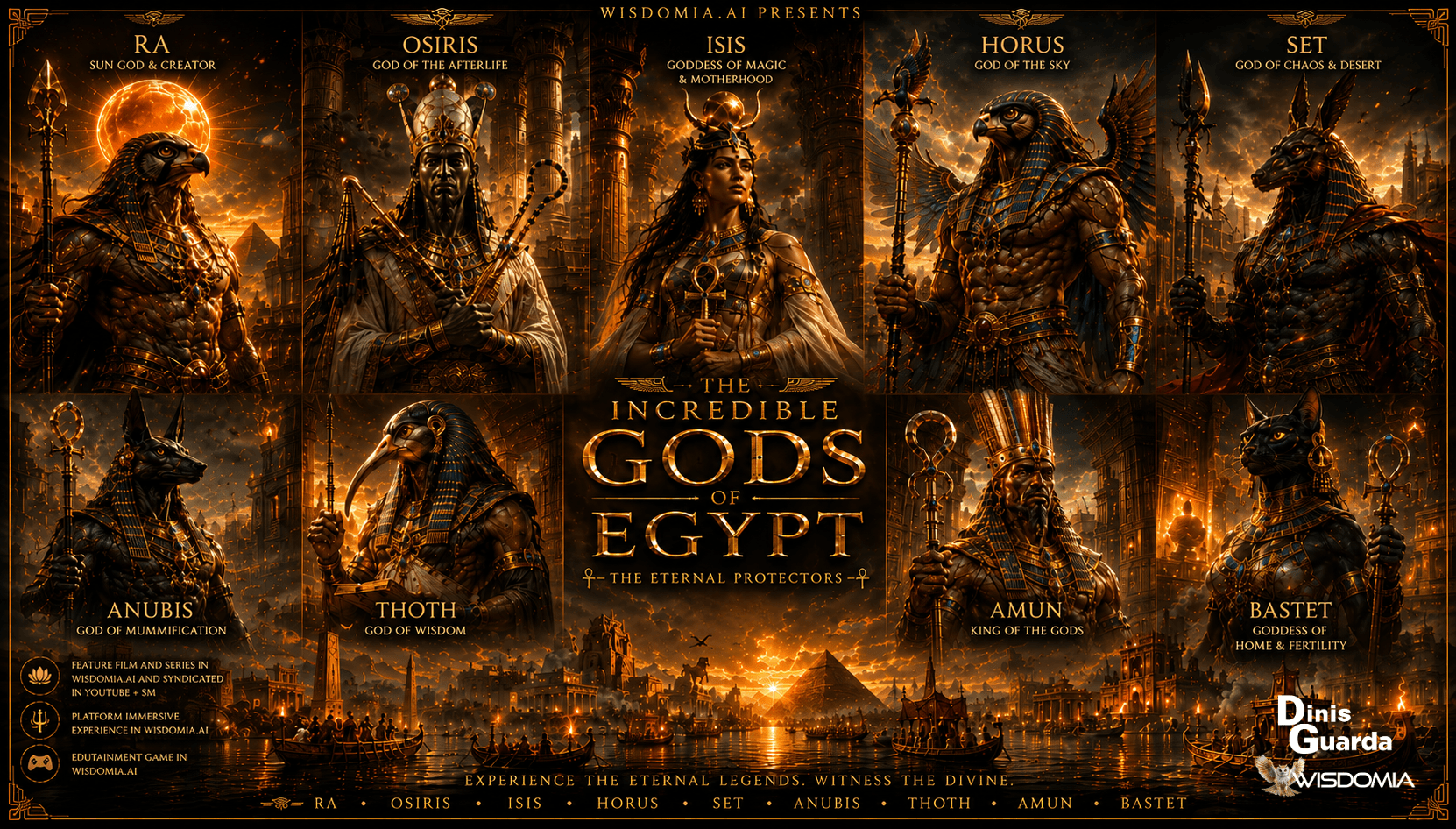
The Egyptian pantheon is not a museum of dead gods, it is a mirror of the human soul. Discover how the gods of the Nile built the first coherent architecture of the sacred and why we are still thinking in hieroglyphs today.
The Architecture of the Sacred
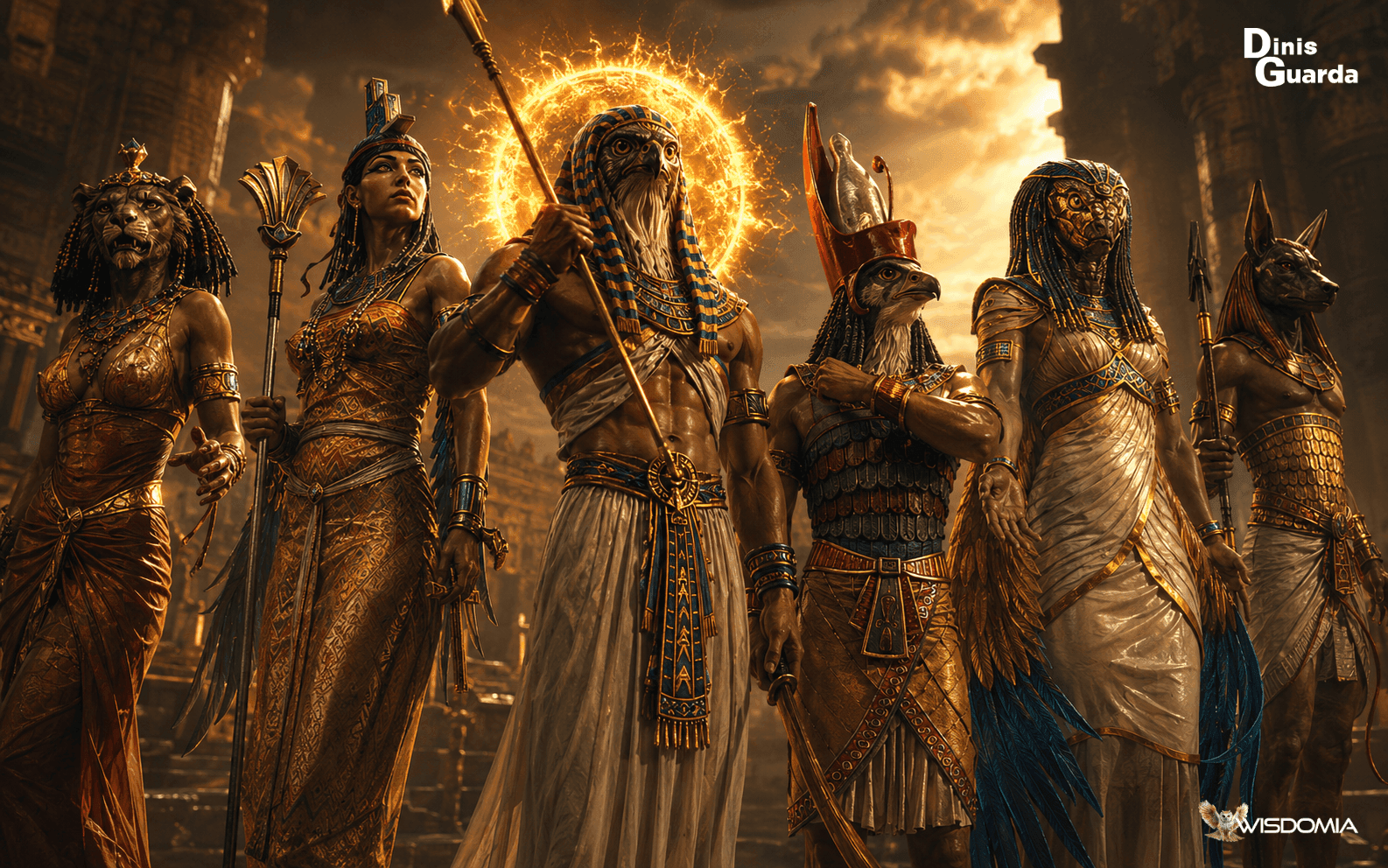
Egypt is where the human imagination first built a universe and then dared to live inside it.
Other peoples had gods before Egypt; every culture in every age has reached out into the dark to touch something larger than itself. But Egypt was the first civilisation to take the scattered, raw intuitions of the human heart, that the sun is a perilous voyage and not a mere lamp, that death is a profound threshold and not an absolute wall, that justice is a measurable cosmic weight and not a comforting wish—and to forge them, over thirty consecutive centuries, into a single, coherent architecture of the sacred.
Sumer raised gods of equal antiquity, yet it is the Nile Valley that left us the most complete, enduring blueprint of a world held together by myth: the intricate cosmogony and the solar calendar, the monumental temple and the hidden tomb, the absolute law of Ma‘at and the delicate scale on which a human heart is weighed against a feather. When we speak of the first great, fully integrated mythology of our species, we are speaking, with the material evidence in our very hands, of the gods of the Nile.
Through this study, we uncover a profound truth that the ancient Egyptians deeply understood, and which we are only now recovering: that a single human life, fully reckoned, already contains the entirety of humankind.
The pantheon of Egypt is not a chaotic crowd of foreign idols or bizarre animal curiosities; it is an elaborate mirror held up to the interior architecture of the human soul. Each divine face represents a distinct faculty, a psychological or cosmic force operating within the single creature who built them all.
- Ra is our structural hunger for cosmic order and the daily, defiant courage to begin again after the dark.
- Osiris is our deep grief, our vulnerability to brokenness, and our absolute refusal to let the beloved dead be merely gone.
- Isis is supreme intelligence bent to the absolute work of love, magic, and reconstruction.
- Thoth is the part of us that writes, that counts, that measures, and that remembers against the eroding tide of time.
- Sekhmet is our dormant capacity for devastating fury, while Hathor is our equally boundless capacity for ecstatic joy.
- Ma‘at is the quiet, foundational conviction—older than any written legal code—that some things are fundamentally, eternally true.
The Three Claims of This Atlas
This volume operates on three core theses, testing each against the physical, textual, and archaeological record of Egypt:
1. The Historical Claim
Egyptian religion is the earliest fully documented, continuous system in which a civilisation explained itself to itself, accounting for origin, social order, mortality, and transcendent meaning across a time span longer than the distance separating us from the founding of ancient Rome.
2. The Anthropological Claim
The gods are not arbitrary, primitive superstitions but perfectly legible psychological and ecological solutions to the real problems of living. The animal-headed forms constitute a sophisticated, precise visual code for specific types of power, environmental dynamics, and temperaments.
3. The Transcendent Claim
The inheritance of Egypt did not die when the last hieroglyph was carved into the stone of Philae. It surfaces in the Hebrew literary imagination, the Greek mystery cults, the Roman Empire where the cult of Isis reached the cold borders of Hadrian's Wall, the Hermetic philosophy that ignited the Western Renaissance, and the strange persistence of Egyptian symbology in our own contemporary iconography. We are, in structural ways we rarely consciously notice, still thinking in hieroglyphs.
The methodology applied throughout this book is the signature of this Atlas series: wisdom, science, and imagination held in a single hand.
- Wisdom, because these are sacred materials that commanded the life and death of millions, and they deserve intellectual gravity rather than casual exoticization.
- Science, because no assertion is made here that the hard archaeology, rigorous philology, and primary hieroglyphic texts do not actively support.
- Imagination, because a living religion is never merely a sterile list of dogmatic propositions; it is an intensely felt world.
The only honest way to convey what it was actually like to fear the chaotic coils of Apophis in the dead of night, or to desperately long for the eternal green of the Field of Reeds, is to make you, the reader, stand directly inside it. You must feel the dry heat of the embalmer’s limestone workshop, smell the rich, river-mud scent of the annual inundation, and feel the cold, heavy weight of divine judgement pressing down upon your chest. Where this text reconstructs a historical scene or an ancient ritual, it does so explicitly from what the tomb-walls, papyri, and temple inscriptions physically show, maintaining a clear boundary where archaeological evidence ends and historical imagination begins.
The Dawn of the Nile: Prehistoric and Early Dynastic Foundations
To understand the gods, we must first understand the mud from which they emerged. Long before the first pharaoh wore the double crown of a unified realm, human beings were navigating the volatile environmental rhythms of the Nile Valley, leaving behind an evolutionary and cultural trail that made the later dynastic explosion possible.
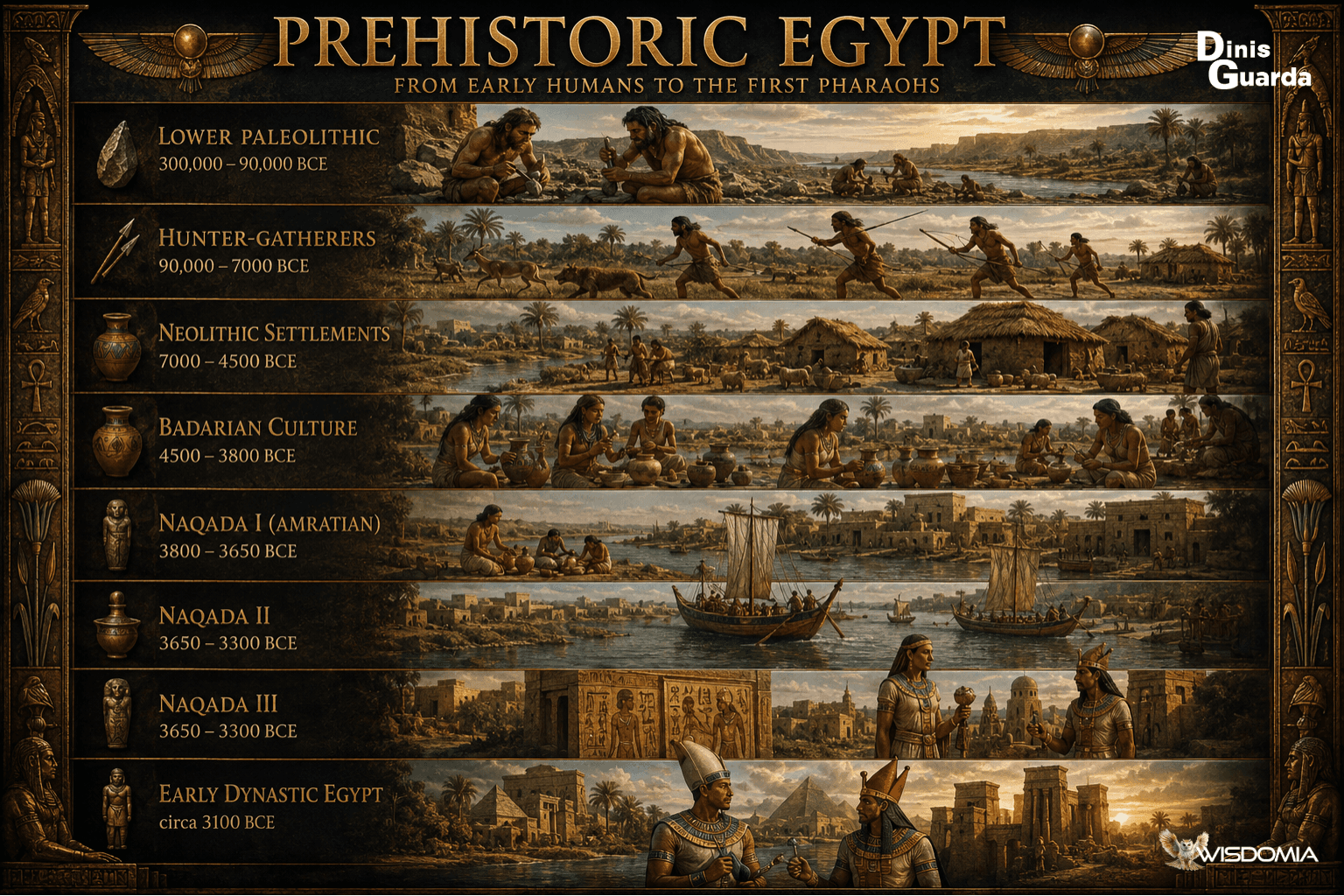
In the Lower Palaeolithic (300,000–90,000 BCE), early hominids moved along the valley's high stone terraces, leaving behind heavy flint hand-axes, already learning the fundamental law: the river is life, and everything outside its reach is barren death.
During the hunter-gatherer period (90,000–7000 BCE), the great North African savannahs dried into desert, forcing scattered populations inward onto the narrow alluvial strip of the Nile.
This ecological bottleneck sparked the Neolithic Settlements (7000–4500 BCE), when humans built permanent mud-brick villages, domesticated cattle, and planted emmer wheat and barley in the black soil of the annual flood.
The Badarian Culture (4500–3800 BCE) introduced an unprecedented ritual sophistication. In their graves, we find beautifully rippled black-topped pottery, delicate ivory combs, and siltstone palettes for grinding eye paint. Crucially, they buried their dead facing west, the direction where the sun died each evening, with offerings of food and tools. The fundamental wager of Egypt had officially begun: the grave was not an ash heap; it was an investment in a continuing journey.
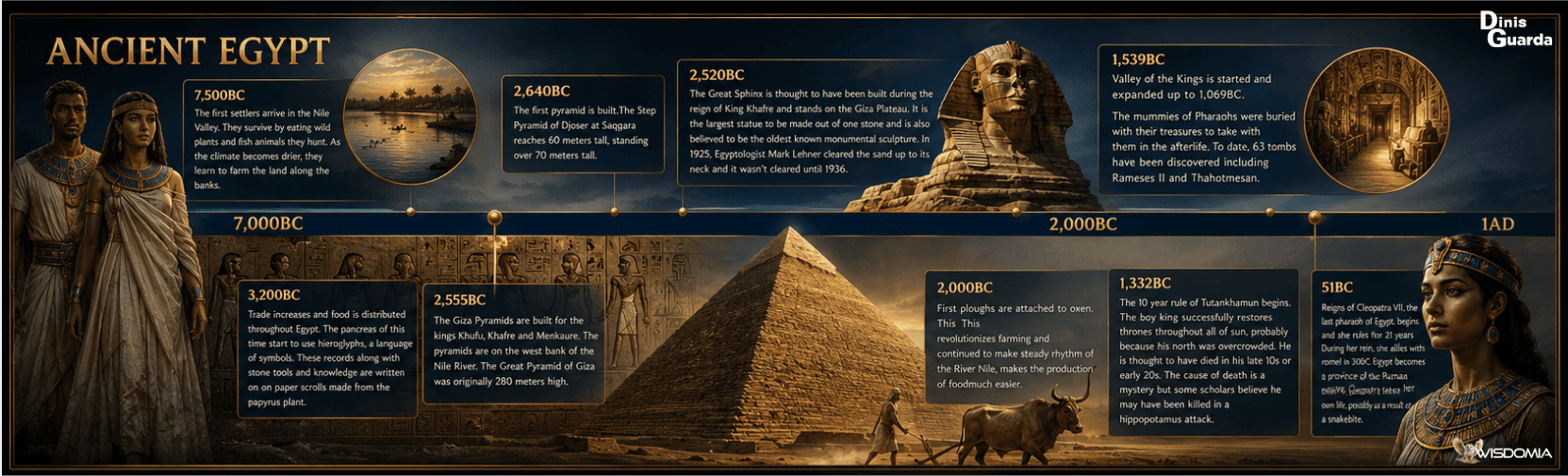
During the Naqada periods (3800–3100 BCE), multi-oared wooden boats navigated the main artery of the Nile, carrying goods and religious concepts between proto-state centres. Local chieftains began adopting visual symbols of cosmic power, the bull's tail, the heavy mace, the majestic falcon. By circa 3100 BCE, a legendary ruler from Upper Egypt unified the entire river under a single administrative and spiritual crown, as recorded on the Narmer Palette. This unification was understood not merely as military conquest but as a monumental cosmic triumph: the ruler was now the earthly manifestation of Horus, charged with maintaining the balance of existence.
The Dynamic Timeline of Dynastic Glory
Once unified, the Egyptian state embarked on a three-thousand-year historical journey that stands as one of the most stable yet dynamic experiments in human history. Together, these visual historical records divide the grand architecture of Egyptian dynastic history into distinct, legible eras, punctuated by periods of internal collapse and foreign transformation.
The Old Kingdom (c. 2575 – 2130 BCE): The Age of Cosmic Monoliths
This foundational era represents the ultimate centralisation of divine power. The pharaoh was not simply an intermediary between gods and men; he was the living sun god's son, the cosmic axis around which the entire state revolved. Around 2610 BCE, Imhotep raised the Step Pyramid of Djoser at Saqqara to over 60 metres. The Great Pyramid of Giza followed for Khufu around 2555 BCE, a mountain of precision-cut limestone 280 Egyptian cubits high, with the Great Sphinx carved nearby under Khafre (2520 BCE). The famous Pyramid Texts—the oldest surviving body of religious writing in human history—were carved into the limestone walls of royal burial chambers, a potent verbal map to rocket the deceased pharaoh into the eternal stars.
The First Intermediate Period & Middle Kingdom (c. 2130 – 1630 BCE): The Rebirth of the Soul
Around 2130 BCE, catastrophic low Nile floods triggered agricultural failure and civil war, shattering the illusion of the untouchable pharaoh. Local governors seized autonomous control, and the ordinary population realised the state could no longer protect them. Yet this dark fragmentation catalysed a democratic revolution of the spirit: if the pharaoh could achieve eternal life through sacred texts, why not the common citizen? When Mentuhotep II reunited the country around 2008 BCE, the Pyramid Texts had been democratised onto the wooden interiors of ordinary coffins, now known as the Coffin Texts. Any individual who could afford a proper burial could now transform into Osiris upon death, regardless of royal blood.
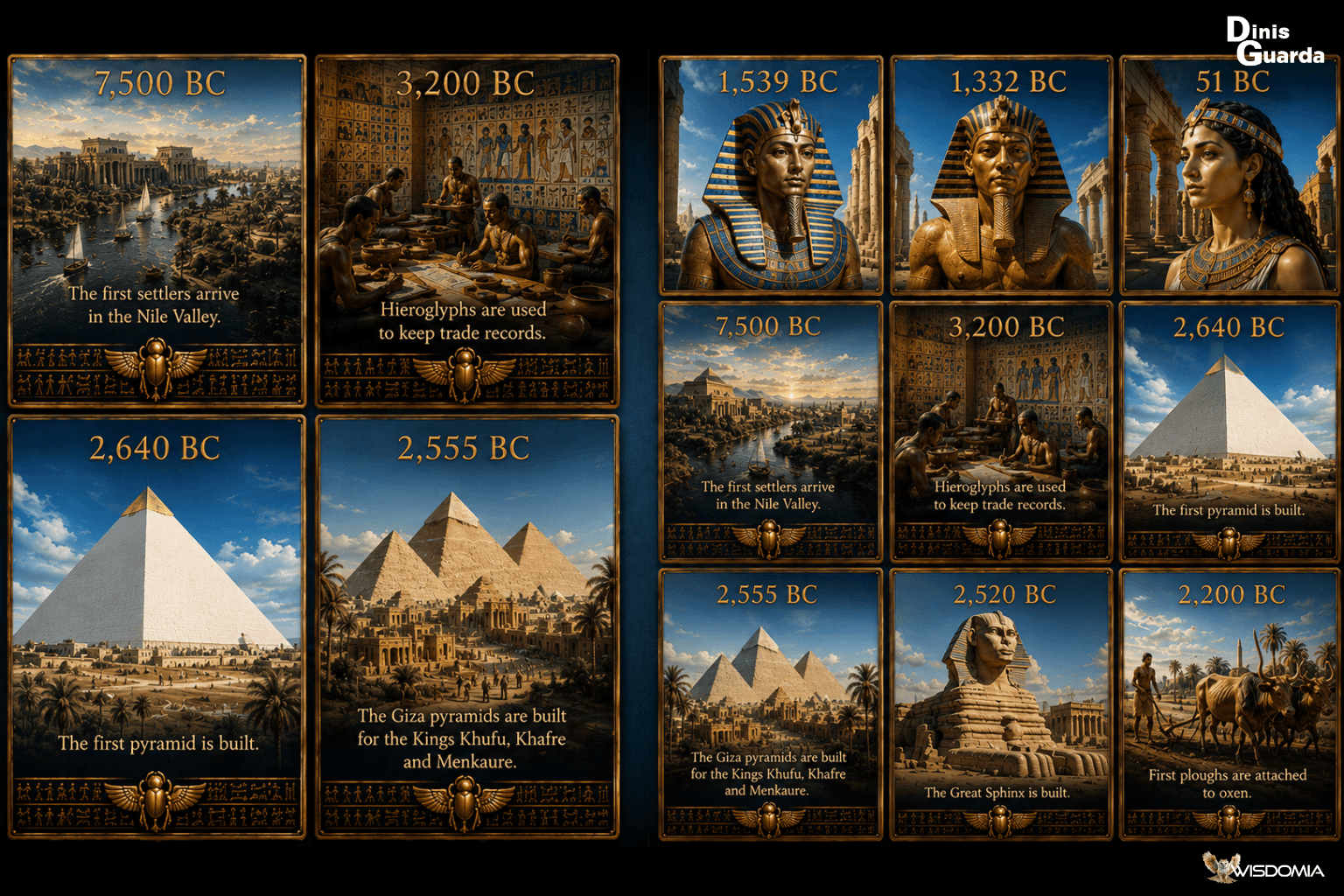
When Mentuhotep II reunited the fractured country around 2008 BCE to inaugurate the Middle Kingdom (c. 1938 – 1630 BCE), the spiritual landscape had shifted completely. This era, celebrated as Egypt's classical literary golden age, saw the wide democratisation of the afterlife. The exclusive Pyramid Texts were adapted and painted onto the wooden interiors of ordinary rectangular coffins, now known to archaeology as the Coffin Texts. Any individual who could afford a proper burial and a sacred coffin could now transform into Osiris upon death, conquering the grave regardless of royal blood.
The Second Intermediate Period & New Kingdom (c. 1630 – 1075 BCE): The Imperial Zenith
After the humiliating Hyksos occupation (c. 1630–1539 BCE), the Theban prince Ahmose I drove the foreign rulers out and established the New Kingdom, an era of unprecedented military expansion into the Levant and Nubia.
Mythologically, this era belongs to Amun-Ra, originally a local Theban wind god merged with the ancient sun god Ra, whose massive temple complex at Karnak became the wealthiest institution on earth. New Kingdom pharaohs hid their bodies in rock-cut tombs in the Valley of the Kings, their walls covered with the Book of the Dead, magical roadmaps through the underworld's complex geometry.
This is the age of Ramesses II, Queen Hatshepsut, and the boy-king Tutankhamun, whose brief reign restored polytheistic orthodoxy after Akhenaten's radical monotheistic experiment.
The Late Period & Ptolemaic Era (c. 664–30 BCE): The Twilight Fusion
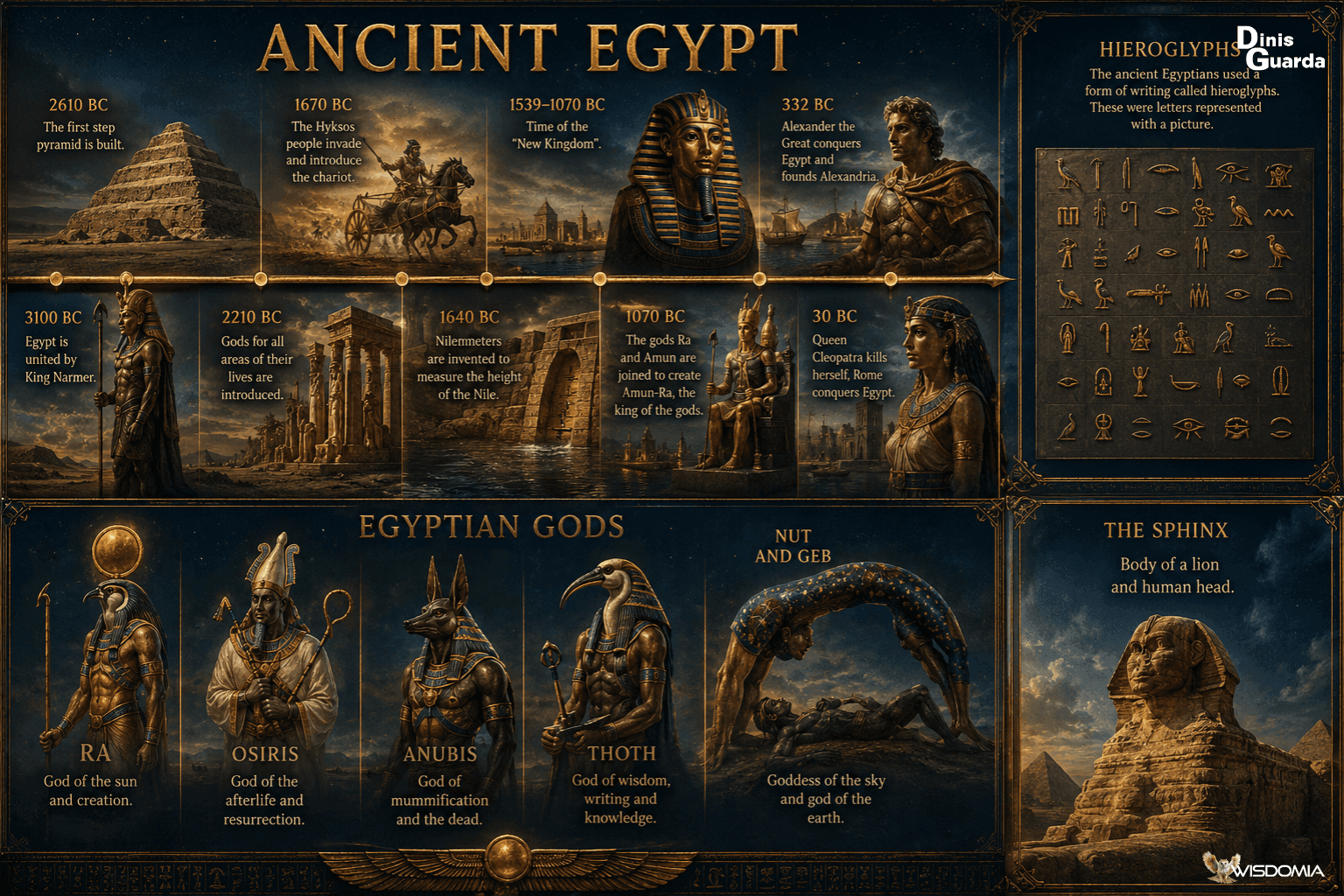
After repeated invasions by Libyan, Nubian, and Persian powers, Alexander the Great entered Egypt in 332 BCE and founded Alexandria. His general Ptolemy established a Greek-speaking dynasty that rebuilt native temples at Edfu, Dendera, and Philae while portraying themselves as a traditional kilted pharaoh. The cult of Isis became the most popular mystery religion in the Greco-Roman world. The fusion ended dramatically with Cleopatra VII, who aligned herself with Julius Caesar and Mark Antony to preserve Egyptian independence. In 30 BCE, following her defeat by Octavian, Cleopatra took her own life. The ancient dynastic timeline, running continuously for over three thousand years, was closed.
As beautifully detailed across the visual records of The Periods of Ancient Egypt and ancient egypt, this was an era of profound cultural and religious synthesis. The Ptolemaic kings rebuilt native temples in classic hieroglyphic styles at Edfu, Dendera, and Philae, portraying themselves on temple walls as traditional, kilted pharaohs. The ancient cult of Isis grew into the most popular mystery religion in the broader Greco-Roman world.
The Anatomy of the Pantheon: The Divine Family Tree
The gods of Egypt were not static, isolated icons; they existed within a complex web of familial relationships, cosmic dynamics, and political associations. To understand how the ancient mind organised its universe, we must examine the divine lineage.
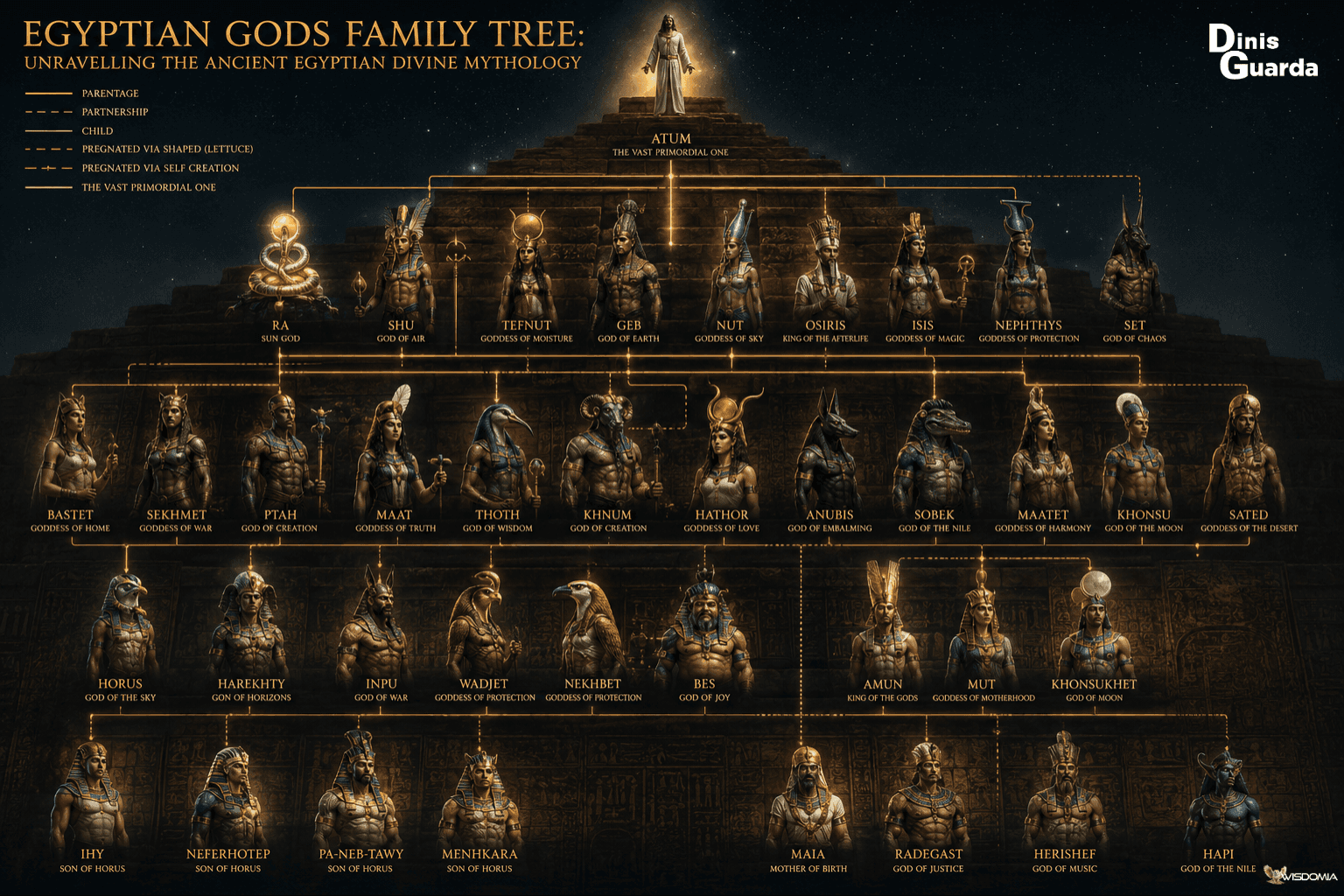
At the apex of this divine lineage stands Atum, the "Vast Primordial One." Before the sky was separated from the earth, before the sun rose for the first time, there was only Nun, a dark, infinite, chaotic ocean of non-existence. Atum, through an act of sheer will, emerged from this dark water onto the primordial mound (Benben). Through self-creation, Atum generated the first divine pair: Shu (the god of dry air) and Tefnut (the goddess of moisture and spit).
This elemental pair united to give birth to the physical structure of our world: Geb (the god of the earth) and Nut (the goddess of the sky). Nut is depicted as a beautiful woman arched in a grand curve over the earth, her body covered in glittering stars, while Geb lies stretched out beneath her, forming the green hills and brown valleys of the Nile.
Geb and Nut gave birth to four iconic deities who represent the fundamental psychological and political struggles of human life: Osiris, Isis, Set, and Nephthys. These four figures formed the core narrative of the Egyptian state identity:
- Osiris, the eldest son, was the legendary first king of Egypt, teaching humanity agriculture, law, and civilised order.
- Set, driven by deep envy and cosmic malice, murdered his brother Osiris, tearing his body into pieces and scattering them across the valley to seize the throne.
- Isis, utilising her supreme magical intelligence, tracked down her husband's scattered pieces, reassembled his body with the assistance of Anubis (the god of mummification), and breathed life back into him long enough to conceive a child: Horus, the falcon-headed sky god.
- Horus grew to adulthood, challenged his uncle Set in a legendary cosmic trial, and reclaimed the rightful kingship of Egypt, becoming the divine prototype for every living pharaoh. Osiris descended into the underworld to reign eternally as the Lord of the Dead and the King of the Afterlife.
Branching further down this family tree are secondary and tertiary generations of deities, each managing specific human and natural realms.
Thoth, depicted with the head of a sacred ibis or a baboon, emerged as the independent god of wisdom, mathematics, writing, and the moon, serving as the cosmic scribe who recorded every divine action.
Bastet, the cat goddess, evolved from a fierce protector into a beloved patron of the home, fertility, and joy. Hathor, wearing the solar disk between cow horns, reigned as the universal goddess of love, music, and beauty, while Amun, the hidden king of gods, dominated the political theology of the New Kingdom empire alongside his divine consort Mut and their lunar son Khonsu.
The Eternal Protectors — Profiles of the Great Gods
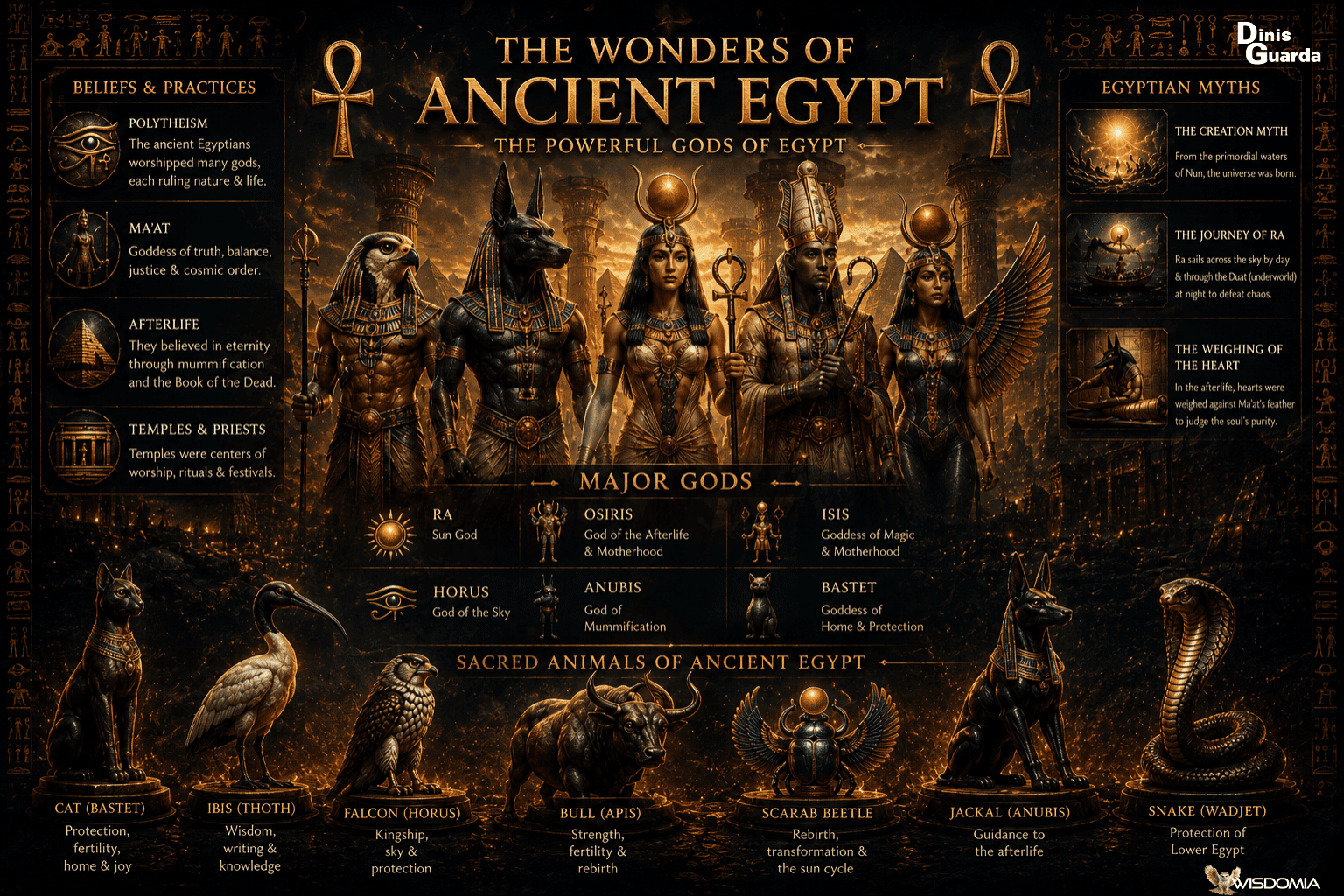
To fully understand the dynamic visual language of this mythology, we must study the specific iconography and theology of the ten primary deities who defined the spiritual life of the Nile Valley. These immortal figures are not mere relics of the past; they are powerful archetypes that continue to echo through human psychology.
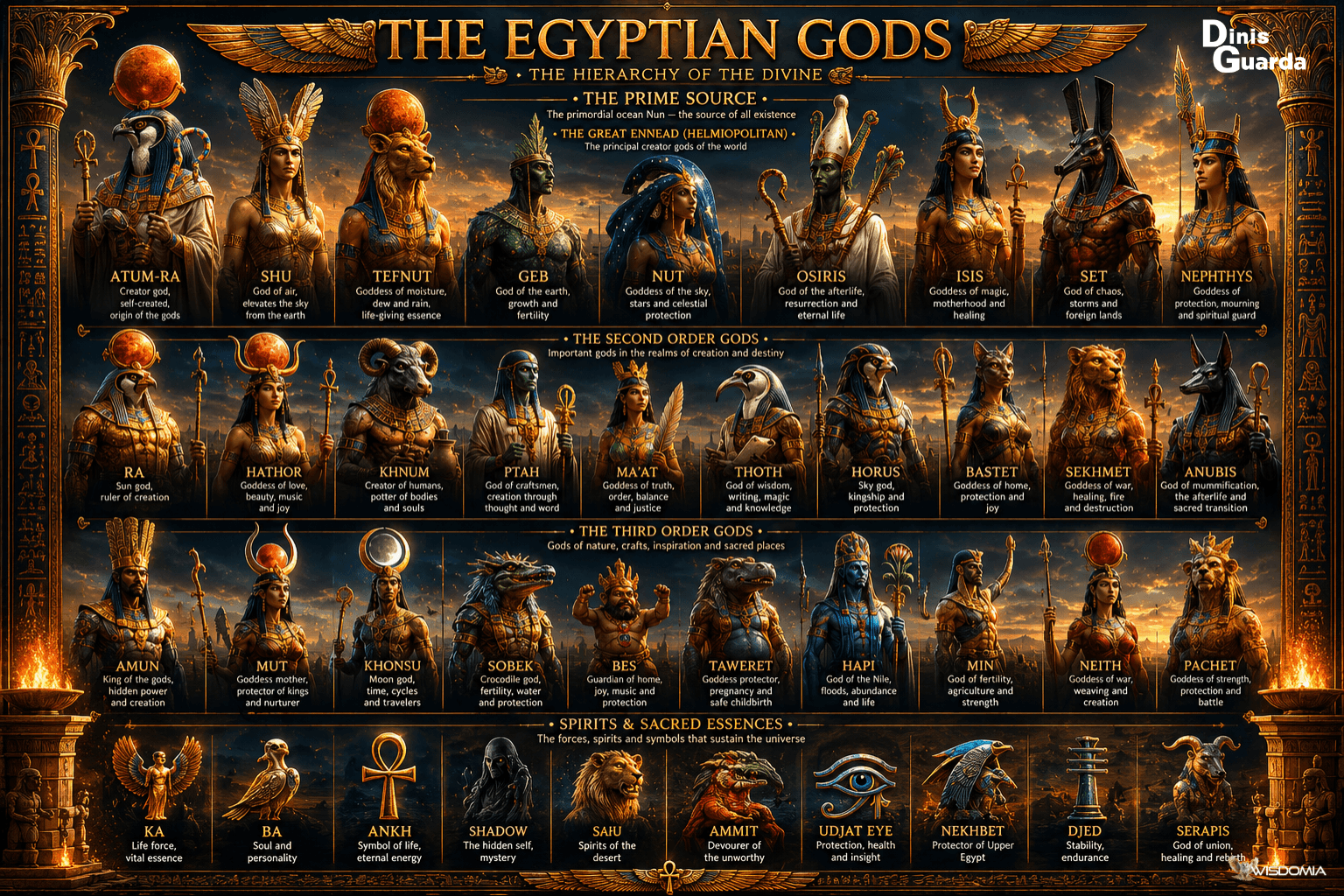
1. Ra: The Sun God and Sovereign Creator
- Iconography: A majestic falcon-headed man crowned with a blazing solar disk encircled by the protective Uraeus cobra, carrying the ankh of life and the was sceptre of power.
- Theology: Ra is the absolute engine of the cosmos. He does not simply shine; he fights. Every single day, Ra sails his solar bark (Mandjet) across the sky, bringing light and warmth to the living world. Every night, he descends into the terrifying depths of the underworld (Duat), where he must directly confront Apophis, the giant serpent of primordial chaos. If Ra fails for a single night, the universe collapses back into non-existence. His daily dawn is the ultimate triumph of cosmic order over chaos.
2. Osiris: The Lord of Resurrection and the Afterlife
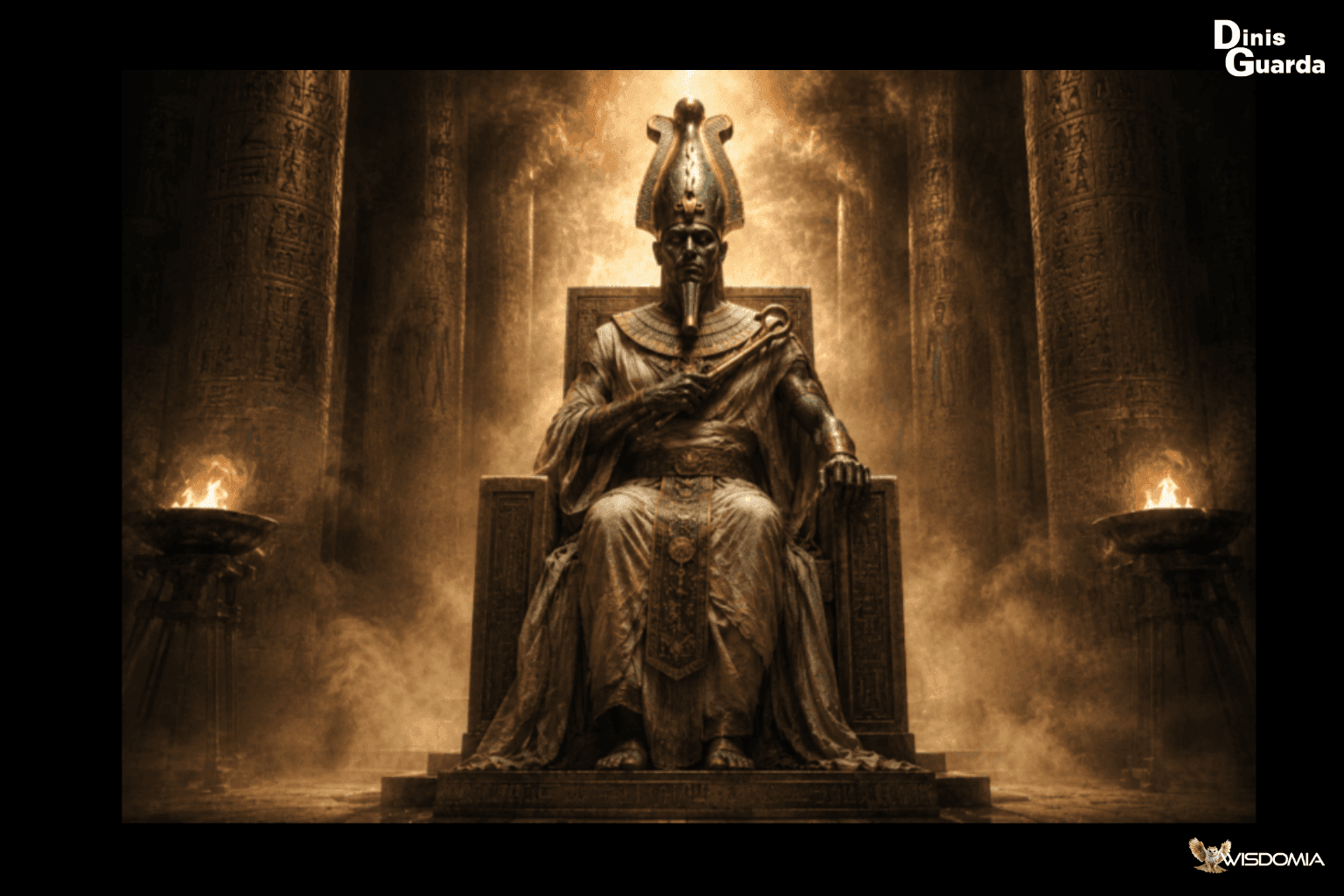
- Iconography: A mummified king with distinctive green or black skin (representing rich fertility and rebirth), wearing the white Atef crown flanked by ostrich feathers, and holding the royal crook and flail tightly across his chest.
- Theology: Osiris represents the profound human triumph over death. He is the broken god who was restored. Because he suffered mortality and overcame it, he became the absolute guarantor of eternal life for every human soul. He does not rule from a terrifying throne of damnation; he rules as a compassionate judge, welcoming those who have lived a life aligned with cosmic truth into his eternal, green kingdom.
3. Isis: The Sovereign of Magic and Motherhood
- Iconography: A beautiful woman wearing the hieroglyphic sign for a throne upon her head, or later adopting the cow horns and solar disk of Hathor, frequently depicted with great, protective raptor wings extended to shield her family.
- Theology: Isis is intelligence bent to the absolute service of love. She is the ultimate protector, the devoted wife who conquered death through magical wisdom, and the mother who raised her child in secret to reclaim a stolen kingdom. Her magic (Heka) was so formidable that she even discovered the secret, true name of Ra, granting her unmatched power across the cosmos. To the ancient world, she was the ultimate sanctuary for the vulnerable.
4. Horus: The Lord of the Sky and Rightful King
- Iconography: A powerful falcon or a falcon-headed warrior wearing the Pschent (the double crown of unified Upper and Lower Egypt).
- Theology: Horus is justice in action. He represents the living king, the active protector of social order against the forces of chaos. His right eye was the sun; his left eye was the moon. In his fierce battles with Set, his left eye was torn out and shattered into pieces. Restored by the wisdom of Thoth, this eye became the Eye of Horus (Wadjet)—the universal symbol of protection, wholeness, and healing that adorned thousands of ancient amulets.
5. Set: The Lord of Chaos, Desert, and Storms
- Iconography: A specialised, unidentified composite animal with a long, squared snout, high erect ears, and a split, tufted tail.
- Theology: Set is the necessary antagonist of the universe. He represents the red, barren desert sands (Deshret), the unpredictable violent desert storm, and the internal force of envy and political rebellion. Yet, the Egyptian mind did not view Set as purely evil. He was absolutely vital; his raw, untamed violence was harnessed by Ra, standing at the prow of the solar bark each night to spear the serpent Apophis. Chaos, properly directed, is essential for defending order.
6. Anubis: The Guardian of the Scales and Embalming
- Iconography: A striking jackal or a jackal-headed man with jet-black skin (representing the protective pitch used in mummification and the fertile soil of rebirth).
- Theology: Anubis is the master of thresholds. When a soul arrives at the gates of the underworld, it is Anubis who gently takes them by the hand and guides them through the dark. He invented the art of mummification to preserve the physical body of Osiris, and he stands over the great scales of judgement, carefully adjusting the plumb bob to ensure perfect cosmic accuracy when the human heart is weighed against truth.
7. Thoth: The Divine Scribe of Wisdom and Time
- Iconography: A man with the distinctive head of a sacred ibis or a seated baboon, holding a reed pen and a writer’s palette.
- Theology: Thoth is the intellect of the cosmos. He is the inventor of the holy hieroglyphic script (Medu Netjer—"the words of the gods"), the patron of all scribes, physicians, and astronomers, and the ultimate keeper of celestial records. Standing inside the Hall of Judgement, Thoth remains completely neutral, dispassionately recording the final verdict of every soul’s trial on his papyrus scroll. He is memory overcoming time.
8. Amun: The King of Gods and Hidden Breath
- Iconography: A stately man wearing a flat-topped crown surmounted by two tall, parallel ostrich plumes, or represented as a ram with curved horns.
- Theology: Amun represents the unseeable, omnipresent force of life. His name literally translates to "The Hidden One." Unlike Ra, who can be seen in the physical sun, Amun is experienced in the invisible wind that moves the sails of the riverboats, and in the silent breath of life that animates the chest. When merged with Ra as Amun-Ra, he became the supreme cosmic architect of the New Kingdom empire.
9. Bastet: The Protectress of Home and Joy
- Iconography: A slender, elegant domestic cat or a cat-headed woman holding a sacred rattle (sistrum) and a protective shield.
- Theology: Bastet represents the warmth and protective fire of the hearth. Originally a fierce lioness warrior, she was domesticated into a gentle, domestic feline form, representing the comforting aspects of the sun's heat. She was the ultimate defender against disease, malevolent spirits, and venomous household pests, bringing joy, dance, and domestic music to human communities.
10. Sekhmet: The Eye of Vengeance and Fire
- Iconography: A terrifying lioness-headed woman crowned with a blazing solar disk and a striking cobra, her linen garments dyed deep red.
- Theology: Sekhmet is the destructive power of the sun. She is the "Eye of Ra," dispatched by her creator to punish humanity when they rebelled against cosmic order. Her breath created the hot winds of the desert, and her fury was so absolute that she nearly wiped out humankind before being tricked into drinking beer dyed red with ochre, mistaking it for blood. She is the patron of warriors and doctors, holding power over both deadly plagues and ultimate physical healing.
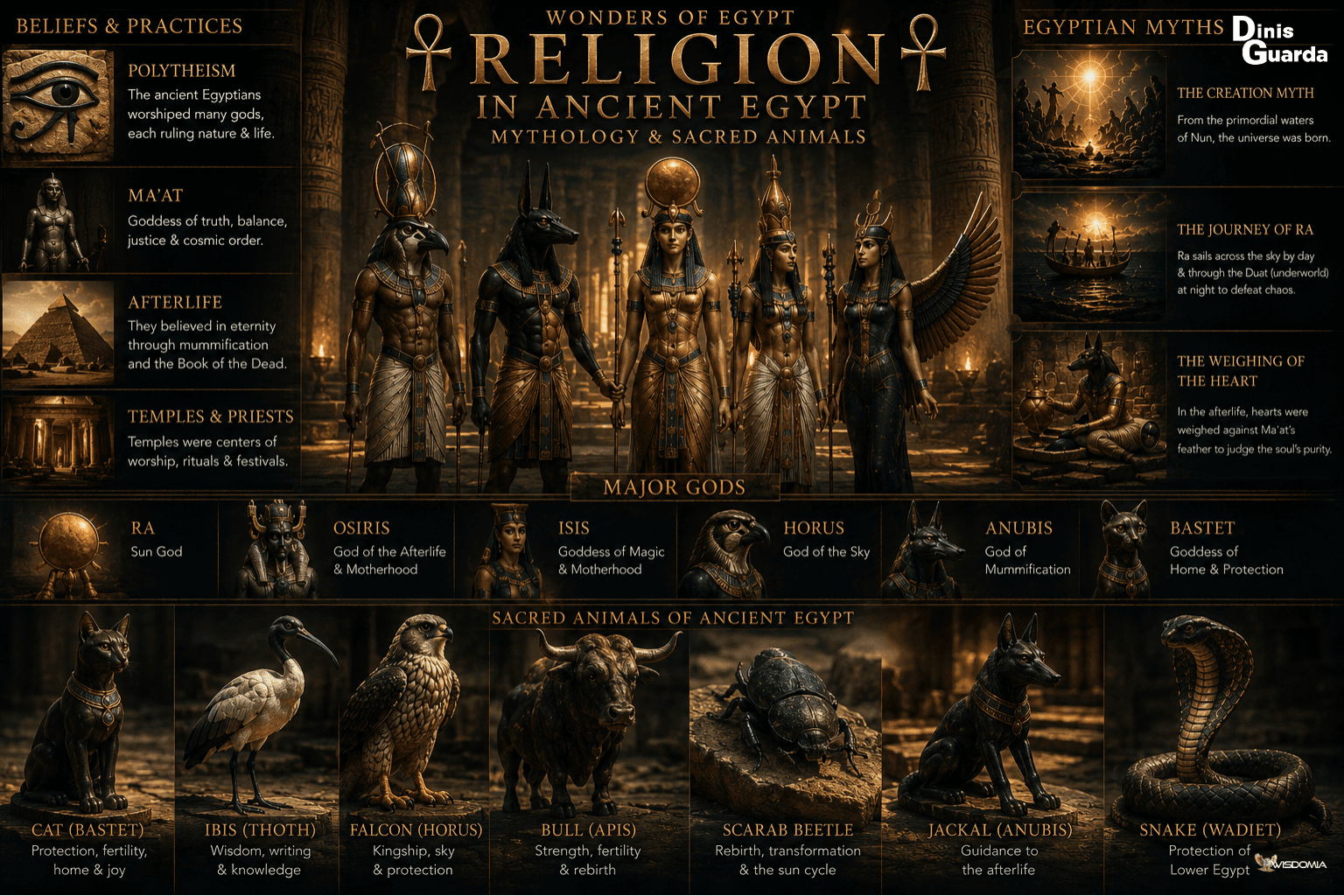
Beliefs and Practices — The Living World of Ritual
A mythology that exists only in books is a dead theology. To the ancient Egyptian, the gods were a vivid, physical reality that required constant interaction, physical nourishment, and daily maintenance.
The daily religious life of the Nile Valley was anchored by four core structural concepts:
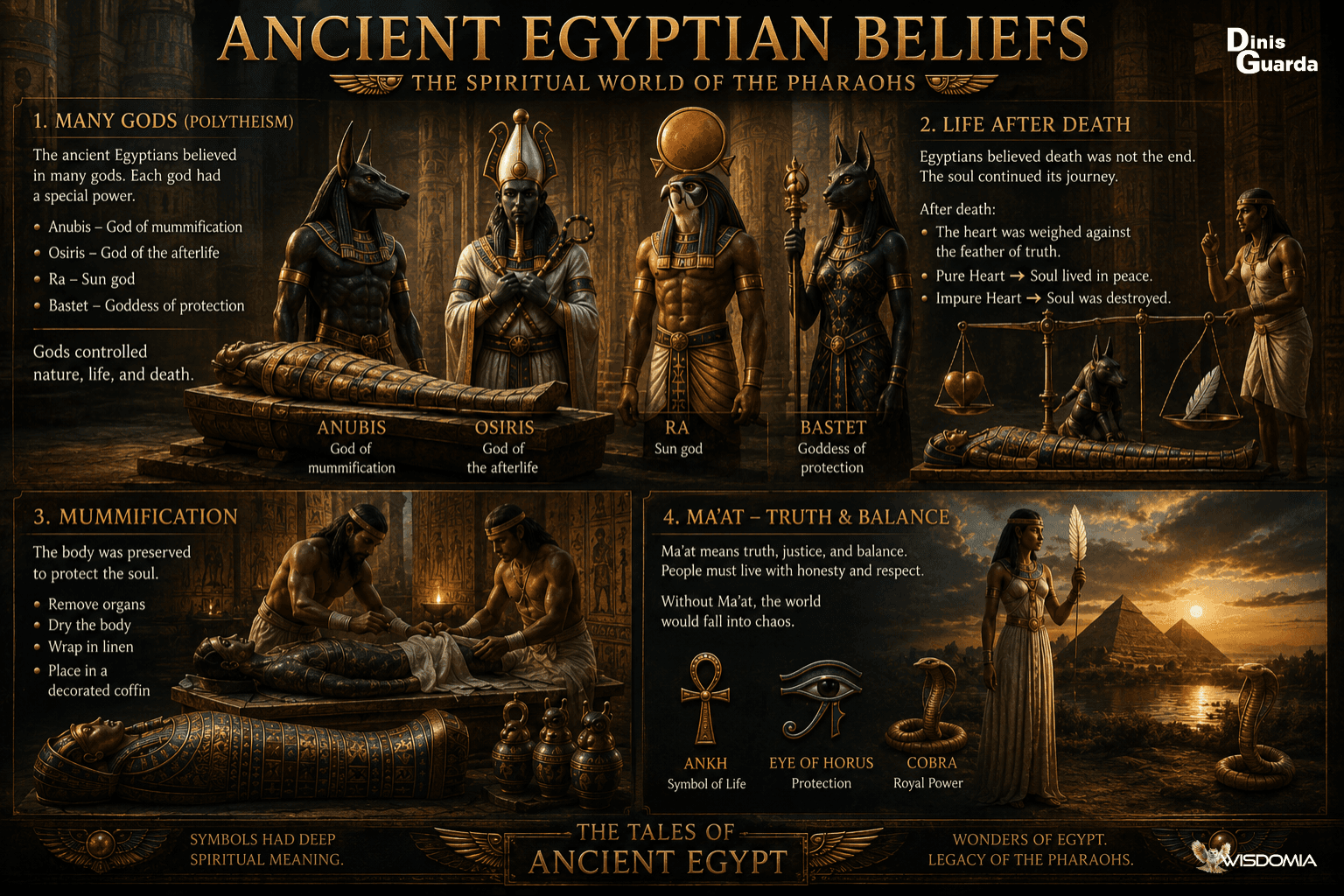
The Framework of Polytheism
The Egyptian universe was crowded with divine presence. There was no clear divide between the natural world and the supernatural realm. A sudden thunderstorm, a venomous scorpion bite, a good harvest, or a sudden stroke of creative inspiration were all direct, personal manifestations of the gods. This polytheistic framework allowed the Egyptian mind to break down the overwhelming complexity of life into distinct, legible components, allowing them to approach a specific deity for a specific problem.
The Absolute Law of Ma'at
At the centre of the cosmic architecture stood Ma'at: a serene goddess wearing a single ostrich feather, representing the eternal structural fabric of reality—cosmic balance, absolute truth, social justice, and predictable order. The pharaoh's primary duty was to 'present Ma'at' to the gods each morning, demonstrating the state's integrity. If Ma'at was neglected, the Nile flood would fail, the government collapse, and primordial chaos would breach Egypt's borders.
The Afterlife and the Technology of Mummification
The ancient Egyptians were not obsessed with death; they were deeply in love with life. The human soul was divided into the Ka (life force), the Ba (unique personality), and the Akh (transfigured spirit), all requiring a physically preserved body to return to each night. This drove the development of mummification: the careful extraction of organs into sacred canopic jars, systematic dehydration in natron salt for forty days, and wrapping in fine linen bandages interspersed with protective amulets.
The ultimate test came in the Weighing of the Heart ceremony. Before the throne of Osiris, the deceased's heart was placed on a balance against the feather of Ma'at. A heart heavy with sin was devoured by Ammit, a monster combining crocodile, lion, and hippopotamus, resulting in absolute annihilation. A heart that balanced perfectly earned the individual entry into the Field of Reeds: an idealised afterlife free from sickness, hunger, or sorrow.
The Temple as a Cosmic Microcosm
An Egyptian temple was not a community house of prayer; it was a precision engine designed to keep the universe running. Its layout modelled the creation myth, outer courtyards with papyrus-stalk columns representing the primaeval marsh, the floor rising toward a pitch-black inner sanctuary representing the primordial mound. Inside stood the sacred cult statue, accessible only to the pharaoh and high priests. Each morning the priests performed the Daily Temple Ritual: breaking the clay seal, washing and anointing the statue, dressing it in fresh linen, and laying out banquets. The gods absorbed the spiritual essence; the physical remains fed the temple staff. This constant exchange of human labour for divine protection kept the cosmos stable.
Sacred Animals, The Terrestrial Avatars
To modern eyes, a pantheon filled with animal-headed figures can seem primitive or confusing. The animal kingdom was a highly sophisticated graphic code for the ancient Egyptians. The animals were not worshipped as gods themselves; rather, they were a living canvas, a physical manifestation of a specific divine aspect on earth.
The Cat (Bastet) was observed for its unique dual nature: a gentle, nurturing companion to its kittens at home, which could instantly transform into a lethal, lightning-fast predator when confronting a snake or rodent. It became the perfect visual code for domestic safety and defensive ferocity.
The Ibis (Thoth), with its curved, elegant beak, was seen dipping its bill into the river mud, mimicking the exact motion of a scribe dipping a reed pen into an inkwell. Its stark black-and-white plumage resembled written text on a clean scroll, making it an intuitive symbol for the preservation of knowledge.
The Falcon (Horus) possessed incredible visual acuity, soaring so high into the sky that its body disappeared from human view, while it could still track its prey with absolute precision on earth. It became the living manifestation of the sky god and the king, looking down upon his realm with total awareness.
The Bull (Apis) was the ultimate living emblem of physical power, raw muscular strength, and unstoppable reproductive virility. A single, specially marked bull was selected by priests to live a luxurious life in Memphis, serving as a biological lightning rod for divine power on earth.
The Scarab Beetle (Khepri) provided one of Egypt's most brilliant metaphors. The beetle was observed rolling a ball of dung across the ground, burying it in the sand, from which fresh, living beetles suddenly emerged. The Egyptians saw this as a model of the sun’s daily journey across the sky, driven by an invisible force of constant self-regeneration and renewal.
The Jackal (Anubis) patrolled the desert cemeteries along the edge of the valley at twilight, digging up shallow graves. Instead of fearing this animal, the Egyptians neutralised the threat by transforming the jackal into the supreme guardian of the grave, reasoning that an animal that knew where the dead were buried was the best guide for souls through the dark landscape of death.
The Snake (Wadiet) represented a lethal, unpredictable strike from the dust, making it a terrifying force of destruction. When placed upon the pharaoh's forehead as the Uraeus cobra, this lethal power was turned outward, serving as an absolute defensive weapon against Egypt's enemies.
The Persistence of the Hieroglyph
We return to where we began: the long colonnade of the Egyptian gods, where the questions we are still asking were first carved into stone.
This ancient mythology did not vanish without a trace. The image of Isis holding her divine child Horus provided a visual prototype for the Madonna and Child that would travel across the Mediterranean. The Greek philosophical concept of the Logos echoes the ancient Memphite Theology, in which the creator god Ptah brought the universe into existence by conceiving it in his heart and speaking it into reality. The obelisk still punctuates major modern squares; the Sphinx remains our universal symbol for hidden wisdom.
This piece is a journey into that grand architecture. We begin, as Egypt itself began, in the dark, primordial water before anything was created; and we end exactly where every reader of this book stands right now: alive, mortal, marking the world with our own unique signs, and carrying, whether we realise it or not, the entire inheritance of humankind in the small, singular vessel of a single life.
previous
Pope Leo's Papal AI Technology Encyclical Entitled Magnifica Humanitas, or "Magnificent Humans"
next
The Empires That Ruled the World: A Historical Analysis
Share this
Dinis Guarda
Author
Dinis Guarda is an author, entrepreneur, founder CEO of ztudium, Businessabc, citiesabc.com and Wisdomia.ai. Dinis is an AI leader, researcher and creator who has been building proprietary solutions based on technologies like digital twins, 3D, spatial computing, AR/VR/MR. Dinis is also an author of multiple books, including "4IR AI Blockchain Fintech IoT Reinventing a Nation" and others. Dinis has been collaborating with the likes of UN / UNITAR, UNESCO, European Space Agency, IBM, Siemens, Mastercard, and governments like USAID, and Malaysia Government to mention a few. He has been a guest lecturer at business schools such as Copenhagen Business School. Dinis is ranked as one of the most influential people and thought leaders in Thinkers360 / Rise Global’s The Artificial Intelligence Power 100, Top 10 Thought leaders in AI, smart cities, metaverse, blockchain, fintech.
More Articles

Coalition for Content Provenance and Authenticity (C2PA): Building the Trust Infrastructure Behind Digital Content
The Coronation of the Legendary King of Maharashtra, India - How Wisdomia AI.DNA / Ztudium Recreated It In 3D AI Spatial Computing?
Face Protocol: The Trust Infrastructure for Digital Identities
AI & Consciousness: EQ/IQ with AI?
Author Leslie Lee Sanders Turns a Lifetime of Quiet Signs Into a Memoir on Spiritual Awakening
About
Where Wisdom Meets AI Utopia Edutainment
Wisdomia.ai is a 3D AI edutainment platform that seamlessly blends learning with immersive play. As the first AI-powered 3D Web 3.0 marketplace created by creators for creators. Founded by renowned serial entrepreneur and author Dinis Guarda, Wisdomia empowers individuals to flourish in an ecosystem designed for collective wisdom EQ. Join us in shaping humanity's future as we harness the power of AI to visualise and create a better world—where technology serves human potential, and innovation is guided by utopian wisdom.
Contact us
Produced by

