
loading...

 The 26B AI Micro-Drama New Storytelling Industry (Part 1)
The 26B AI Micro-Drama New Storytelling Industry (Part 1)
Dinis GuardaAuthor
Wed Aug 12 2026

AI-powered micro-dramas are reshaping global entertainment. Explore the $26B vertical video market, China’s duanju model, AI production, monetisation, audience growth and the future of mobile-first storytelling.
A Wisdomia White Paper: Part I — The Format and the Market: Anatomy of a Vertical Revolution
Foreword: The Oldest Technology Meets the Newest
Seventy-three thousand years ago, in a cave at Blombos on the southern Cape of Africa, a human hand ground ochre into a paste and scored a lattice of crossed lines onto a piece of stone. There was no market for it. No audience metric. No retention curve. Only the irreducible human compulsion to compress the world into a symbol and hand that symbol to someone else.
Everything that follows in this paper, every LoRA weight, every hook-rate benchmark, every coin bundle priced at £4.99, is a downstream tributary of that single gesture.
We are now watching the strangest chapter of that long story. Storytelling, the oldest human technology, has collided with generative artificial intelligence, the newest, and the collision point is not a cinema, a broadcast tower or a streaming service. It is a rectangle roughly the size of a human palm, held vertically, watched with one thumb poised to scroll.
The micro-drama, duanju in Mandarin, vertical drama in the trade press, is a serialised scripted narrative of sixty to ninety seconds per episode, shot 9:16, built for the phone and only the phone. It looks, to the untrained eye, like the most disposable artefact our civilisation has yet produced. It is not. It is a precision instrument, tuned to the exact frequency of human attention, and it is currently earning more money in China than the country's entire domestic box office.
What is actually happening is this: Scheherazade has been industrialised.
In One Thousand and One Nights, a woman survives by refusing to finish a story. Each dawn she breaks off mid-sentence, and the king, who intended to kill her, postpones the execution to hear the ending. The cliffhanger is not a narrative device in that book. It is a survival mechanism. It is the original paywall.
Dickens understood it, publishing The Pickwick Papers in monthly shilling parts and leaving readers hanging on the docks of New York waiting for the ship carrying the next instalment of The Old Curiosity Shop. Aristotle had already named the machinery in the Poetics: peripeteia, the sudden reversal; anagnorisis, the moment of recognition. The micro-drama does nothing Aristotle did not describe. It simply does it every fifty-eight seconds, in nine languages, generated by a model, and charges you a coin to continue.
That is the subject of this arrticle. Not whether it is art, a question that has never once been settled in advance for any new medium but how it works, what it costs, who is building it, what the law is doing about it, and what it tells us about the shape of human attention in the age of machines.

Executive Summary: Ten Findings
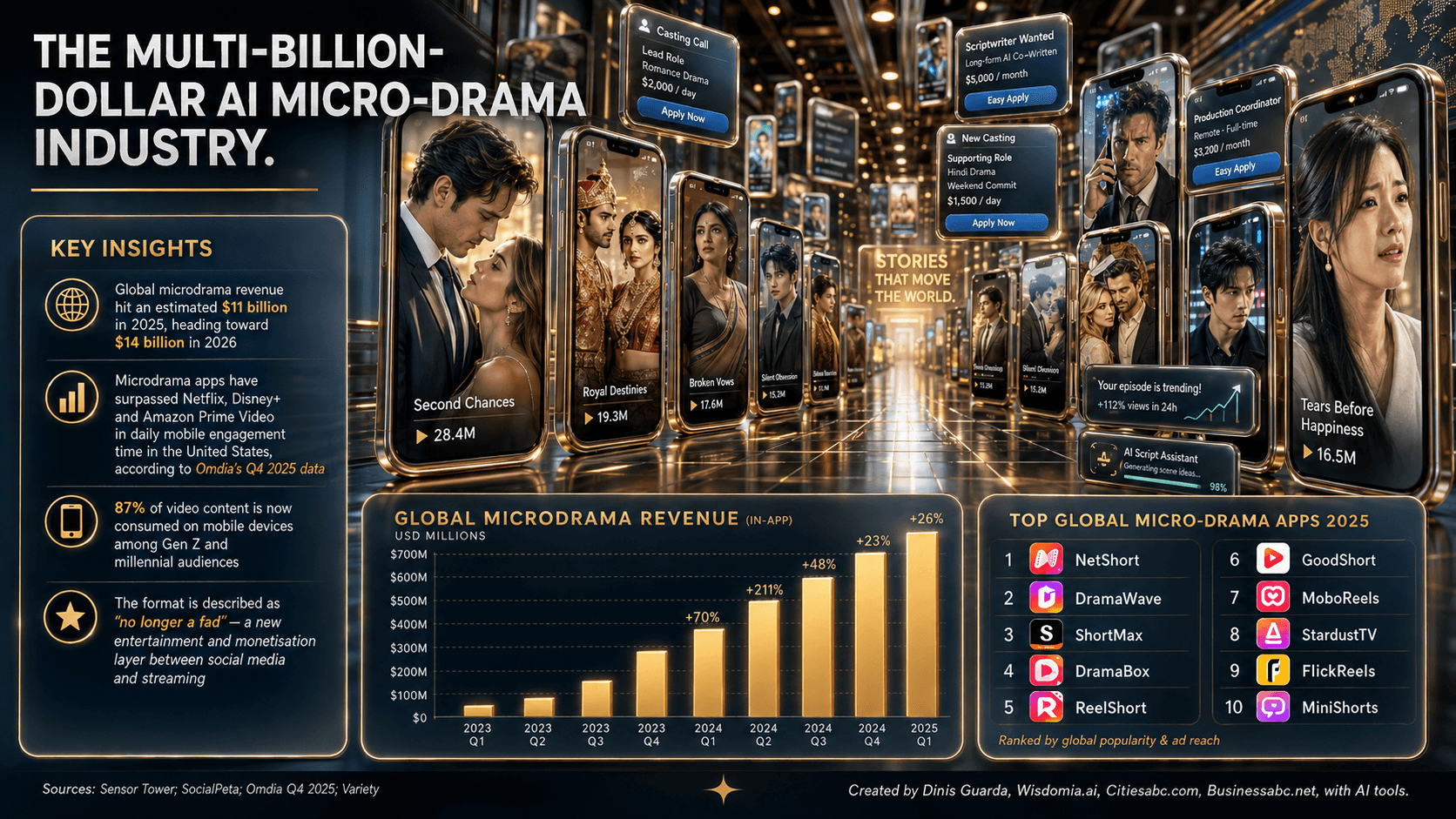
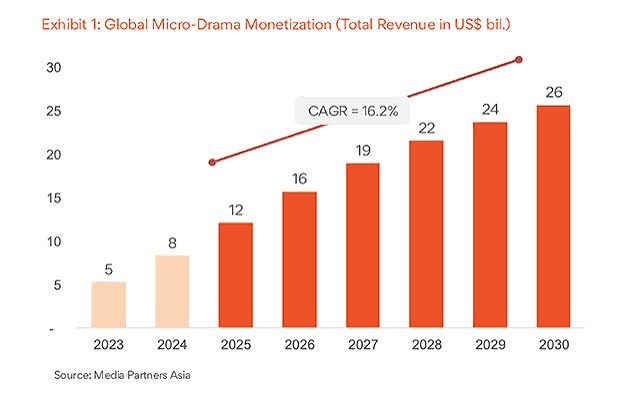
- The category is now material, not marginal. Global micro-drama revenues stood at roughly $11 billion in 2025 and are forecast to reach $26 billion by 2030, a compound annual growth rate of approximately 16 per cent.
- China crossed a symbolic threshold in 2025. Chinese micro-drama revenues climbed from $0.5 billion in 2021 to $7 billion in 2024, reached $9.4 billion in 2025, and are projected to exceed $16.2 billion by 2030. In 2025 the format surpassed China's domestic theatrical box office for the first time.
- The rest of the world is growing four times faster than China. Outside China, the market generated $1.4 billion in 2024 and is forecast to reach $9.5 billion by 2030 — a 28.4 per cent CAGR against China's 11.5 per cent.
- The United States is the most lucrative single market outside China, forecast to grow from $819 million in 2024 to $3.8 billion by 2030, with adoption driven by affluent urban women aged 30–60.
- Profitability is proven, not theoretical. DramaBox reported $323 million in revenue and $10 million in net profit for 2024, the clearest evidence that the unit economics closed.
- Scale is already vast. More than 830 million viewers consume micro-dramas globally, with around 60 per cent paying for access, and the category has passed 2.3 billion cumulative app downloads.
- AI has moved from experiment to slate strategy. Korea's Vigloo produced a fully AI-native 22-episode English-language series in eight weeks with fewer than ten people, and now targets roughly 30 per cent of its annual slate through AI-driven studio workflows.
- Audiences do not appear to punish synthetic performers. Shortical reported that audience response to its fully AI-generated series Bound by Fire was on par with its live-action titles.
- Cost collapse is the engine. India's Dashverse produced Raftaar, a 42-episode AI action series, for roughly ₹10–12 lakh against a conventional comparable of ₹80 lakh to ₹1 crore, a reduction of roughly 85–90 per cent, in three weeks rather than one to two months.
- Capital has arrived in a new form. Micro-drama platforms are being financed like mobile games, not studios: Shortical raised $100 million in non-dilutive user-acquisition financing from PvX Partners, following $25 million to StoReel and $14 million to Luni.
Definition: What a Micro-Drama Actually Is
A micro-drama is a serialised scripted narrative designed exclusively for vertical, mobile-first consumption. Its defining constraints are structural rather than thematic:
Attribute | Specification |
| Aspect ratio | 9:16, vertical, single-thumb operation |
| Episode length | 60–120 seconds; increasingly compressing toward 60 |
| Series length | 60–100 episodes (Western apps), 22–42 episodes (AI-native pilots) |
| Total runtime | 80–120 minutes — the length of a feature, atomised |
| Narrative unit | One reversal per episode, one hook per ending |
| Cast density | Rarely more than two faces in frame; the phone cannot hold a crowd |
| Monetisation | Free episodes 1–15; coin unlocks, rewarded ads or subscription thereafter |
The genre repertoire is deliberately narrow and deliberately universal: billionaire romance, secret heir, revenge on the family who wronged you, werewolf and vampire fantasy, time-travel redress, the wronged wife who returns transformed. These are not new. They are the load-bearing walls of folk narrative, Cinderella, the Count of Monte Cristo, the Ugly Duckling, the returning king, rebuilt for a device that fits in a pocket.

The "AI" distinction
An AI micro-drama is one in which generative models materially perform or assist the work of production: script generation, storyboarding, scene composition, synthetic performers, facial expression transfer, voice cloning, dubbing and localisation. Three tiers have emerged in practice:
- AI-assisted: human cast and shoot, AI used for localisation, ideation, marketing variants and post-production. The dominant model today.
- AI-hybrid: human screenwriters and directors, synthetic performers and environments. Shortical's Bound by Fire sits here.
- AI-native: the entire pipeline from script to voice performance is generative. Vigloo's Bloodbound Luna sits here.
The distinction matters enormously for law, for labour and for cost and we return to each in Parts II and III.
Origin: China's Duanju Engine and the Escape Velocity of a Format
The format did not emerge from film. It emerged from the collision of three Chinese ecosystems: web-novel publishing, mobile gaming monetisation and short-video distribution.
Web-novel platforms, China Literature, Tomato Novel, had already trained hundreds of millions of readers on serialised, chapter-locked, pay-to-continue narrative. Mobile gaming had perfected the coin economy. Douyin, WeChat Video Accounts and Kuaishou provided distribution with payment rails already embedded. Micro-drama is what you get when those three systems are wired together and pointed at melodrama.
Chen Bo, chief executive of Neorigin, has traced the format's evolution directly from gaming methodologies and web novels rather than from television. That lineage explains almost everything about how the business behaves: it commissions like a game studio, tests like a performance marketer and distributes like a social platform.

The scale achieved is difficult to overstate. Revenues moved from $0.5 billion in 2021 to $9.4 billion in 2025, an increase of roughly nineteen times in four years, and in doing so overtook the entire Chinese theatrical box office. By 2030, advertising is forecast to contribute 56 per cent of Chinese micro-drama revenues, subscriptions 39 per cent and commerce 5 per cent.
Vivek Couto, executive director of Media Partners Asia, delivered the sector's most quoted verdict at the point the numbers became undeniable: "It's no longer a fad." He characterises micro-drama as a new entertainment and monetisation layer sitting between social media and streaming.
That framing, a layer, not a genre, is the correct one, and it is why incumbents were slow to see it. Micro-drama did not attack television. It occupied the interstitial minutes that television never had a product for: the queue, the commute, the ten minutes before sleep.
The Numbers: Anatomy of a $26 Billion Category
| Metric | Value |
| Global revenues, 2025 | ~$11bn |
| Global revenues, 2030 (forecast) | ~$26bn |
| China, 2021 → 2024 → 2025 | $0.5bn → $7bn → $9.4bn |
| China, 2030 (forecast) | $16.2bn (11.5% CAGR) |
| Ex-China, 2024 → 2030 | $1.4bn → $9.5bn (28.4% CAGR) |
| United States, 2024 → 2030 | $819m → $3.8bn |
| Japan, 2030 (forecast) | >$1.2bn |
| Global viewers | >830m, ~60% paying |
| Cumulative category downloads | >2.3bn |
| Ex-China quarterly revenue, Q3 2025 | $800m (2× Q3 2024) |
Three structural facts deserve emphasis.
First, the growth is now outside China. A 28.4 per cent CAGR ex-China against 11.5 per cent inside it means the centre of gravity is migrating. China remains the largest single market and the source of the operating playbook, but the incremental dollar is increasingly American, Japanese, Korean, Indian and Latin American.
Second, the cost structure is inverted relative to traditional media. Couto's formulation is precise: production is cheap, distribution is expensive, and success depends on speed, scale, and repeatable IP. In cinema, the negative cost dominates. Here, customer acquisition cost dominates. This single inversion explains why micro-drama companies raise user-acquisition debt rather than slate finance, a point we quantify in Part III.
Third, profitability is demonstrated. DramaBox's $323 million revenue and $10 million net profit in 2024 is the proof point the category needed. Hernan Lopez of Owl & Co put the discipline plainly when assessing the new financing structures: "You have to prove the unit economics are there."

The Geography of Desire: Where the Format Lands and Why
Micro-drama does not travel uniformly. It travels along the grooves cut by payment infrastructure, gender demographics and existing serialised-reading cultures.
United States. The most lucrative ex-China market. Adoption is driven by affluent urban women aged 30–60, with romance, CEO storylines and revenge narratives dominating. DramaBox and ReelShort lead the app charts; DramaBox's participation in the Disney Accelerator signals major studio attention.
Japan. Forecast to become the largest APAC market outside China at over $1.2 billion by 2030, supported by LINE Pay integration and growing local production capacity. Japan's manga-and-serial reading culture is the deepest pre-existing substrate the format has found anywhere.
South Korea. Where AI-native production is furthest advanced commercially. Vigloo, operated by SpoonLabs and backed by an $86 million stake from games company Krafton, is applying K-drama craft to the vertical format. Krafton's thesis is instructive: the serial engagement loop of vertical drama resembles the engagement loop of a live-service mobile game closely enough that the same audience-building and monetisation logic transfers.
India. Officially still "exploratory" in MPA's assessment and simultaneously the most interesting laboratory in the world for AI-native production, which we examine in detail in Part III.
South-East Asia and Latin America. Identified as the strongest emerging growth territories. MPA analyst Myat Pan Phyu singles out Thailand for a 360-degree model distributing through both OTT apps and mobile networks with dual ad-and-subscription monetisation.
Africa. Barely measured, and therefore the most under-priced opportunity in the category. Adrian Cheng, chair of Crisp, described micro-drama as a phenomenon running from Seoul to São Paulo, noting that in Lagos comedians already thrive in two-to-three-minute vertical scripted video, and arguing that every frame is intentional, every moment carries intention.

Why Now: Four Converging Forces
The micro-drama could not have existed in 2015. Four curves had to cross.
1. The device became the theatre. Vertical video was a joke until it was 70 per cent of consumption. The phone did not adapt to cinema's grammar; cinema's grammar was discarded.
2. Payment rails collapsed into content. WeChat mini-programmes, in-app coin purchases, LINE Pay, rewarded video — the distance between "I want to know what happens" and "I have paid to know what happens" fell to roughly one second and one thumb-press. Desire and transaction became adjacent. That adjacency is the business model.
3. Attention restructured itself. I have argued in The 5th Industrial Revolution that the defining scarcity of our era is not compute, capital or even energy, but coherent human attention. Micro-drama is the first narrative form engineered natively for a fragmented attentional landscape rather than mourning it.
4. Generative models crossed the production threshold. Between 2024 and 2026, text-to-video and image-to-video systems moved from novelty to viable production tooling. The leading operators now build on video-generation engines capable of sustaining character consistency across shots — the single technical barrier that had kept synthetic drama out of commercial pipelines.
Each force alone would have produced a curiosity. Together they produced a category.
The Disruption Thesis: What Breaks, What Survives
Let me be ruthless about this, because the sector's promotional literature is not.
What breaks:
- The theatrical release window as a default. Not cinema itself — cinema will survive as ritual and as spectacle — but the assumption that a filmed story's natural first destination is a screen larger than a person.
- The crew as fixed cost. When a 42-episode action series can be produced for the cost of a single day of conventional car-stunt photography, the economic logic that sustained mid-tier production labour is dismantled, not adjusted.
- The gatekeeper's veto. Commissioning by taste is being replaced by commissioning by hook-rate. This is a genuine loss as well as a genuine democratisation, and honest analysis must hold both.
- Localisation as a cost centre. AI dubbing has turned a six-month, six-figure process into a 48-hour, four-figure one.
What survives and becomes more valuable, not less:
- Story architecture. Every operator interviewed across the trade press in 2026 converges on the same conclusion: the content lives and dies on a compelling story. The bottleneck has moved from execution to judgement.
- Taste. StoReel co-founder Angela Yu put it with unusual clarity: what's really going to be competitive is everybody's taste.When generation becomes free, discrimination becomes the scarce good.
- Trust and rights. As Part III sets out, the ability to prove you own what you made is becoming a balance-sheet item.
- The human face — conditionally. Audiences have shown they will accept synthetic performers when pacing holds. They have not yet shown they will love them.
There is a phrase I keep returning to, from Anne Chan of AR Productions, one of the sector's earliest operators, whose analysis of the economics is titled around a single warning: the Michelin approach will fail. It is the most useful sentence in the industry. Prestige logic — spend more, polish longer, win the review, is precisely inverted here. This is a business of velocity, iteration and portfolio, in which the quality bar is set by retention, not by craft consensus. Operators who import prestige instincts into a portfolio business will lose money with impeccable taste.
Cliffhanger: What Part II Opens
We have established what the format is, where it came from, how large it has become and why it arrived exactly now.
What we have not yet opened is the machine room, the part almost nobody outside the studios sees. How does a team of nine people produce twenty-two episodes of dark fantasy in eight weeks? How does a generative model keep a face the same across eight hundred shots? What does a minute of synthetic screen time actually cost in GPU hours, and where does that cost go?
Part II — The Machine Room: AI Production, Pipelines and Unit Economics takes the pipeline apart, layer by layer, from LoRA training to temporal deflickering, and reconstructs the true cost of a synthetic minute.
References
- Media Partners Asia, The Micro-Drama Economy, September 2025; reported in Deadline, "Micro-Drama Revenues In China Set To Exceed Box Office In 2025." https://deadline.com/2025/09/micro-drama-revenue-china-exceed-box-office-mpa-1236545453/
- "Micro Drama Distribution Platforms 2026," citing Media Partners Asia and Owl & Co. https://vitrina.ai/blog/micro-drama-distribution-platforms-2026/
- Variety, "Inside the $26 Billion Global Microdrama Boom Reshaping Entertainment," November 2025. https://variety.com/2025/tv/news/global-microdrama-boom-1236560947/
- World Screen, "Micro-Drama Market Ex-China Projected to Top $9 Billion," September 2025. https://worldscreen.com/micro-drama-market-ex-china-projected-to-top-9-billion/
- Exchange4media, "US micro-drama market on track to reach $3.8bn by 2030," September 2025. https://www.exchange4media.com/media-others-news/us-micro-drama-market-on-track-to-reach-38-bn-by-2030-report-147529.html
- Variety, "Microdramas Eyes $26 Billion Future at Crisp's Seoul Conference," November 2025. https://variety.com/2025/tv/news/microdrama-26-billion-future-crisp-seoul-conference-1236584525/
- Business Wire, "Vigloo Debuts Fully AI-Produced English-Language Supernatural Microdrama," 10 March 2026. https://www.businesswire.com/news/home/20260310243745/en/
- AOL / Business Insider, "AI actors helped this micro drama app raise $100 million in financing," 1 July 2026. https://www.aol.com/articles/ai-actors-helped-micro-drama-100001000.html
- Business Standard, "Dashverse plans to release 100 microdramas produced by AI," September 2025. https://www.business-standard.com/companies/news/dashverse-to-launch-100-ai-microdramas-with-frameo-ai-platform-125090900320_1.html
- C21Media, "Microdrama platform Shortical secures $100m financing from PvX Partners," July 2026. https://www.c21media.net/news/microdrama-platform-shortical-secures-100m-financing-from-pvx-partners/
- Maureen Kerr, "Vertical Drama Is Splitting in Two," March 2026. https://maureenkerr.substack.com/p/vertical-drama-is-splitting-in-two
- TheWrap, "Could AI-Generated Microdramas Be the Future of Mobile Entertainment?", June 2026. https://www.thewrap.com/media-platforms/tv/ai-generated-microdramas-could-be-the-future-of-mobile-entertainment/
- Patrick Frater and Janine Stein, Two The Point, "Micro Dramas: How to Tame a Billion $$$ Business," with Anne Chan, CEO, AR Productions; produced by ContentAsia and F Media, 8 April 2026. https://patrickfrater.substack.com/p/micro-dramas-how-to-tame-a-billion
- TODAY, "How AI is transforming the way China's microdramas are made." https://www.today.com/video/how-ai-is-transforming-the-way-china-s-microdramas-are-made-266943045834
Share this

Dinis Guarda
Author
Dinis Guarda is an author, entrepreneur, founder CEO of ztudium, Businessabc, citiesabc.com and Wisdomia.ai. Dinis is an AI leader, researcher and creator who has been building proprietary solutions based on technologies like digital twins, 3D, spatial computing, AR/VR/MR. Dinis is also an author of multiple books, including "4IR AI Blockchain Fintech IoT Reinventing a Nation" and others. Dinis has been collaborating with the likes of UN / UNITAR, UNESCO, European Space Agency, IBM, Siemens, Mastercard, and governments like USAID, and Malaysia Government to mention a few. He has been a guest lecturer at business schools such as Copenhagen Business School. Dinis is ranked as one of the most influential people and thought leaders in Thinkers360 / Rise Global’s The Artificial Intelligence Power 100, Top 10 Thought leaders in AI, smart cities, metaverse, blockchain, fintech.
More Articles

Beeple’s ‘Diffuse Control’ Brings AI-Powered Art to MMoCA

Blenheim Palace Brings Megalosaurus to Life Through Art, Science and Engineering

Architecture of Movement: What Deserts, Nomads and World Heritage Teach Us About Belonging
The Spiritual Meaning of the AI Singularity: What Remains Human in the Age of Artificial Intelligence?
About
Where Wisdom Meets AI Utopia Edutainment
Wisdomia.ai is a 3D AI edutainment platform that seamlessly blends learning with immersive play. As the first AI-powered 3D Web 3.0 marketplace created by creators for creators. Founded by renowned serial entrepreneur and author Dinis Guarda, Wisdomia empowers individuals to flourish in an ecosystem designed for collective wisdom EQ. Join us in shaping humanity's future as we harness the power of AI to visualise and create a better world—where technology serves human potential, and innovation is guided by utopian wisdom.
Contact us
Produced by

