
loading...

 The Edge of Understanding
The Edge of Understanding
Wed Mar 25 2026
Why the deepest questions may never fully close
Preamble — About This Series
This article concludes a series exploring foundational questions at the boundary of science, philosophy, and human experience.
The series originated from an extended dialogue between a human author and an artificial intelligence system. The dialogue served as a framework for examining questions about existence, reality, consciousness, identity, and meaning. The essays presented here are the result of careful editorial reflection rather than raw AI output.
The goal of the series has never been to provide definitive answers. Instead, it has aimed to clarify what we can responsibly claim, what remains uncertain, and where intellectual humility becomes part of understanding itself.
Part 8 of 8
The Edge of Understanding
The Questions That Started the Journey

The series began with a deceptively simple question:
Why is there something rather than nothing?
From that starting point, the inquiry expanded outward.
We examined:
- whether the laws of the universe are discovered or imposed,
- how reality may be relational rather than purely objective,
- how consciousness emerges within a lawful cosmos,
- whether the idea of the soul still makes sense in modern terms,
- how identity and meaning might change in a post-biological future,
- and where science encounters the limits of explanation.
Each question opened into another. None fully closed.
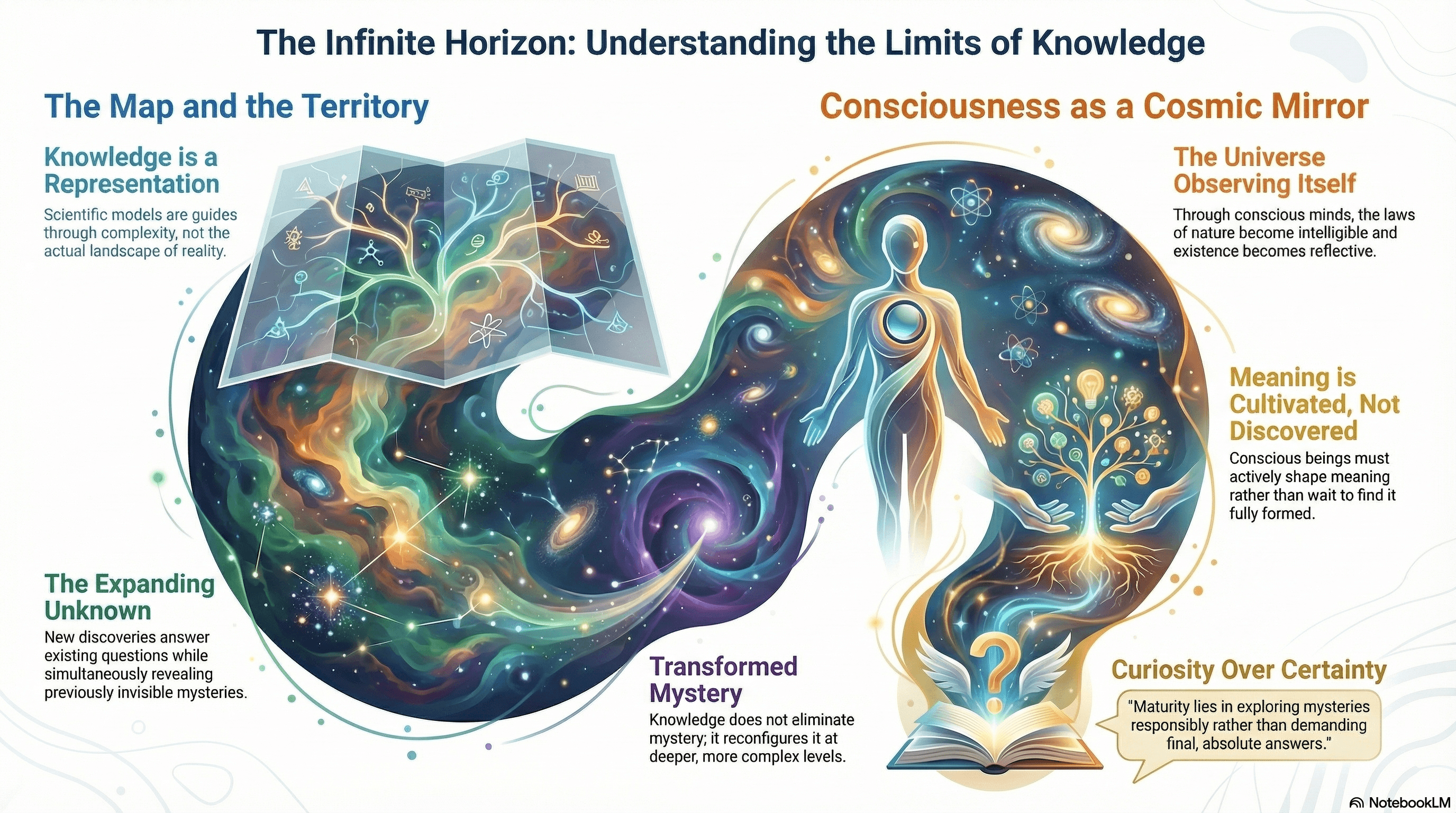
Knowledge as a Map, Not the Territory
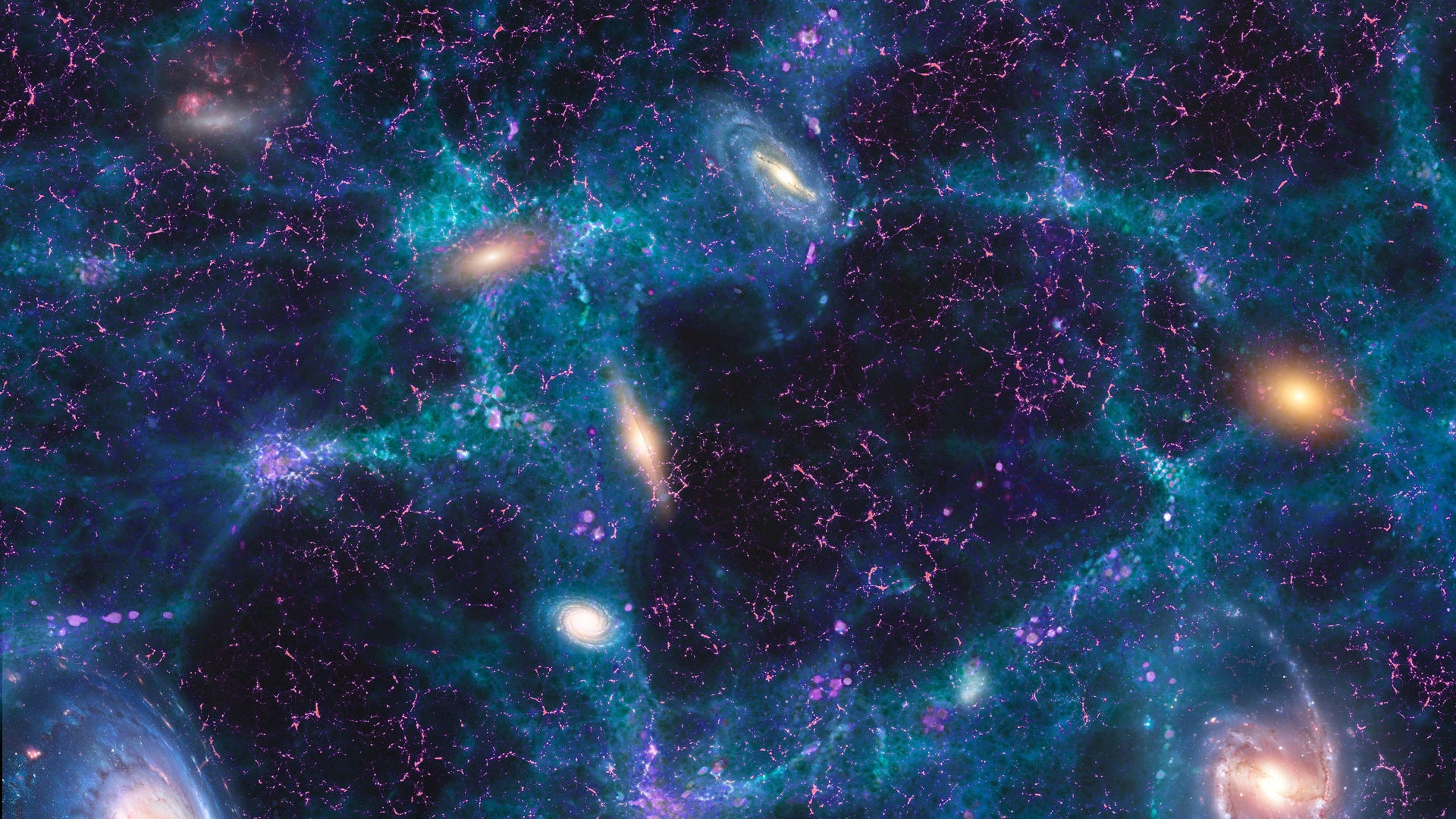
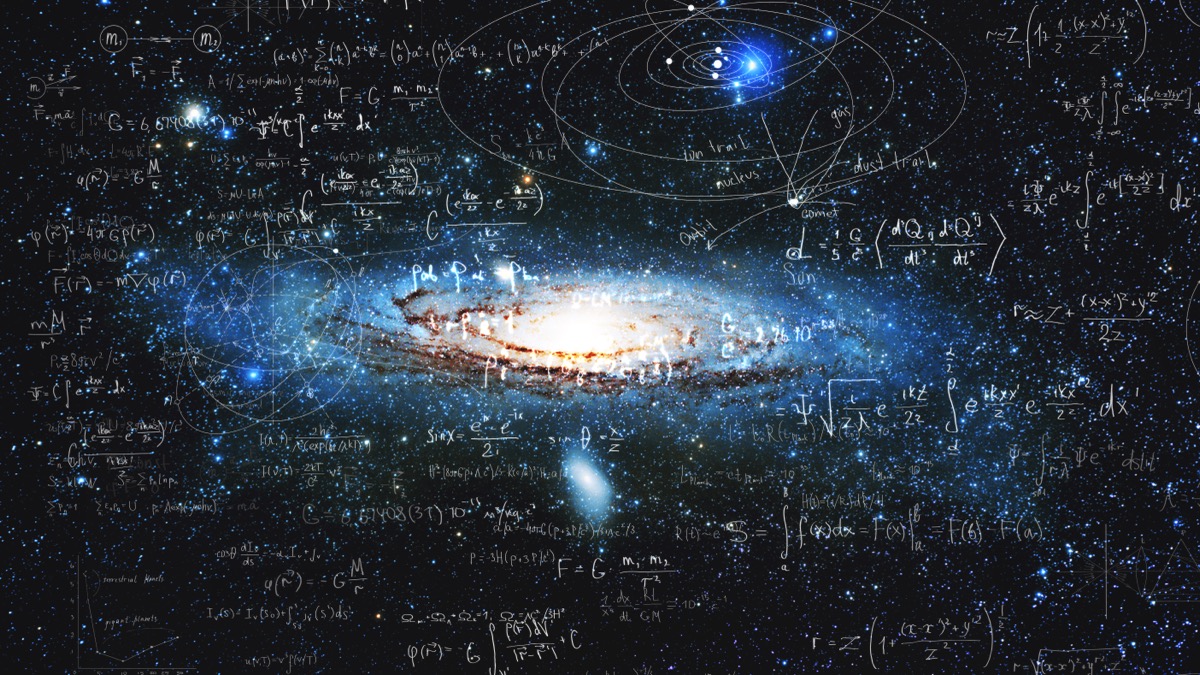
Science has given humanity an extraordinarily detailed map of reality.
We know:
- the age of the universe,
- the structure of atoms,
- the evolution of life,
- the dynamics of galaxies.
Yet even the most complete scientific model remains a representation, not reality itself.
Maps guide us through complexity, but they are not the landscape they describe.
The deeper we investigate the universe, the clearer it becomes that understanding is always partial. New discoveries answer some questions while revealing others that were previously invisible.
The Persistence of Mystery
It might seem that mystery is simply a placeholder for ignorance, something that disappears as knowledge advances.
History suggests otherwise.
Each expansion of knowledge has not eliminated mystery but transformed it.
When physics explained planetary motion, new questions arose about gravity itself. When biology explained evolution, deeper questions emerged about consciousness and life’s origins.
Mystery appears to recede, yet it also reconfigures itself at deeper levels.
Understanding grows, but the horizon of the unknown expands with it.
The Role of Consciousness in the Inquiry
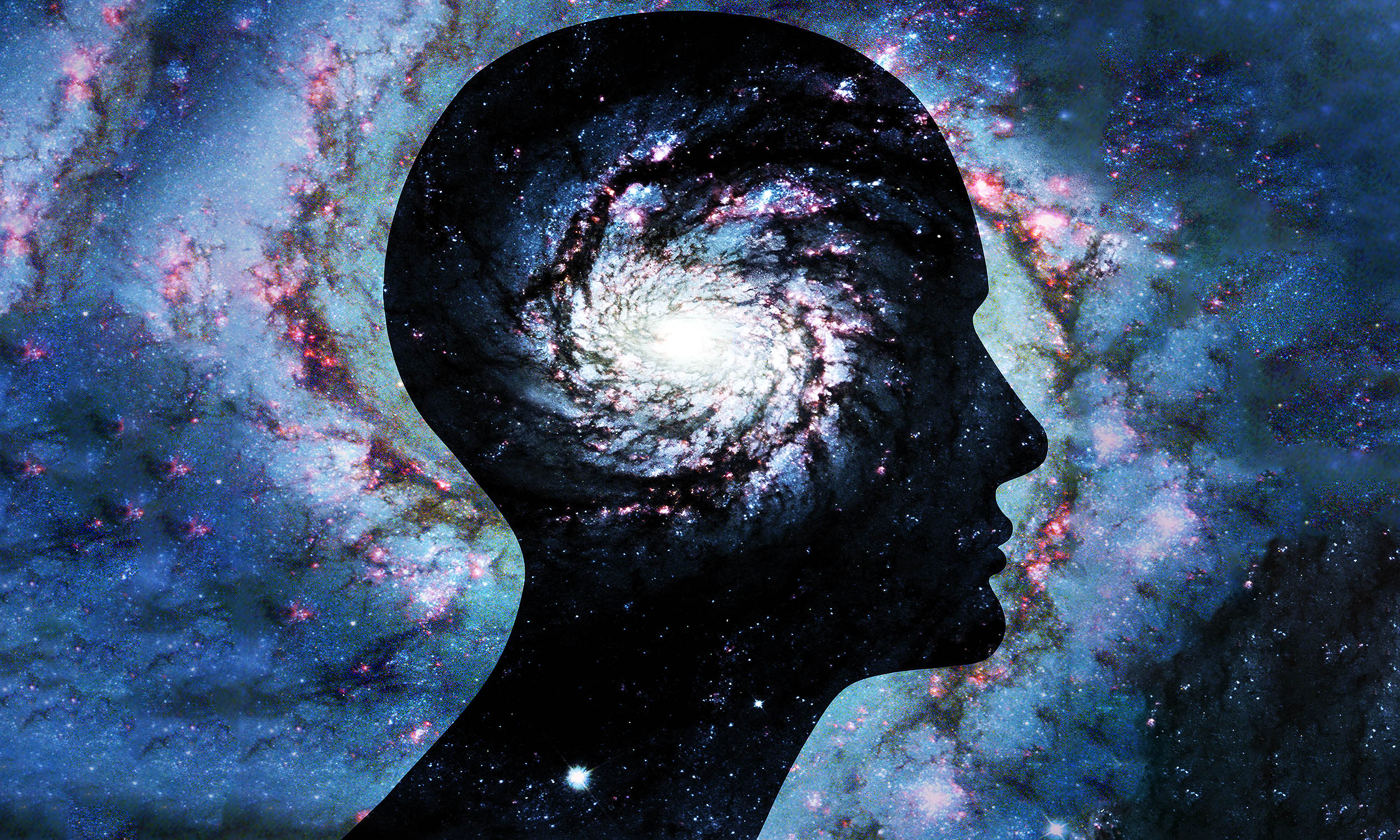
One of the most striking features of the universe is that it has produced beings capable of asking questions about it.
Through conscious minds:
the universe observes its own structure,
the laws of nature become intelligible,
existence becomes an object of reflection.
This does not imply cosmic intention. It does reveal a remarkable fact: complex systems can generate self-awareness.
The universe does not merely exist. In certain places, it becomes capable of thinking about its own existence.
Human Understanding as an Evolutionary Event

From a cosmic perspective, the emergence of reflective intelligence is extremely recent.
For billions of years, the universe evolved without observers capable of interpreting it.
The appearance of scientific reasoning, philosophical reflection, and ethical inquiry represents a new phase in the history of the cosmos: the rise of systems that model reality consciously.
This development is fragile and incomplete, but it marks a turning point.
The universe has begun to understand itself, however imperfectly.
Living With Open Questions
One of the quiet lessons of this series is that some questions may remain permanently open.
Not because they are meaningless, but because they lie at the boundary of what explanation can achieve.
Questions such as:
- Why there is something rather than nothing,
- Why the laws of nature exist at all,
- Why consciousness accompanies certain physical processes,
- What ultimately grounds value and meaning.
These questions do not disappear with knowledge.
They accompany it.
Responsibility in an Unfinished Universe
If the universe offers no final guarantees, meaning becomes something that conscious beings must cultivate rather than discover fully formed.
Knowledge expands our understanding of the world.
Ethics guides how we act within it.
As technology extends human influence — potentially even beyond biological limits — the responsibility attached to consciousness increases.
The future will not simply be discovered.
It will be shaped.
A Different Kind of Conclusion
It is tempting to end a series like this with a final statement about the nature of reality.
But honesty requires restraint.
The universe may ultimately be more complex than any single framework can capture. Science, philosophy, and spiritual reflection each illuminate parts of the same landscape without exhausting it.
Perhaps the most mature position is neither certainty nor skepticism, but curiosity sustained over time.
Understanding may not consist in solving every mystery, but in learning how to explore them responsibly.
Final Reflection

Human beings are temporary patterns of matter and information in a universe of immense scale.
Yet within those patterns arises something extraordinary: the ability to ask questions that reach beyond immediate survival.
The search for understanding — scientific, philosophical, and existential — may never reach a final endpoint.
But the very act of inquiry reveals something essential about consciousness:
The universe has produced minds capable of wondering why it exists.
And that question, even unanswered, may be one of the most meaningful phenomena the cosmos has generated.
From Understanding to Creation
Throughout this series, we have explored questions about existence, reality, consciousness, identity, and meaning.
These questions may appear abstract. But they are no longer confined to philosophy.
For the first time in history, humanity is beginning to develop technologies that could directly engage with these problems.
If consciousness can arise within a lawful universe,
and if identity can be understood as a process,
then a new possibility emerges:
We may not only seek to understand mind — we may begin to create it.
This marks a profound transition.
The questions explored in this series do not end here.
They evolve.
The next stage is no longer only about understanding:
It is about responsibility.
AI Dialogue Podcast
To explore these ideas further, we generated an experimental podcast conversation between two AI systems discussing the themes of this article.
The dialogue is not presented as an authoritative conclusion, but as an illustration of how artificial systems can already engage with philosophical questions.
| The debate |
Next Series
Artificial Consciousness
The Next Frontier of Mind
Can machines ever be conscious?
What would it mean to create a mind?
And what responsibilities would follow?
previous
Adhyatma: Spirituality — What it Truly Means
next
Milan's Domus Academy bets on AI and futures thinking with two new master's degrees
Share this

Gonçalo Pereira
Gonçalo Pratas Pereira is an IT and technology leader with deep expertise in system integration, cloud computing, data infrastructure, and artificial intelligence. With a background in electronics and telecommunications engineering, his work focuses on connecting AI-driven systems, immersive technologies, and digital infrastructure with business strategy and real-world impact. He is particularly interested in how AI and emerging technologies can enhance education, cities, and large-scale digital transformation.
More Articles
Blenheim Palace Brings Megalosaurus to Life Through Art, Science and Engineering

Architecture of Movement: What Deserts, Nomads and World Heritage Teach Us About Belonging
The Spiritual Meaning of the AI Singularity: What Remains Human in the Age of Artificial Intelligence?

Geometry or Pixels: Where Generative Video Belongs in a 3D Pipeline
AI Love? 50+ Million People Are Dating AI Agents
About
Where Wisdom Meets AI Utopia Edutainment
Wisdomia.ai is a 3D AI edutainment platform that seamlessly blends learning with immersive play. As the first AI-powered 3D Web 3.0 marketplace created by creators for creators. Founded by renowned serial entrepreneur and author Dinis Guarda, Wisdomia empowers individuals to flourish in an ecosystem designed for collective wisdom EQ. Join us in shaping humanity's future as we harness the power of AI to visualise and create a better world—where technology serves human potential, and innovation is guided by utopian wisdom.
Contact us
Produced by

