
loading...
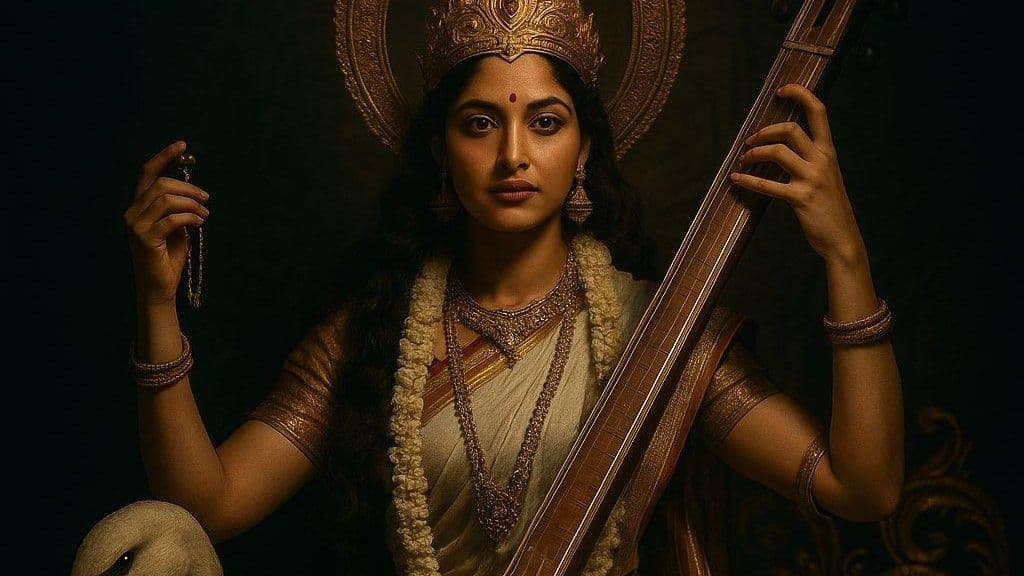


Saraswati, a revered deity in Hinduism, embodies the essence of knowledge, wisdom, music, arts, speech, learning, and consciousness. Her significance transcends time, from the Vedic period to the present.
Introduction
Saraswati embodies the essence of knowledge, wisdom, music, arts, speech, learning, and consciousness. Her significance transcends time, from the Vedic period to the present. Once associated with the sacred Saraswati River, she now symbolizes intellect and creativity. As one of the three principal goddesses in the Tridevi, alongside Lakshmi and Parvati, her presence is powerful and inspiring. Depicted as a graceful white woman, she radiates purity and truth. As the embodiment of divine energy, Saraswati is vital in nurturing knowledge, education and culture within the Hindu tradition, inspiring us all with her profound influence.
The Significance of Names
Saraswati, whose name is derived from the Sanskrit words "saras," meaning "flow," and "wati," meaning "possessing," translates to "She who possesses the flow." This name beautifully symbolizes the continuous flow of knowledge and wisdom. Known by several other names, she embodies a profound connection to intellect and creativity. The etymology of her name not only links her to the sacred Saraswati River, a river revered in Hindu mythology, but also serves as a powerful reminder of the ever-flowing nature of wisdom.
- Bharati: The embodiment of eloquence and speech.
- Vani/Vagdevi: The divine goddess of speech.
- Sharada: The ultimate bestower of knowledge and learning.
- Brahmi or Brahmasvarupini: Brahma's divine form and power are linked to ancient scripts.
- Savitri: A radiant beam of light reflects a profound Vedic mantra, a sacred hymn that Saraswati is believed to have inspired and which is dedicated to her. This association with the Vedic mantra further underscores her role as the embodiment of knowledge and spirituality.
- Gayatri: The powerful meter of a revered Vedic mantra, revered as a goddess in her own right.
- Mahavidya: The essence of excellent knowledge.
- Kalaimagal: The majestic queen of the arts, celebrated in Tamil culture.
These names celebrate her diverse attributes, illuminating the many facets of her divine nature, which is deep and complex, just like the knowledge and wisdom she symbolizes.
Appearance/ Iconography
Saraswati is depicted as a serene and graceful goddess, often seated on a white swan or a lotus. Her portrayal exudes a captivating beauty and elegance, serving as a powerful inspiration that transcends cultural boundaries.
- White: the color of her garments and the lotus she sits on, symbolizes purity, truth, and enlightenment, casting a radiant light that uplifts and enlightens.
- Four Arms: These arms embody the four facets of human personality in learning: mind, intellect, alertness, and ego, while also representing the wisdom of the four Vedas.
- Veena, a musical instrument: As she plays the veena, this classical Indian stringed instrument, she symbolizes her mastery over the arts and music, embodying the harmony of the universe.
- Book/Manuscript: This signifies the essence of knowledge and learning, with a rosary emphasizing the contemplation of wisdom and the sacred teachings of the Vedas.
- Rosary (Akshamala): Represents the depth of meditation, spirituality, and the power of focused concentration.
- The water pot (Kamandalu): she holds symbolizes purity and the transformative power to cleanse thoughts and actions, offering a rejuvenating cleanse to the mind and spirit.
- Lotus: Seated upon a white lotus, she represents the journey toward the Absolute Truth and the blossoming of profound knowledge.
- Swan (Hamsa): Her traditional mount symbolizes discernment, the ability to distinguish between right and wrong, and the purity of knowledge. Occasionally, a peacock is also portrayed, representing transcendence over ego and pride. The peacock, with its ability to eat poisonous snakes and transform them into nourishment, symbolizes the power of Saraswati to transform negative qualities like ego and pride into wisdom and knowledge.
- Crescent Moon: Often depicted with a crescent moon on her forehead, signifying tranquillity and balance.
Historical Narratives and Roles
Saraswati embodies a rich tapestry of historical and mythological narratives rooted in Vedic traditions. In the Rigveda, she is revered as a mighty river and a goddess, often recognised as the 'most powerful' of the Vedic rivers. As her significance evolved, she transformed from a river goddess to a symbol of wisdom and learning. This transition can be understood as a reflection of the Vedic people's growing appreciation for the importance of knowledge and learning in their society. She became closely associated with Brahma, the creator god, emerging from his mouth and symbolising the primordial sound and the inception of all knowledge.
Her influence extends to the realms of language, arts, and creativity. She granted divine knowledge to sages and inspired remarkable works across literature, art, and music. Initially celebrated in the Rigveda for her associations with fertility and purification, her identity grew in prominence within post-Vedic texts, such as the Brahmanas, Aranyakas, Upanishads, and epics, where her connections to wisdom, speech (Vac, a personification of speech), and the arts came to the forefront.
Later narratives in the Puranas discuss her birth and her relationship with Brahma, often portraying her as his consort or as a mind-born daughter. This concept of a 'mind-born daughter' refers to a being created from the thoughts or mind of a deity, in this case, Brahma. Saraswati was created to assist him in creating by imparting wisdom and language. Thus, Saraswati occupies a central role, bridging the sacred and the creative, nurturing the mind and the spirit to pursue knowledge and artistic expression.
- Goddess of Knowledge and Wisdom: The ultimate source of all forms of knowledge, both sacred and secular, she illuminates the path to understanding.
- Goddess of Speech and Language: As the creator of Sanskrit, she embodies eloquence and graceful communication.
- Goddess of Music and Arts: She ignites the spark of creativity in music, dance, painting, and all artistic pursuits.
- Mother of the Vedas: Saraswati is revered in some texts as the divine mother of the sacred Vedas, the very foundation of Vedic knowledge and wisdom.
- Guardian of Learning: Saraswati inspires students, scholars, teachers and artists who seek her blessings for success and enlightenment in their academic and creative journeys.
Regional Variance
Worship and traditions surrounding Saraswati inspire diverse expressions across various regions of India and beyond. Her reverence transcends geographical boundaries, uniting us in a rich tapestry of practices and representations unique to each locale. In northern and western India, her veneration shines brightly, with dedicated temples in places like Jammu, Kashmir and Rajasthan as testaments to her enduring impact.
- West Bengal: Saraswati Puja, a celebration of knowledge, holds a special place in the hearts of students. The installation of idols and offering books, inkpots, and musical instruments symbolise the quest for wisdom. The cultural programs that accompany the puja serve as a unifying force, bringing communities together in a shared reverence for learning.
- South India (Tamil Nadu, Karnataka, Kerala): Saraswati, known as Vagdevi, is a symbol of education and intellectual growth. Her worship during Navaratri is a testament to the importance of learning, with Kerala's 'Vidyarambham' serving as a sacred initiation into knowledge. The Ayudha Puja, a celebration of the tools and instruments that fuel our creativity, further underscores her cultural significance.
- Maharashtra: During Navaratri, Saraswati Puja is embraced with heartfelt devotion, honouring books and musical instruments that inspire and uplift, a tradition that continues to hold significant meaning in the hearts of the people.
- Uttar Pradesh: This day radiates positivity and hope, and it is celebrated amid the vibrant festivities of Vasant Panchami, with bright yellow attire, special prayers, and the joyous spirit of kite flying, uplifting the spirits of all who partake in the celebrations.
- Other Regions: Across various cultures, the essence remains the same: setting up idols or images, offering yellow flowers and sweets, chanting mantras, and seeking blessings for knowledge and creativity.
- Outside India: Saraswati's influence transcends borders. It is recognised in Buddhist and Jain traditions and revered in different forms in Myanmar (Thurathadi), China (Biancaitian), Japan (Benzaiten), and Thailand (Suratsawadi), inspiring countless hearts worldwide.
Incarnations
Saraswati, primarily revered in her main form, is inspired through her various aspects and manifestations within Hindu philosophy and mythology. As the consort of Lord Brahma, she complements him beautifully in creating the universe. Embodying Shakti, she represents the divine feminine energy, a powerful force of creation. In her incarnation as Vagdevi, she plays a vital role in the sacred creation, preservation, and dissolution processes, harnessing the transformative power of speech and wisdom to empower and inspire.
- In Shaktism, a major tradition within Hinduism that focuses on the worship of Shakti, particularly in the Devi Mahatmya, Saraswati is revered as a powerful, eight-armed warrior goddess who embodies the strength to vanquish asuras (demons) and inspire resilience.
- Brahmani: In Shaktism, she is a Matrika (mother goddess) who signifies the divine power of Brahma and is a beacon of knowledge, guiding all who seek wisdom and enlightenment.
- Neela Saraswati (Tara Mahavidya): In certain Tantric traditions, she shines forth in her fierce form, representing transcendental knowledge and the triumph over obstacles, encouraging us to rise above.
- Savitri and Gayatri: In various regions and texts, these goddesses are seen as twin identities, their essence reflecting the radiant power of the sun and the sacred Vedic mantras that uplift the spirit.
- Vidhya Saraswati/Sharadamba: Local manifestations revered in specific temples, such as those in Basara, Warangal, and Sringeri, serve as vital connections to the divine, inspiring devotion and learning.
Text or epic-associated
Saraswati, the revered goddess of wisdom and knowledge, is prominently mentioned in ancient texts and epics such as the Rigveda, Mahabharata, and Puranas. At the heart of her worship is the Saraswati Vandana, a powerful prayer cherished by students, teachers, musicians, and artists across India. This hymn celebrates her as the ultimate source of learning and intellectual achievement. Saraswati symbolises intellect and culture, and her influence transcends time and geography, continuously inspiring individuals worldwide in their quest for knowledge and enlightenment. Her wisdom has a universal appeal, inspiring and motivating people from all walks of life.
- Rigveda: The earliest mention of Saraswati shines as a revered river goddess who is celebrated for her wisdom and strength.
- Vedas (in general): She embodies the essence of sacred knowledge and is honoured as the mother of the Vedas.
- Mahabharata: Invoked for wisdom and guidance, she is depicted as the Vedas's mother and Krishna's voice.
- Ramayana: While her presence is subtle, her blessings resonate in Lord Ram's noble deeds and wisdom.
- Puranas: Many Puranas narrate her birth and her profound relationship with Brahma, portraying her vital roles in the cosmos. The Vishnu Purana emphasises her as a fountain of knowledge and a divine figure linked to learning and creativity.
- Upanishads: In philosophical discussions, she inspires the quest for knowledge as a guiding muse.
- Devi Mahatmya and Devi Bhagavata Purana: In Shaktism, these texts elevate her to the status of the supreme goddess (Devi) and reveal her powerful manifestations.
- Classical Literature: Frequently invoked at the start of Sanskrit texts, she is the goddess of learning and eloquence.
Her engagement with these texts underscores her vital role in preserving Hinduism's rich intellectual, spiritual, and cultural heritage. Often regarded as sacred, these writings illuminate profound philosophical concepts while offering insights into rituals and ethics. Through her work, she deepens our understanding of the beliefs that have inspired millions over centuries, emphasising the connection between historical context and modern interpretations within Hindu communities.
References
Encyclopedic and General Knowledge Sources
Wikipedia – Saraswati
https://en.wikipedia.org/wiki/Saraswati
Wikipedia – Vasant Panchami
https://en.wikipedia.org/wiki/Vasant_Panchami
Wikipedia – Tridevi
https://en.wikipedia.org/wiki/Tridevi
Britannica – Sarasvati
https://www.britannica.com/topic/Sarasvati-Hindu-goddess
Institutional & Museum Sources
British Library – Hindu Deities in Manuscripts
https://www.bl.uk/collection-guides/hindu-deities-in-manuscripts
Ancient Indian Wisdom – Iconography of Sarasvati
https://ancientindianwisdom.com/culture-overview/iconography-of-sarasvati
Sacred Texts & Scriptural Databases
Internet Sacred Text Archive – Hinduism Collection
https://www.sacred-texts.com/hin/index.htm
Bharatavani – Digital Library of Indian Knowledge
https://bharatavani.in/
Wisdom Library – Devi Bhagavata Purana
https://www.wisdomlib.org/hinduism/book/devi-bhagavata-purana
Devotional, Cultural & Community Sources
Srichants – Saraswati in the Vedas
https://srichants.in/saraswati-in-vedas-the-origins-saraswati-goddess/
Srichants – Saraswati’s Role in the Creation of the Vedas
https://srichants.in/saraswatis-role-in-the-creation-of-the-vedas/
Manidvipa – Saraswati
https://www.manidvipa.in/saraswati
Share with friends
Saraswati, a revered deity in Hinduism, embodies the essence of knowledge, wisdom, music, arts, speech, learning, and consciousness. Her significance transcends time, from the Vedic period to the present.
Weapon
None (symbolic Veena)
Symbol
Veena, Book, Swan, White Lotus
Mount
Swan or Peacock
Consort
Brahma
Festivals
Vasant Panchami


About
Where Wisdom Meets AI Utopia Edutainment
Wisdomia.ai is a 3D AI edutainment platform that seamlessly blends learning with immersive play. As the first AI-powered 3D Web 3.0 marketplace created by creators for creators. Founded by renowned serial entrepreneur and author Dinis Guarda, Wisdomia empowers individuals to flourish in an ecosystem designed for collective wisdom EQ. Join us in shaping humanity's future as we harness the power of AI to visualise and create a better world—where technology serves human potential, and innovation is guided by utopian wisdom.
Contact us
Produced by

