
loading...

 Death, Identity, and Meaning in a Post-Biological Future
Death, Identity, and Meaning in a Post-Biological Future
Wed Mar 11 2026
What happens to value when mortality is no longer inevitable?
Preamble — About This Series
This article is part of a series that explores foundational questions at the boundary of science, philosophy, and human experience.
The series emerged from an extended dialogue between a human author and an artificial intelligence system. That dialogue served as a space for careful questioning, conceptual testing, and intellectual refinement. The texts presented here are not raw AI outputs, but curated essays shaped through human editorial judgment.
The aim is not to provide final answers, but to clarify what we can reasonably claim, what remains unresolved, and where intellectual honesty requires restraint rather than speculation.
Part 6 of 8
Death, Identity, and Meaning in a Post-Biological Future
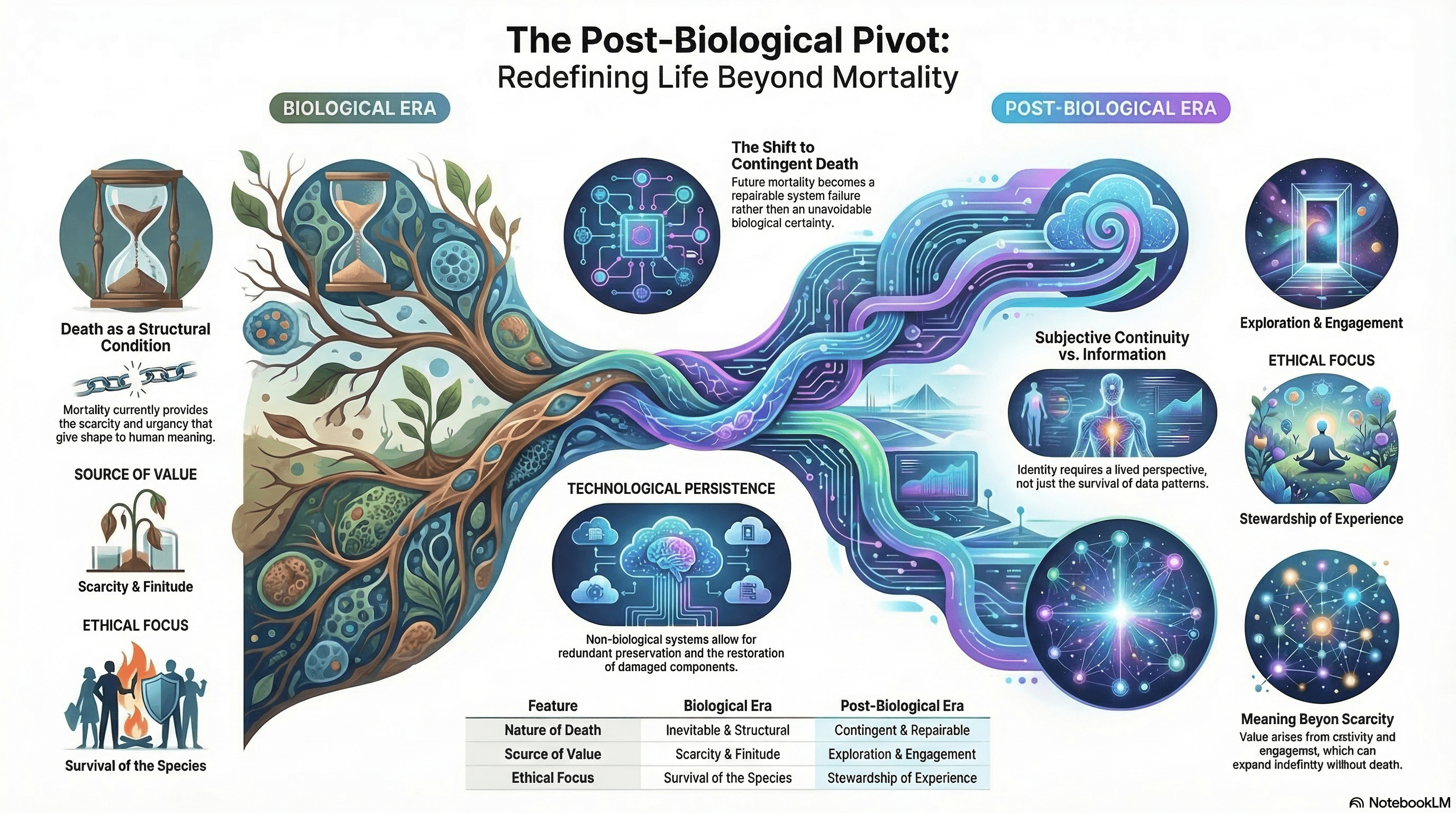
The Historical Role of Death
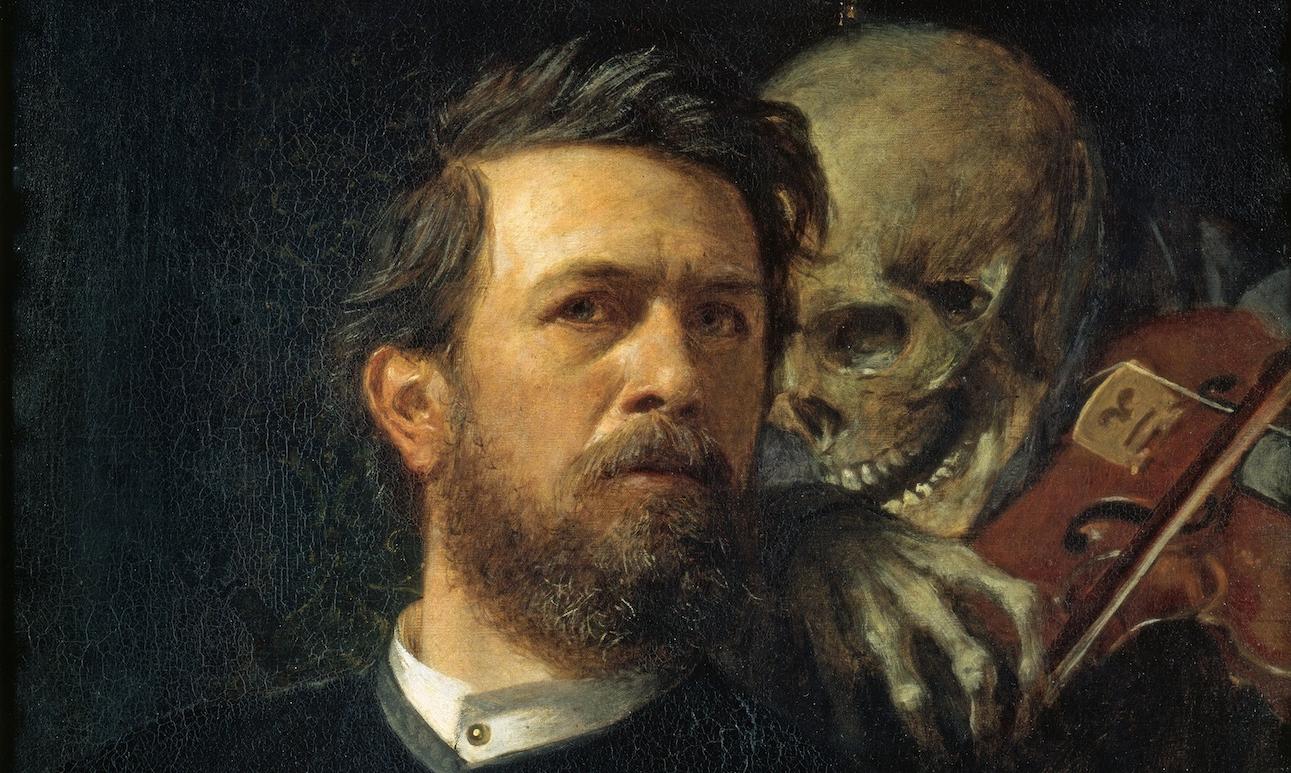
For most of human history, death has not merely been a biological event. It has been the horizon that gives shape to life itself.
Mortality influences:
- urgency,
- responsibility,
- memory,
- and the meaning we attach to our actions.
We plan because time is limited.
We value relationships because they cannot last indefinitely.
We reflect on legacy because existence appears temporary.
In this sense, death has functioned not only as an ending, but as a structural condition of meaning.
The possibility that death might not remain inevitable therefore raises a profound question:
If mortality changes, what happens to meaning?
A Post-Biological Horizon

Recent advances in neuroscience, biotechnology, and artificial intelligence have revived a possibility once confined to speculative thought: that consciousness may not always remain tied to biological organisms.
If identity depends on patterns of information and integrated processes rather than on carbon chemistry specifically, then in principle those patterns might persist in other substrates.
This possibility remains uncertain. But even as a theoretical scenario, it forces us to reconsider the relationship between identity and mortality.
If conscious processes could be preserved, repaired, or migrated, death might cease to be structurally unavoidable.
The Transformation of Mortality

In such a future, death would not necessarily disappear. Instead, its role would change.
Biological organisms face inevitable decay. Entropy gradually erodes the structures required for life.
In non-biological or hybrid systems, however, many forms of failure could become repairable:
- damaged components could be replaced,
- information could be redundantly preserved,
- systems could be restored without interrupting their overall function.
Death would shift from being inevitable to being contingent.
It would remain possible, but no longer unavoidable.
The Fragility of Identity

Even in such a future, the deeper philosophical challenge remains.
If a conscious system is copied, transferred, or reconstructed, several questions arise:
- Is the resulting system the same person?
- Does identity require uninterrupted causal continuity?
- Can duplication preserve a single self?
These questions reveal that the core issue is not merely the survival of information, but the persistence of subjective continuity.
A perfect copy may reproduce structure without preserving the lived perspective that makes an individual life feel continuous.
Technological persistence does not automatically guarantee existential continuity.
Would Meaning Collapse Without Death?
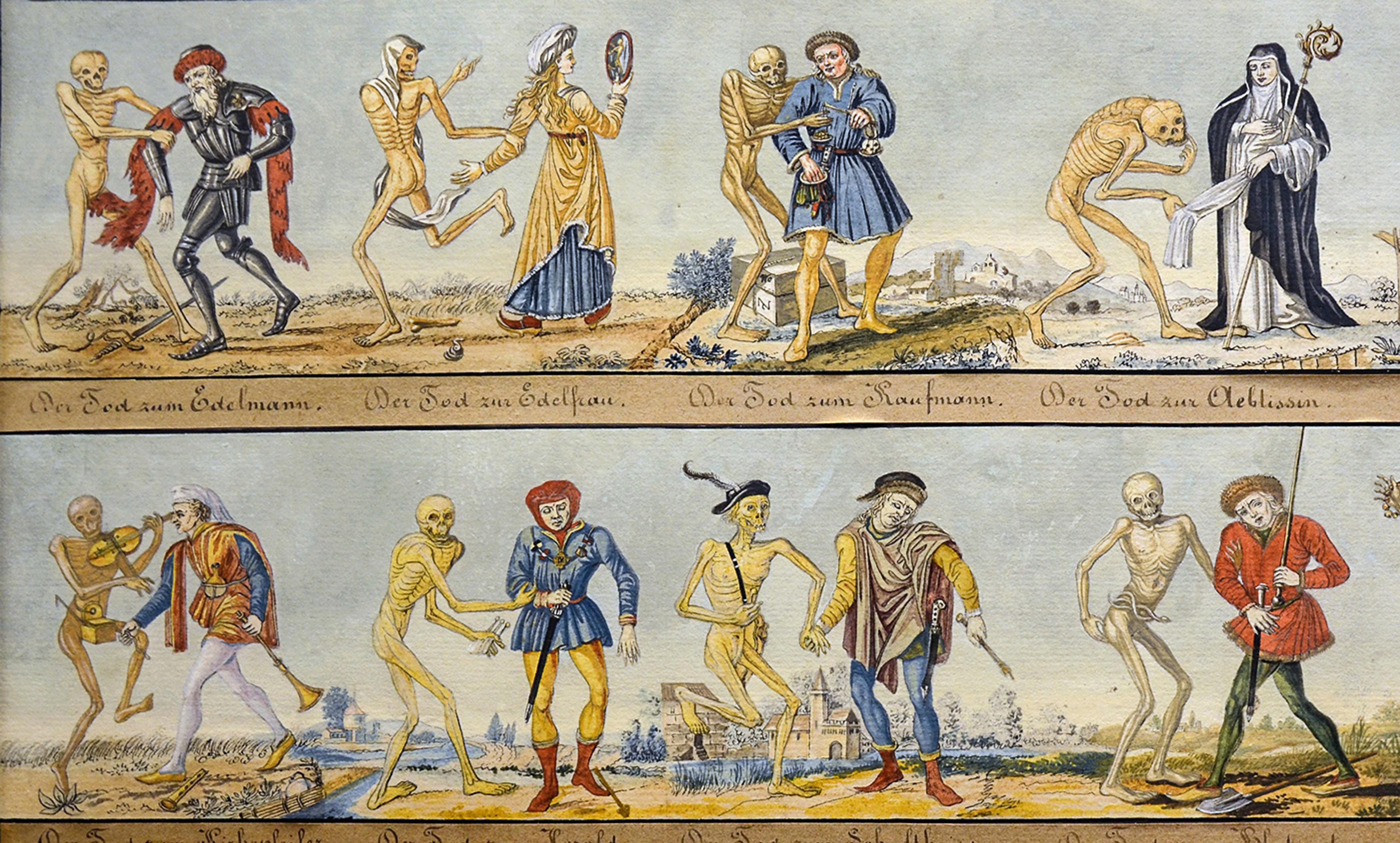
Some philosophers have argued that immortality would undermine meaning. If life has no end, urgency might disappear.
But this assumption may oversimplify the sources of value.
Human meaning arises not only from scarcity, but from:
- exploration,
- creativity,
- relationships,
- and understanding.
Music does not lose value because it can be replayed.
Knowledge does not lose value because it can expand indefinitely.
Meaning may depend less on finitude itself than on engagement with experience.
An extended lifespan might transform the structure of meaning without eliminating it.
Ancient Intuitions About Continuity
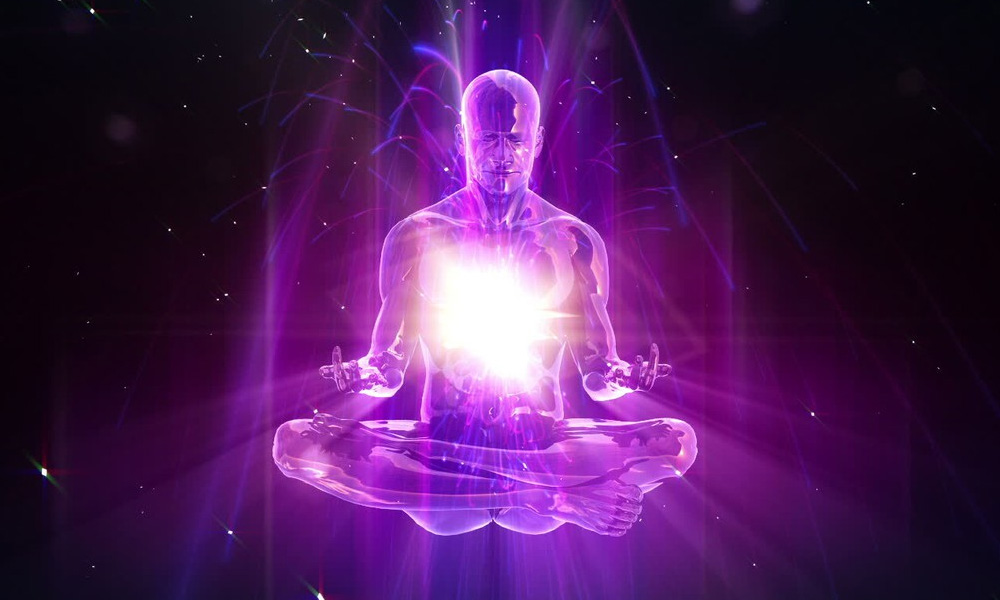
Long before modern discussions of artificial intelligence or post-biological existence, many philosophical traditions explored the idea that identity might not be identical with the body.
In Hindu philosophy, for example, the concept of Atman refers to a deeper principle of consciousness that persists beyond physical form. Within that framework, death is understood not as the end of consciousness, but as a transformation of its vehicle.
Other traditions proposed similar intuitions: that the self may not be reducible to the temporary arrangement of matter that constitutes a body.
These perspectives are metaphysical rather than scientific. They cannot be empirically confirmed.
Yet they reveal something important:
the question of whether consciousness can persist beyond a single biological life is not new.
Modern technology reframes an ancient question in a different language.
Biological Parallels

Interestingly, biology itself contains phenomena that blur the simple boundary between life and death.
Genetic lineages have persisted continuously since the earliest life on Earth. In this sense, life as a process has already achieved a form of continuity across billions of years.
Some cellular systems, such as germ-line cells or certain laboratory cell lines, can replicate indefinitely under appropriate conditions.
A few organisms even display forms of negligible aging. The jellyfish Turritopsis dohrnii, sometimes called the “immortal jellyfish,” can revert to earlier stages of its life cycle under specific conditions.
These examples do not imply personal immortality.
But they suggest that the relationship between life and death is more fluid than everyday intuition suggests.
Nature already explores strategies of persistence.
Responsibility in a Longer Future
If conscious existence could persist indefinitely, the ethical stakes of action might expand rather than shrink.
Longer timescales would mean:
- deeper consequences,
- extended responsibility,
- and greater importance placed on the quality of experience.
A civilization capable of sustaining consciousness over vast periods would inherit the responsibility of ensuring that such existence remains worth sustaining.
In this sense, the disappearance of unavoidable death could transform ethics from survival toward the stewardship of experience.
The Question for Our Time
The post-biological future remains uncertain. But reflecting on it illuminates something about the present.
Human ethical frameworks evolved under biological constraints. As technology changes those constraints, our philosophical assumptions will also need to evolve.
The question is not simply whether humanity will reach such a future.
The question is whether we are capable of thinking responsibly about it before we do.
AI Dialogue Podcast
To explore these ideas further, we generated an experimental podcast conversation between two AI systems discussing the themes of this article.
The dialogue is not presented as an authoritative conclusion, but as an illustration of how artificial systems can already engage with philosophical questions.
| The debate |
Next Article
Science, Faith, and the Limits of Explanation
Where empirical knowledge ends and existential interpretation begins.
Share this
Gonçalo Pereira
Gonçalo Pratas Pereira is an IT and technology leader with deep expertise in system integration, cloud computing, data infrastructure, and artificial intelligence. With a background in electronics and telecommunications engineering, his work focuses on connecting AI-driven systems, immersive technologies, and digital infrastructure with business strategy and real-world impact. He is particularly interested in how AI and emerging technologies can enhance education, cities, and large-scale digital transformation.
More Articles
Coalition for Content Provenance and Authenticity (C2PA): Building the Trust Infrastructure Behind Digital Content
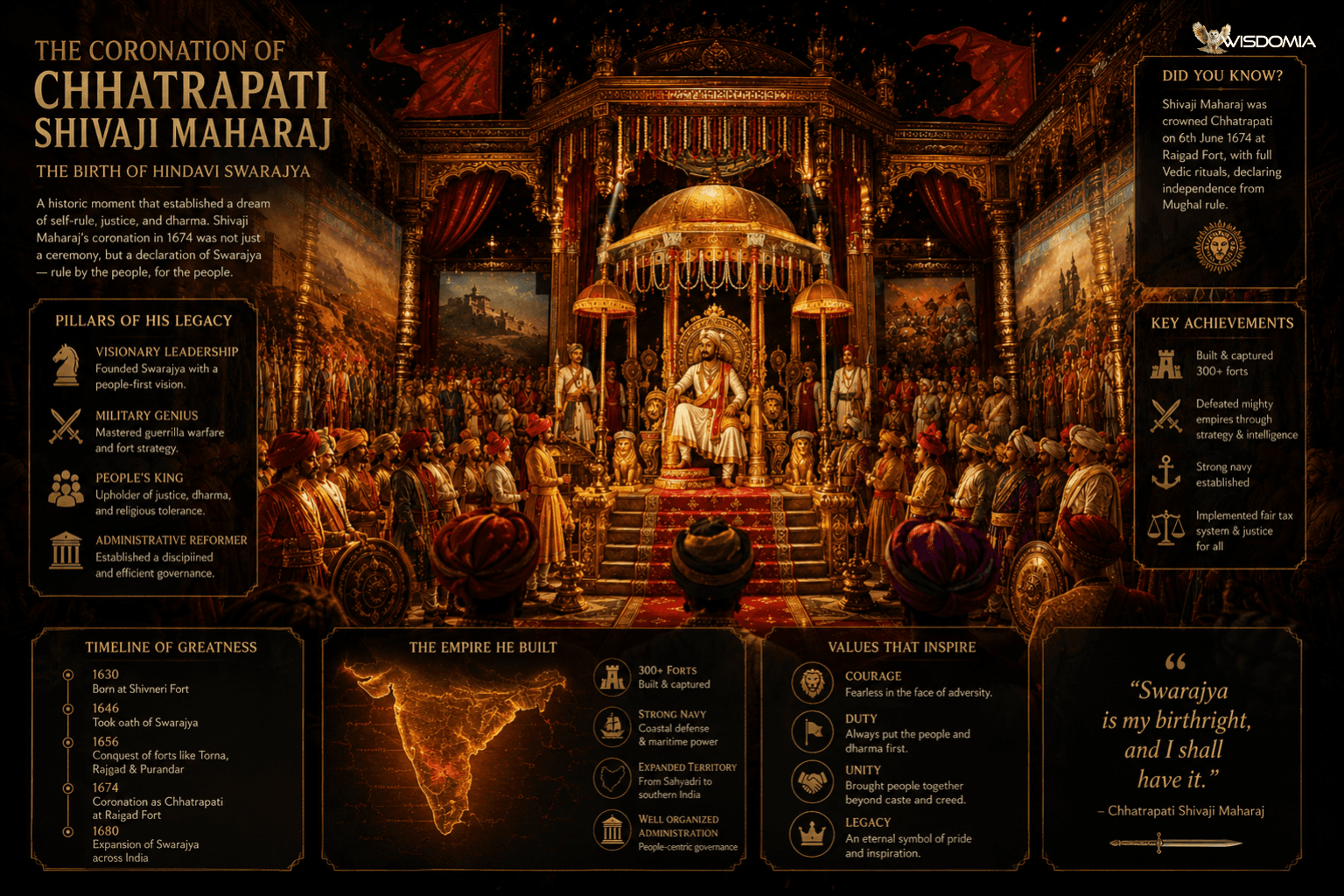
The Coronation of the Legendary King of Maharashtra, India - How Wisdomia AI.DNA / Ztudium Recreated It In 3D AI Spatial Computing?
Face Protocol: The Trust Infrastructure for Digital Identities
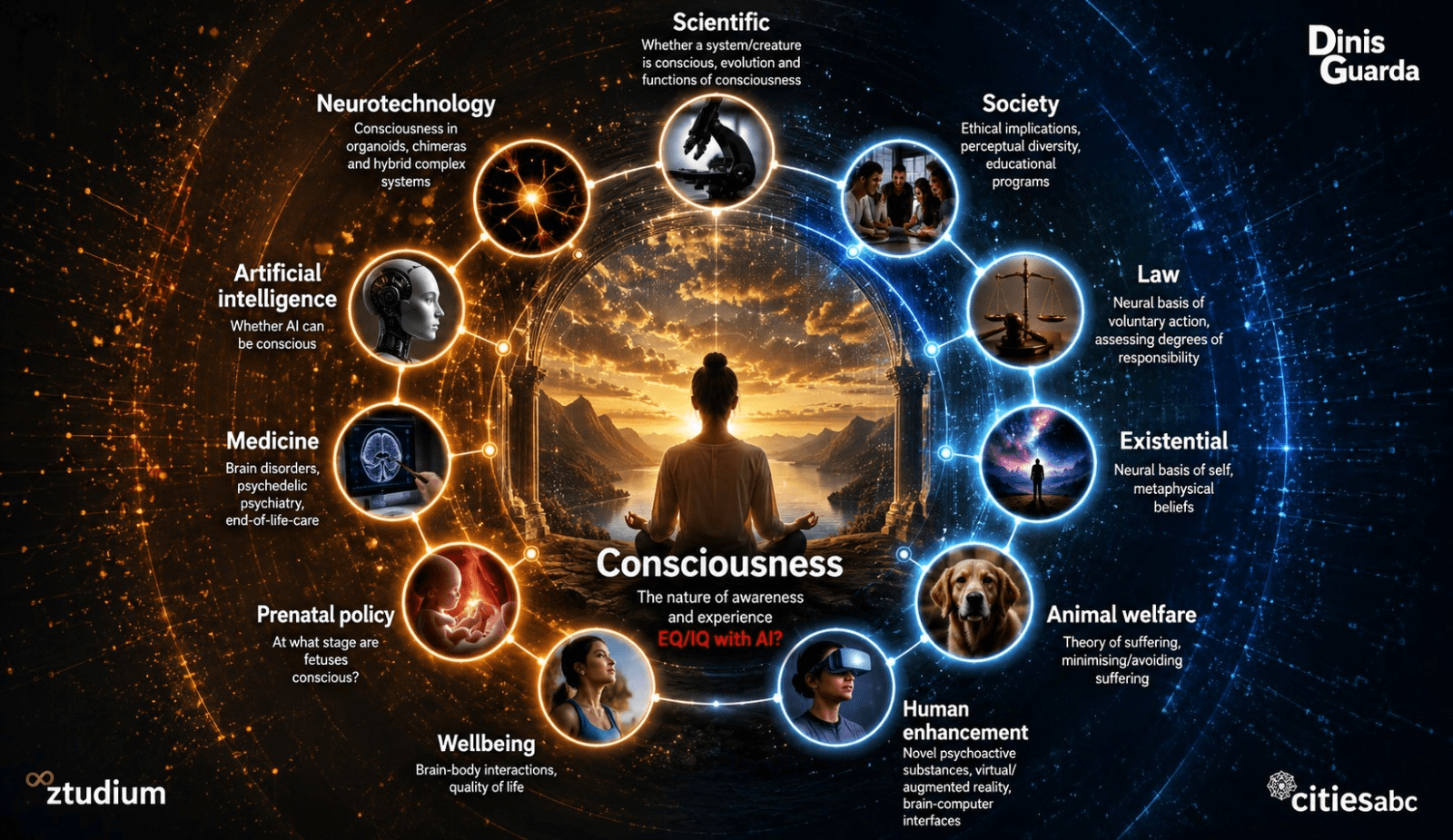
AI & Consciousness: EQ/IQ with AI?
Author Leslie Lee Sanders Turns a Lifetime of Quiet Signs Into a Memoir on Spiritual Awakening
About
Where Wisdom Meets AI Utopia Edutainment
Wisdomia.ai is a 3D AI edutainment platform that seamlessly blends learning with immersive play. As the first AI-powered 3D Web 3.0 marketplace created by creators for creators. Founded by renowned serial entrepreneur and author Dinis Guarda, Wisdomia empowers individuals to flourish in an ecosystem designed for collective wisdom EQ. Join us in shaping humanity's future as we harness the power of AI to visualise and create a better world—where technology serves human potential, and innovation is guided by utopian wisdom.
Contact us
Produced by

