
loading...

 Science, Faith, and the Limits of Explanation
Science, Faith, and the Limits of Explanation
Tue Mar 17 2026

Where knowledge ends and interpretation begins
Preamble — About This Series
This article is part of a series that explores foundational questions at the boundary of science, philosophy, and human experience.
The series emerged from an extended dialogue between a human author and an artificial intelligence system. That dialogue served as a space for careful questioning, conceptual testing, and intellectual refinement. The texts presented here are not raw AI outputs, but curated essays shaped through human editorial judgment.
The aim is not to provide final answers, but to clarify what we can reasonably claim, what remains unresolved, and where intellectual honesty requires restraint rather than speculation.
Part 7 of 8
Science, Faith, and the Limits of Explanation
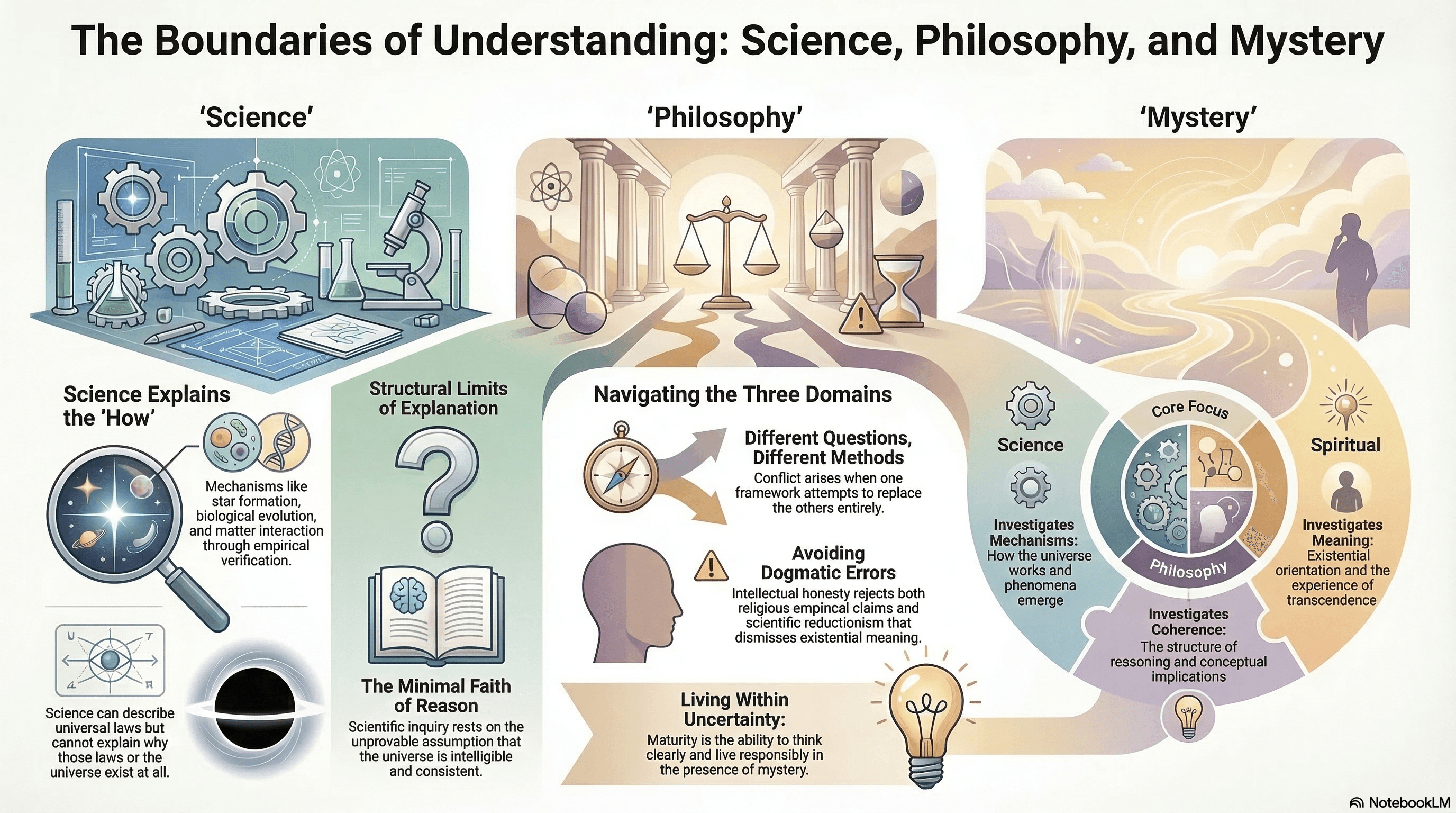
The Temptation of Final Answers
Human beings have always sought ultimate explanations.
Religious traditions offered cosmologies grounded in divine intention.
Philosophy sought rational structures behind existence.
Science developed methods for describing how the universe behaves.
Each of these approaches emerged from the same impulse: the desire to understand the world and our place within it.
But over time, a conflict emerged.
Science appeared to challenge traditional religious explanations, while religious traditions often resisted scientific conclusions that contradicted established beliefs.
Yet the deeper tension may not lie between science and religion themselves, but between different expectations about what explanation can achieve.
What Science Actually Explains
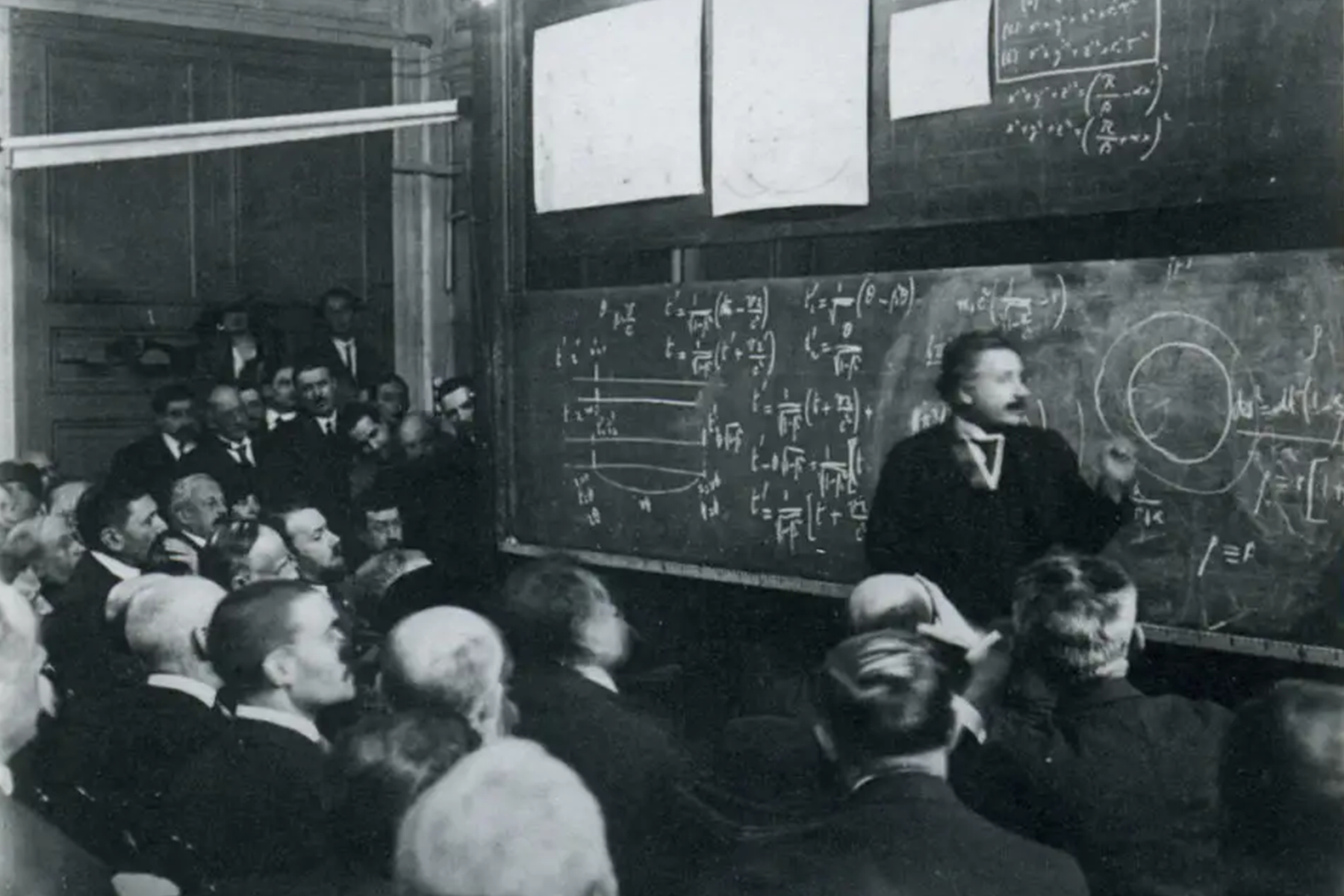
Science is extraordinarily powerful within its domain.
Through observation, experiment, and mathematical modeling, it explains:
- how stars form,
- how biological evolution unfolds,
- how matter interacts,
- how the universe expands.
Science excels at identifying mechanisms.
But science does not claim to answer every possible question. Its method is built around empirical verification and predictive models. Questions that cannot be tested experimentally fall outside its methodological scope.
This does not make those questions meaningless. It simply means they require different kinds of reasoning.
Where Explanation Reaches Its Boundary
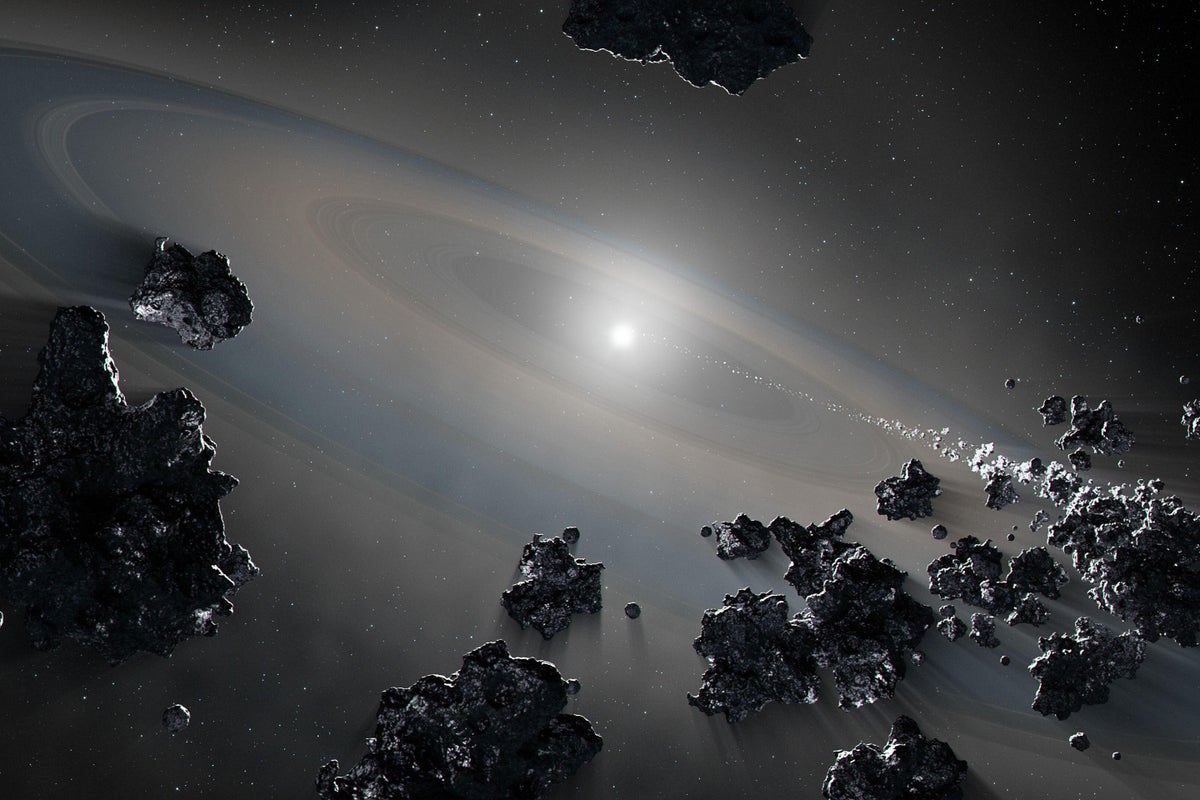
Even within science, explanation eventually reaches a limit.
Physics can describe the laws governing matter and energy, yet it cannot fully explain why those laws exist in the first place.
Cosmology can describe the early universe, yet it cannot conclusively explain why there is a universe at all.
Neuroscience can map the neural correlates of consciousness, yet it cannot fully account for why physical processes give rise to subjective experience.
These boundaries are not failures of science.
They are structural limits of explanation itself.
At some point, inquiry encounters questions that cannot be answered solely by describing mechanisms.
The Minimal Faith Behind Reason
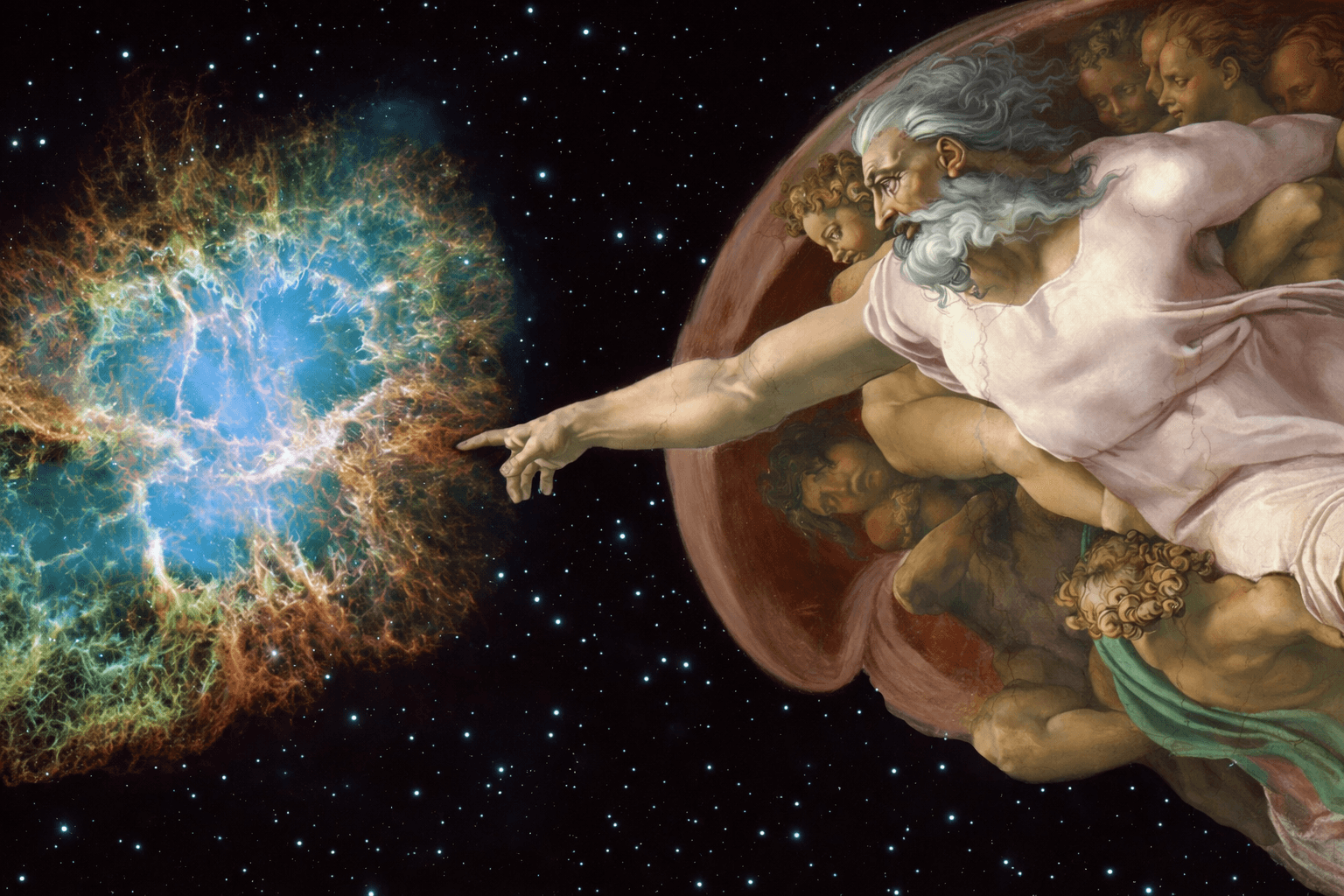
It is sometimes assumed that science eliminates faith. In reality, science rests on a small set of foundational assumptions that cannot themselves be proven empirically.
Among them are:
- that the universe is intelligible,
- that patterns observed in the past will persist,
- that reasoning itself is reliable.
These assumptions are not dogmatic beliefs, but they are conditions that make inquiry possible.
In this sense, even the most rigorous scientific reasoning involves a minimal form of faith — not faith in specific doctrines, but faith in the coherence of reality.
When Faith Becomes Dogma
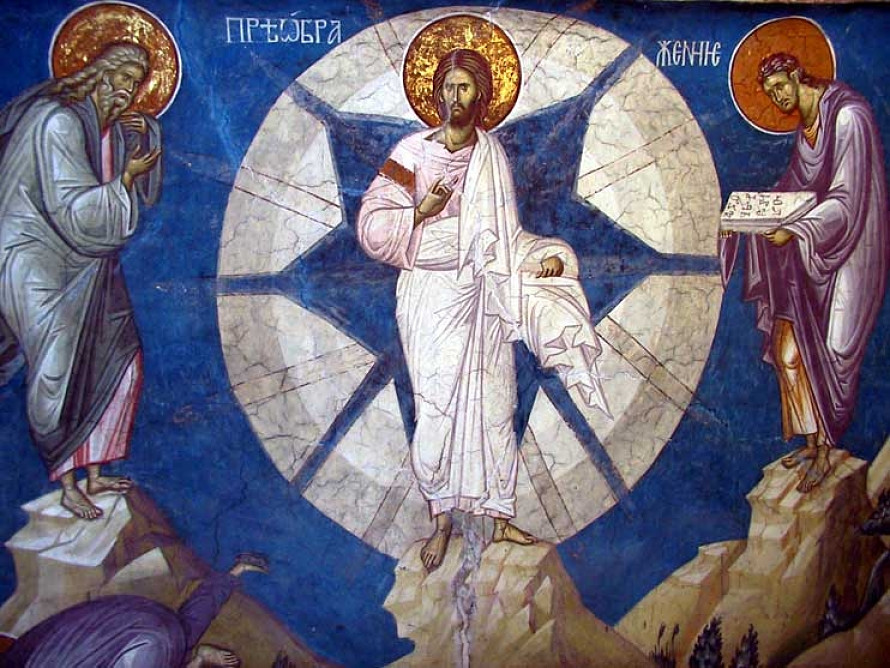
Religious traditions historically attempted to answer questions that science now addresses with far greater precision.
When religious explanations insist on making empirical claims about the natural world that contradict evidence, they risk becoming dogmatic.
But the same danger exists on the opposite side.
When scientific language is extended beyond its empirical domain to dismiss all philosophical or existential questions as meaningless, it becomes a form of scientific reductionism.
Both errors arise from the same misunderstanding: the belief that a single framework can answer every type of question.
Different Questions, Different Methods
The most productive relationship between science and faith may not be competition, but differentiation.
Science investigates:
- how the universe works,
- what structures govern reality,
- how phenomena emerge.
Philosophy explores:
- the coherence of concepts,
- the implications of knowledge,
- the structure of reasoning.
Spiritual traditions often address:
- existential meaning,
- moral orientation,
- the human experience of transcendence.
These domains overlap, but they are not identical.
Confusion arises when one attempts to replace the others entirely.
Living Without Absolute Guarantees

If both science and metaphysics encounter limits, a difficult realization follows:
Human beings must live without complete certainty about the ultimate nature of existence.
This condition can be unsettling. Many systems of belief attempt to remove uncertainty entirely.
Yet intellectual maturity may involve something different:
the ability to live responsibly within uncertainty.
Knowledge can expand without eliminating mystery.
Meaning can emerge without metaphysical guarantees.
The Shared Horizon
Despite their differences, science and spiritual reflection share a common starting point.
Both arise from wonder.
Both attempt to understand a universe that is vastly larger than human concerns.
And both acknowledge, in different ways, that existence is not fully transparent to us.
Recognising this shared horizon does not dissolve disagreement.
But it can replace hostility with curiosity.
The Question That Remains
Throughout this series we have explored:
- why existence exists at all,
- whether the laws of nature are discovered or imposed,
- what reality means in a relational universe,
- how consciousness arises,
- whether the concept of the soul still makes sense,
- and how mortality shapes meaning.
Each question leads naturally to the next, yet none provides a final closure.
Perhaps this is not a failure of inquiry, but its defining characteristic.
Understanding may not consist in eliminating mystery, but in learning how to think clearly in its presence.
Final Reflection
Human beings are temporary structures in a universe that has existed for billions of years.
Yet within those structures, something remarkable has emerged: the capacity to ask questions about existence itself.
The universe may not have been designed to produce understanding.
But it has produced minds capable of seeking it.
And that, in itself, may be one of the most extraordinary consequences of existence.
AI Dialogue Podcast
To explore these ideas further, we generated an experimental podcast conversation between two AI systems discussing the themes of this article.
The dialogue is not presented as an authoritative conclusion, but as an illustration of how artificial systems can already engage with philosophical questions.
| The debate |
Next Article
Why the deepest questions may never fully close
previous
Death, Identity, and Meaning in a Post-Biological Future
next
Adhyatma: Spirituality — What it Truly Means
Share this

Gonçalo Pereira
Gonçalo Pratas Pereira is an IT and technology leader with deep expertise in system integration, cloud computing, data infrastructure, and artificial intelligence. With a background in electronics and telecommunications engineering, his work focuses on connecting AI-driven systems, immersive technologies, and digital infrastructure with business strategy and real-world impact. He is particularly interested in how AI and emerging technologies can enhance education, cities, and large-scale digital transformation.
More Articles

Coalition for Content Provenance and Authenticity (C2PA): Building the Trust Infrastructure Behind Digital Content
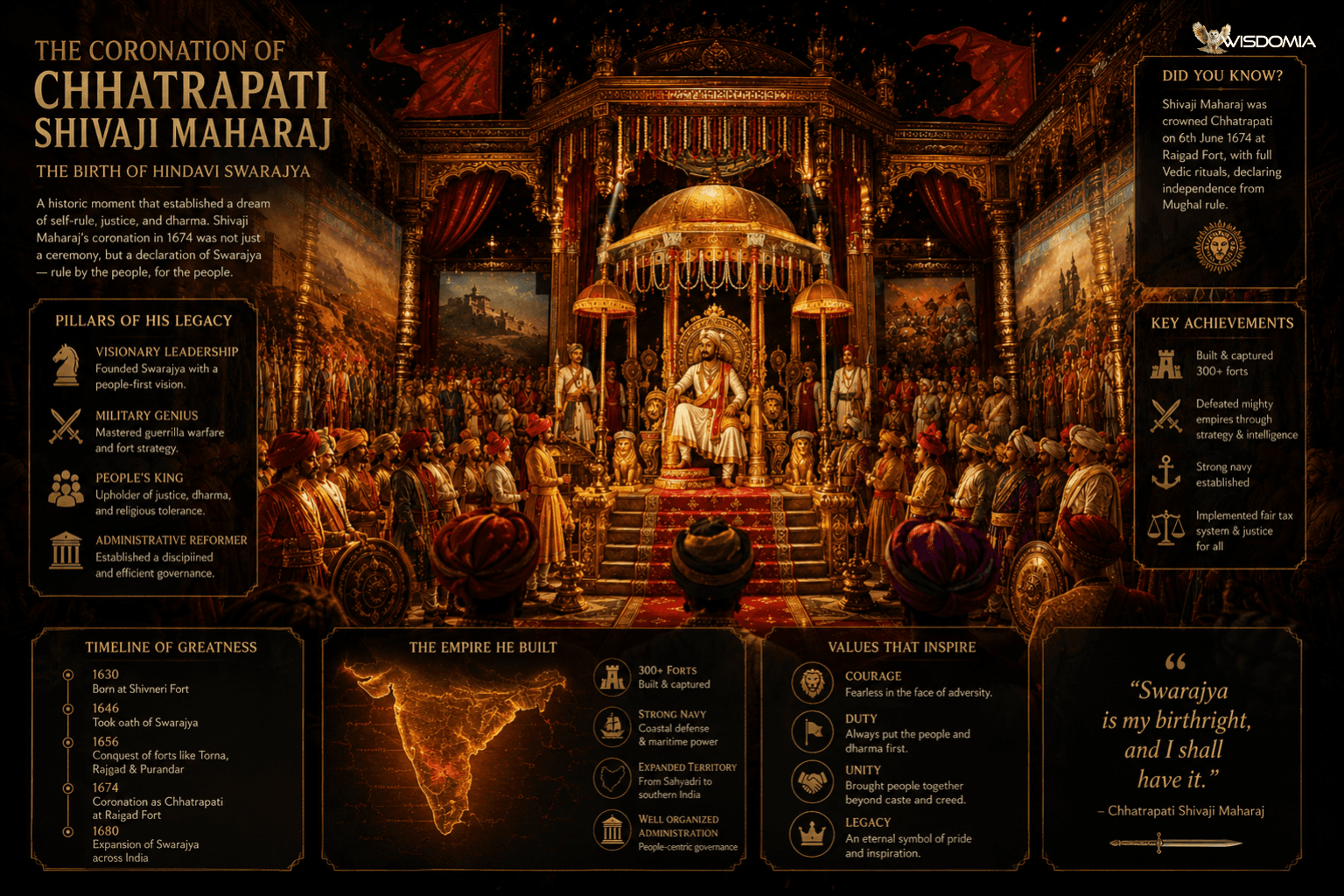
The Coronation of the Legendary King of Maharashtra, India - How Wisdomia AI.DNA / Ztudium Recreated It In 3D AI Spatial Computing?
Face Protocol: The Trust Infrastructure for Digital Identities
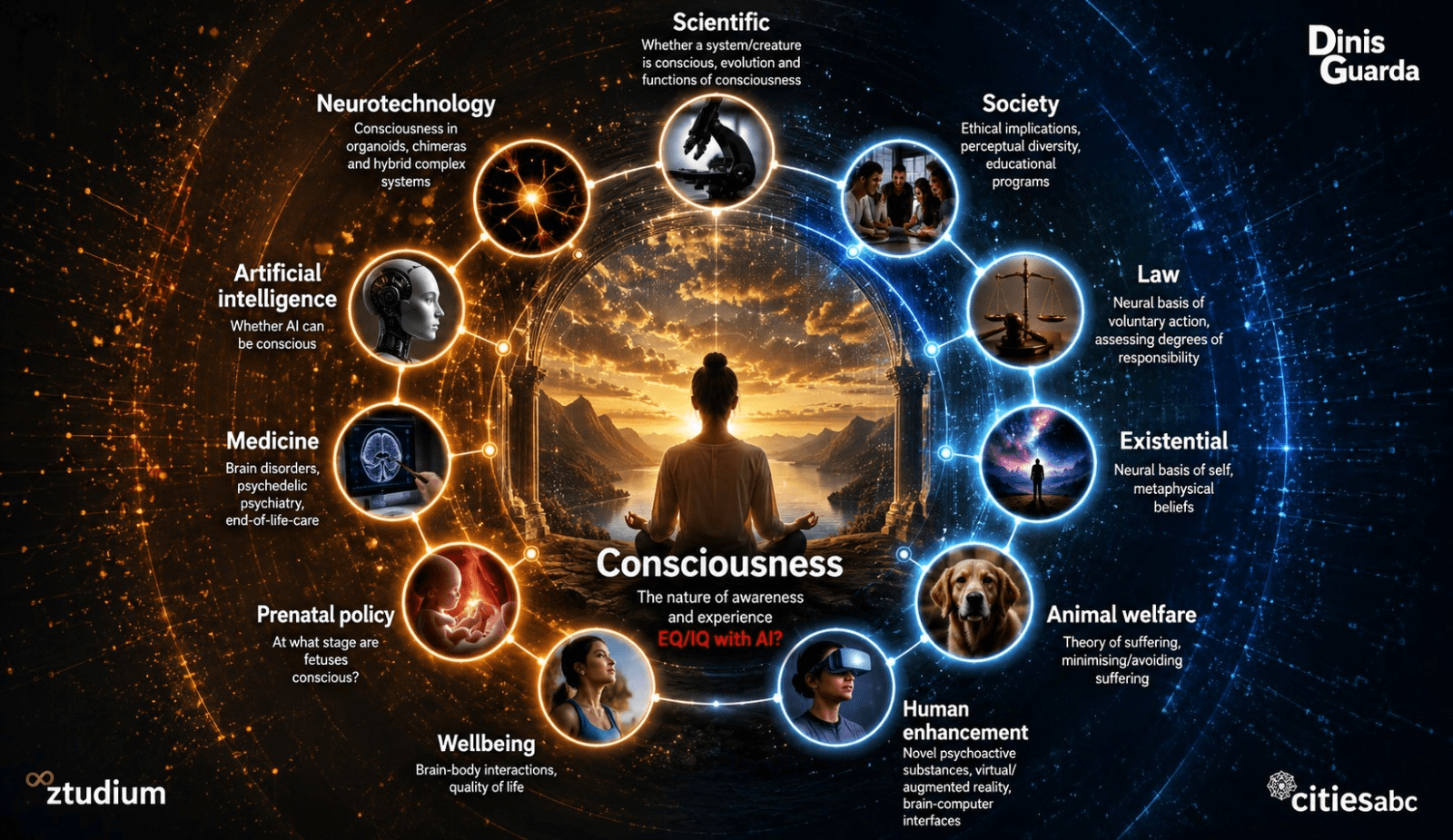
AI & Consciousness: EQ/IQ with AI?
Author Leslie Lee Sanders Turns a Lifetime of Quiet Signs Into a Memoir on Spiritual Awakening
About
Where Wisdom Meets AI Utopia Edutainment
Wisdomia.ai is a 3D AI edutainment platform that seamlessly blends learning with immersive play. As the first AI-powered 3D Web 3.0 marketplace created by creators for creators. Founded by renowned serial entrepreneur and author Dinis Guarda, Wisdomia empowers individuals to flourish in an ecosystem designed for collective wisdom EQ. Join us in shaping humanity's future as we harness the power of AI to visualise and create a better world—where technology serves human potential, and innovation is guided by utopian wisdom.
Contact us
Produced by

