
loading...
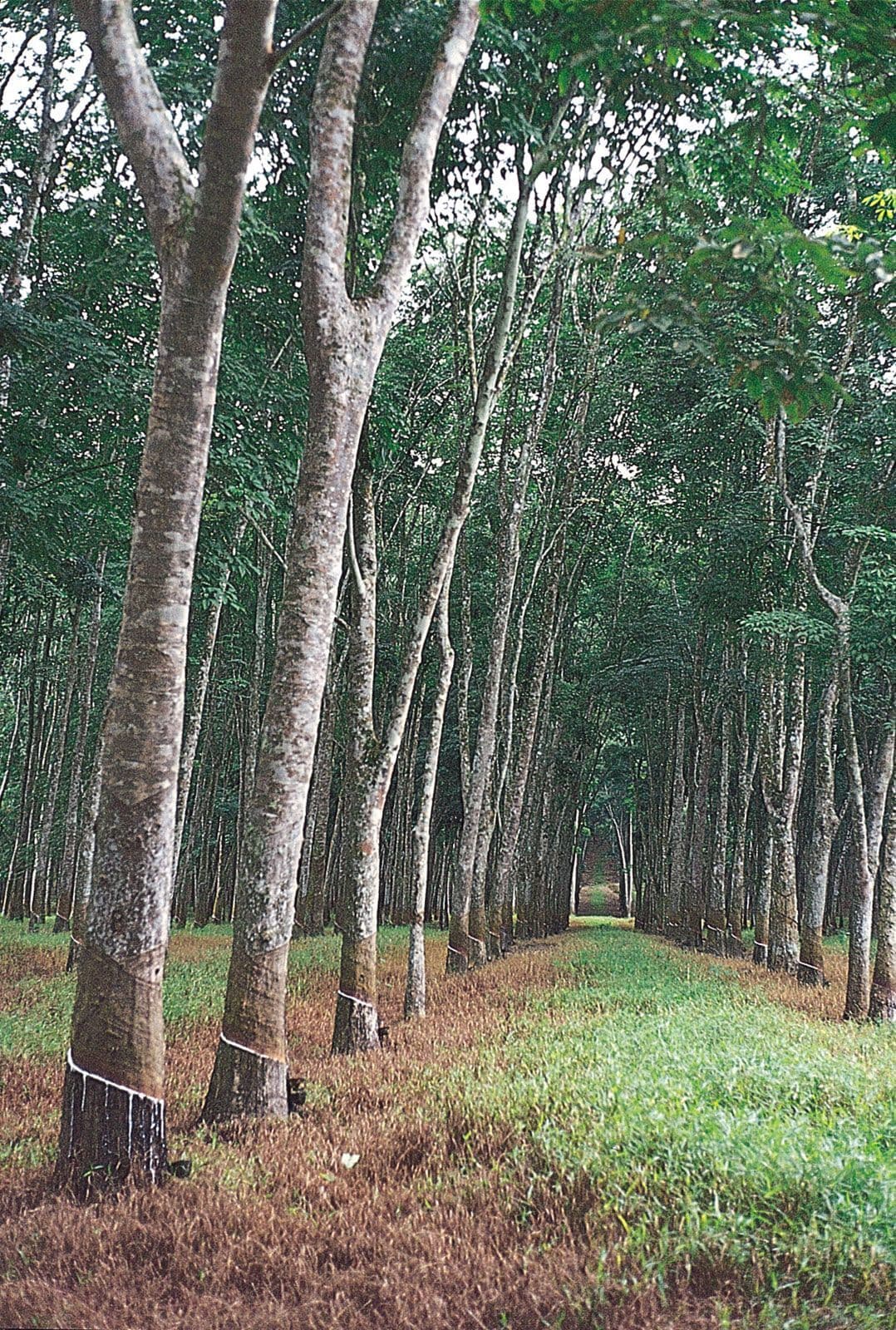


A tropical evergreen tree that is best known for its economic importance in producing natural rubber latex.
Summary
Rubber trees, scientifically known as Hevea brasiliensis, are native to the Amazon rainforest. These trees are best known for their ability to produce latex, a milky fluid from which natural rubber is made. The rubber tree is a perennial plant with a lifespan of approximately 100 years, but its latex-producing ability diminishes after 25 to 30 years. It grows mainly in tropical regions, specifically in countries like Brazil, Thailand, Indonesia, and Malaysia, which are the world's leading rubber producers.
The rubber tree is a tall deciduous tree that can reach up to 30-40 meters in height. It has a straight trunk and a large crown. The leaves are oblong, shiny, dark green on top and lighter underneath. The rubber tree blooms and produces small, bell-shaped flowers that are yellowish in color. It also produces a brown, oval fruit that contains many tiny seeds. The bark of the rubber tree is smooth and greyish, and it is from this bark that the latex is extracted.
Latex is a complex emulsion consisting of proteins, alkaloids, starches, sugars, oils, tannins, resins, and gums that coagulate on exposure to air. It is extracted by making a downward diagonal incision on the tree's bark, which allows the latex to flow into a collecting cup. This process is called 'tapping'. After collection, the latex is coagulated into blocks for transportation. It is then processed into a variety of products such as gloves, balloons, tires, erasers, and elastic bands, among others.
Commercial cultivation of rubber trees started in the 19th century. The British explorer Sir Henry Wickham played a significant role in the worldwide rubber industry. He smuggled rubber tree seeds from Brazil to Britain in 1876. These seeds were then propagated in Kew Gardens, London, and later sent to the British colonies in Asia, marking the beginning of the Asian rubber industry.
Today, the rubber tree is a major economic resource. Despite the development of synthetic rubber, natural rubber from Hevea trees is still in high demand due to its superior quality. It is used in a wide range of industries, including automotive, medical, and construction. However, rubber cultivation also has environmental implications. It often involves deforestation, which results in loss of wildlife habitats and contributes to climate change. It also leads to soil degradation due to the use of pesticides and fertilisers.
There are numerous research efforts aimed at improving the rubber tree's productivity and resistance to diseases. Breeding programs are focused on developing new varieties that can produce more latex and are resistant to diseases such as leaf blight and South American leaf blight, which are major threats to rubber plantations. Furthermore, research is also being done on the development of alternative sources of natural rubber, such as the Russian dandelion and the Guayule shrub, to reduce the dependence on Hevea trees.
In conclusion, the rubber tree is an important agricultural commodity that plays a significant role in the global economy. It is the primary source of natural rubber, a material that is indispensable in various industries. However, the cultivation of rubber trees also presents environmental challenges that need to be addressed. Continuous research and the development of sustainable cultivation practices are crucial in ensuring the future of the rubber industry.
Human Use and Interaction
Humans have been interacting with and using rubber trees for hundreds of years. The rubber tree, known scientifically as Hevea brasiliensis, is a species of deciduous tree native to the tropical rainforests of South America. Its most significant attribute is the latex sap it produces, which is used to make natural rubber. From car tires to medical devices, the rubber tree plays an integral role in numerous aspects of human life.
Indigenous peoples in South America were the first to discover the usefulness of the rubber tree. They learned to tap the tree to extract the latex sap, which they then processed into a form of rubber. This material was used to make a variety of items, including balls for games, footwear, and containers. The process of tapping a rubber tree involves making a cut in the bark and collecting the latex sap that oozes out. This method does not harm the tree, and a single tree can be tapped for many years.
With the arrival of European explorers in South America, knowledge of the rubber tree and its uses spread around the world. In the 19th century, the industrial revolution led to a surge in demand for rubber. The material's flexibility, durability, and water-resistance made it ideal for a wide range of industrial applications. However, the method of extracting latex from the rubber tree in South America was labor-intensive and time-consuming. This led to the exploitation of local populations and the decimation of rubber tree forests.
In an attempt to meet the growing demand for rubber, seeds from the rubber tree were smuggled out of South America and planted in other tropical regions around the world. This led to the establishment of rubber plantations in places like Southeast Asia, Africa, and the Pacific Islands. These plantations used a more efficient method of tapping the rubber trees, which involved making a series of small cuts in the bark rather than a single large cut. This method allowed for the collection of more latex and also extended the life of the tree.
Today, the majority of the world's natural rubber comes from these rubber plantations. The biggest producers are Thailand, Indonesia, and Malaysia. The rubber industry continues to be a significant source of employment in these countries, providing jobs for millions of people. However, the industry also faces numerous challenges. These include the threat of diseases that can wipe out entire plantations, the environmental impact of rubber production, and the volatility of rubber prices on the global market.
Despite these challenges, the rubber tree remains an essential resource for humans. The latex it produces is used in a wide range of products that we use daily. For example, the medical industry relies heavily on rubber for things like gloves, catheters, and other medical equipment. The automotive industry uses rubber for tires, seals, and hoses. Other uses of rubber include erasers, rubber bands, and adhesives.
Furthermore, rubber is a key material in the aerospace industry, where it is used in the manufacture of seals, gaskets, and insulation. In the construction industry, rubber is used for roofing materials, window seals, and flooring. Even in the fashion industry, rubber is used to make items such as waterproof boots and coats.
The rubber tree also has other uses beyond the production of latex. Its wood is valued for its durability and is often used in the manufacture of furniture. In addition, the tree is sometimes planted as an ornamental tree for its attractive foliage and ability to adapt to various soil and climate conditions. Finally, the rubber tree plays an important role in carbon sequestration, helping to mitigate the effects of climate change.
In conclusion, the rubber tree is an incredibly versatile plant that has been, and continues to be, of great importance to humans. From its early use by indigenous peoples in South America to its current role in global industries, the rubber tree has proven to be a vital resource. As we continue to rely on the products it provides, it is crucial that we also work to ensure the sustainability of rubber production, for the benefit of both the environment and the people who depend on it for their livelihoods.
Cultural and Symbolic Significance
The rubber tree, scientifically known as Hevea brasiliensis, holds significant cultural and symbolic significance in different parts of the world. Originating from the Amazon rainforest, the rubber tree is not just an ordinary plant. It has transformed economies, sparked innovation, and inspired various cultural practices and beliefs.
The rubber tree is famously known for its latex sap, which is harvested and used to produce natural rubber. This has played a pivotal role in many economies, especially in Southeast Asia, where countries like Malaysia, Indonesia, and Thailand are the leading producers of natural rubber. The rubber tree has contributed significantly to the economic growth of these countries, offering employment to millions of people and contributing to their Gross Domestic Product (GDP).
Historically, the rubber tree is associated with resilience and durability due to its ability to produce latex for a long period and withstand harsh environmental conditions. It was considered sacred by the indigenous tribes of the Amazon rainforest, such as the Sateré-Mawé people, who believed that the rubber tree possessed a spirit. They used the latex from the rubber tree for various purposes, including making shoes and balls for their traditional games.
The rubber tree is also a symbol of prosperity and wealth in various cultures. This is because of its economic value and the range of products that can be made from its latex. These products include tires, gloves, balloons, condoms, and even clothing. The rubber tree is thus seen as a source of income and wealth, contributing to its symbolic significance.
In the Amazon rainforest, the rubber tree holds spiritual significance. Indigenous tribes believe that the tree has a spirit and that it can bring good luck. They respect and protect the rubber tree, seeing it as a gift from their ancestors. The tree is often part of their rituals and ceremonies, further cementing its cultural importance.
Moreover, the rubber tree is a symbol of sustainability in the modern world. Its ability to absorb carbon dioxide and release oxygen has made it an important part of efforts to combat climate change. Rubber tree plantations act as carbon sinks, absorbing significant amounts of carbon dioxide, thus helping to mitigate the effects of global warming.
Furthermore, the rubber tree has played a significant role in the history of innovation. The discovery of vulcanization, a process that strengthens rubber, by Charles Goodyear in 1839 led to the creation of various rubber products, including the first rubber tires. This sparked the growth of the rubber industry and led to the invention of many other products, further enhancing the symbolic significance of the rubber tree.
In the field of medicine, the rubber tree has contributed to significant advancements. Latex gloves, which are made from the sap of the rubber tree, have become essential in medical procedures. They provide a protective barrier, preventing the spread of infections and diseases. This has further added to the symbolic importance of the rubber tree, highlighting its role in promoting health and safety.
In conclusion, the rubber tree holds immense cultural and symbolic significance. From its role in the economy to its spiritual importance, and from its contribution to innovation and sustainability to its impact on health and safety, the rubber tree has left an indelible mark on human society. Its resilience and versatility symbolize the potential for growth, prosperity, and sustainability, making it a powerful symbol in cultures around the world.
Aesthetic and Experiential
The rubber tree, scientifically known as Hevea brasiliensis, possesses a unique aesthetic and experiential quality that sets it apart from other flora. Native to the Amazon rainforest, these trees have been cultivated for their natural latex, a milky white fluid that they produce, which is a primary source of natural rubber.
The aesthetic appeal of the rubber tree is undeniable. Mature trees can grow up to 30 meters in height, with a wide, spreading canopy that provides shade and a distinctive visual presence. The tree's bark is a light grey-brown color, with vertical lines running the length of the trunk. The leaves, on the other hand, are dark green and glossy, providing a striking contrast against the bark.
Additionally, the rubber tree's aesthetic appeal is not limited to its external appearance. One of the most intriguing aspects of the rubber tree is its ability to produce latex. When the tree's bark is cut or damaged, the latex seeps out, creating a striking white contrast against the tree's dark bark. This characteristic not only adds to the tree's visual appeal but also provides an interesting point of interest for those who are curious about the natural world.
The experiential aspect of the rubber tree is equally as fascinating. The primary use of the latex produced by the tree is in the production of natural rubber. This process involves tapping the tree for its latex, which is then treated to remove impurities before being processed into rubber. This process, while labor-intensive, provides a unique experience for those involved. There is something incredibly satisfying and rewarding about being able to take a raw, natural resource and transform it into a useful product.
The process of tapping a rubber tree for its latex is an experience in itself. It requires patience and precision, as the tree must be cut at just the right angle and depth to allow the latex to flow without damaging the tree. Once the latex starts flowing, it is collected in a small cup or container attached to the tree. Watching the slow, steady drip of the latex is a mesmerizing experience, a testament to the incredible power and productivity of nature.
However, the rubber tree is not just a source of natural rubber. It also plays an important role in the ecosystem, providing habitat and food for a variety of wildlife. The large, broad leaves provide shelter for birds and insects, while the tree's flowers and seeds provide food for a variety of animals. Being in the presence of a rubber tree, whether in a natural forest setting or a cultivated plantation, is an experience that connects us to the complex web of life that sustains our planet.
Moreover, the rubber tree has cultural significance in many parts of the world. In some cultures, the tree is considered sacred and is used in religious ceremonies. In others, it is seen as a symbol of prosperity and wealth, as the latex it produces is a valuable commodity. These cultural aspects add another layer to the experiential dimension of the rubber tree, offering a glimpse into the diverse ways in which humans interact with and derive meaning from the natural world.
In conclusion, the rubber tree offers a unique combination of aesthetic and experiential qualities. Its striking appearance, combined with its productive capabilities and ecological importance, make it a fascinating subject of study and exploration. Whether you are admiring its stately form, tapping it for its precious latex, or simply enjoying its presence in a forest or garden, the rubber tree is sure to leave a lasting impression.
References
Share with friends
A tropical evergreen tree that is best known for its economic importance in producing natural rubber latex.
Common Name
Rubber Tree
Scientific Name
Hevea brasiliensis
Family
Euphorbiaceae
Native Region / Habitat
South America
Tree Type
Evergreen
Lifespan / Age Range
Up to 100 years
Growth Habit
Fast-growing, can reach up to 30 meters in height
Leaves / Foliage Description
Dark green, shiny, oval leaves
Trunk
Straight trunk with greyish bark
Fruit / Flowering Characteristics
Small, round fruit that contains seeds
Ecological Role
Primary producer, supporting a variety of wildlife, and plays a key role in carbon sequestration
Related Trees of The World


About
Where Wisdom Meets AI Utopia Edutainment
Wisdomia.ai is a 3D AI edutainment platform that seamlessly blends learning with immersive play. As the first AI-powered 3D Web 3.0 marketplace created by creators for creators. Founded by renowned serial entrepreneur and author Dinis Guarda, Wisdomia empowers individuals to flourish in an ecosystem designed for collective wisdom EQ. Join us in shaping humanity's future as we harness the power of AI to visualise and create a better world—where technology serves human potential, and innovation is guided by utopian wisdom.
Contact us
Produced by

